Introduction:
Mines and Minerals (Development and Regulation) Act, 1957 (MMDR Act) provides the principal legal framework for regulating mineral exploration and mining in India. It seeks to establish uniform fiscal framework by regulating power of States to impose additional levies on mineral rights and mineral-bearing lands.
Why Was Reform Needed?
i. Mining is subject to around 14 taxes and fees like royalty, auction premium, DMF, GST etc.
ii. Additional levies imposed by different States create significant variations in mineral costs. Some States have imposed levies on mineral-bearing lands at rates of up to 20%.
iii. Excessive fiscal costs can make extraction of strategically important minerals such as graphite and atomic minerals such as uranium less economical.
iv. India imported minerals worth ₹10.12 lakh crore in FY 2025-26. Therefore important for reducing import dependence and strengthening manufacturing.
v. Different State-level levies can distort mineral prices across regions and raise input costs for downstream sectors such as steel, cement, power and construction, ultimately affecting consumers.
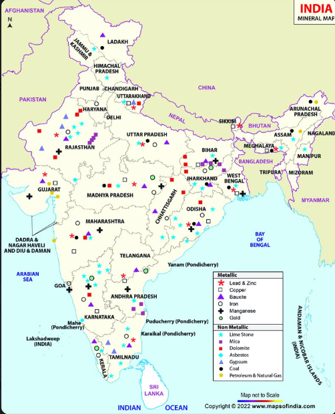
Key Mineral Areas in India
| State | Important mineral areas | Strategically important minerals |
|---|---|---|
| Odisha | Keonjhar, Sundargarh, Mayurbhanj, Koraput | Iron ore, bauxite, chromite, manganese, coal |
| Jharkhand | Singhbhum, Dhanbad, Bokaro, Hazaribagh | Iron ore, coal, uranium, copper, bauxite |
| Chhattisgarh | Bailadila–Dantewada, Bastar, Korba | High-grade iron ore, coal, bauxite, limestone |
| Rajasthan | Bhilwara, Udaipur, Barmer, Zawar | Lead-zinc, copper, limestone, gypsum, silver, potash |
Before vs After- What changes
| Mines and Minerals (Development and Regulation) Act, 1957 | MMDR Amendment Act, 2026 |
|---|---|
| • Mining was taxed differently in every State. | • A single, Centre-directed tax framework will apply under New Section 9D. |
| • New levies could be introduced even after mining operations started. | • States cannot impose new levies except under conditions set by the Central Government. |
| • Retrospective tax demands could be raised at any time. | • All pending retrospective dues are now declared invalid. |
| • The maximum burden fell on small and medium miners. | • Every miner now benefits from a fair and equal framework. |
Major Mineral-Sector Reforms Since 2014
-
- Since the 2015 MMDR reforms, 723 major mineral blocks have been auctioned across 17 States replacing the earlier discretionary allocation mechanism
- In FY 2025–26, iron ore production reached a record 313 million tonnes while limestone production reached 484 million tonnes.
-
- National Critical Mineral Mission (NCMM) approved in January 2025 with an outlay of ₹16,300 crore.
- Geological Survey of India completed 457 projects in Field Season 2025–26.
- 656 District Mineral Foundations (DMFs) have been established to channel mining-related revenues towards local infrastructure, healthcare, education, etc.
Does the Amendment Take Away States’ Mineral Revenue?
No because amendment is aimed at regulating additional levies not dismantling the existing revenue-sharing framework from mining. Since 2014 States have continued to receive the overwhelming share of mining revenue.
-
- States received more than ₹7 lakh crore from mineral revenue including coal.
- Nearly 90% of mining-sector revenue now accrues to States.
- State revenue from coal increased from ₹11,947.97 crore in 2014-15 to ₹32,183.09 crore in 2025-26.
- The auction regime has also created a new revenue stream through auction premiums.
The broader argument of the reform is therefore that States continue to retain substantial mineral revenues while the Centre seeks greater uniformity in the fiscal treatment of mineral extraction. Thus, reform seeks to rationalise the manner of taxation rather than redistribute mineral revenues away from States.
Challenges:
1. Restricting States from imposing fresh levies on mineral rights and mineral-bearing lands may narrow their fiscal policy space.
2. The power given to the Centre to prescribe conditions and restrictions on State levies could generate disputes over the appropriate balance between national mineral-market uniformity and State autonomy.
3. A uniform fiscal framework may not adequately account for differences in geology, extraction costs, infrastructure, environmental costs and social impact across mineral-producing regions.
4. Mining-affected States and communities continue to face costs relating to land degradation, displacement, pollution and pressure on local infrastructure.
5. Fiscal relief to mining operators does not automatically guarantee lower prices, greater investment or employment.
Way Forward
1. Conditions governing State levies should be evolved through structured consultation with mineral-rich States to preserve the spirit of cooperative federalism.
2. Mining reforms should be accompanied by greater domestic capacity for processing, refining, recycling and downstream manufacturing.
3. Fiscal rationalisation should not weaken environmental safeguards.
4. Stronger mine-closure plans, ecological restoration and effective utilisation of DMF funds are essential.
5. National Critical Mineral Mission should be strengthened. So that India develops an end-to-end critical-mineral supply chain.
Conclusion:
The MMDR Amendment Act, 2026 attempts to resolve a genuine problem of fragmented mineral taxation and improve the predictability of India’s mining regime. However, its success will ultimately depend on maintaining a careful balance between fiscal uniformity and State autonomy.
Spread the Word