TOPIC-1: 3rd BIMSTEC Conference on Traditional Medicine Knowledge, Genetic Resources & IPR
-
- UPSC Relevance: GS Paper 2 (Bilateral, Regional & Global Groupings — BIMSTEC Regional Cooperation; Health Governance) & GS Paper 3 (Science & Technology — Intellectual Property Rights [IPR], Protection of Traditional Knowledge, Biodiversity Conservation, Access & Benefit-Sharing [ABS]).
Introduction: The Ministry of Ayush, Government of India with All India Institute of Ayurveda (AIIA), Goa, hosted Third BIMSTEC Conference on Traditional Medicine Knowledge, Genetic Resources, and Intellectual Property Rights in Goa on September 16–17, 2026. The event focused on establishing a regional framework for conserving traditional medicine and preventing bio-piracy.
About BIMSTEC Traditional Medicine:
-
- The Bay of Bengal Initiative for Multi-Sectoral Technical and Economic Cooperation (BIMSTEC) connects seven Member States: Bangladesh, Bhutan, India, Myanmar, Nepal, Sri Lanka, and Thailand.
- Coordinated under the BIMSTEC Task Force for Traditional Medicine (BTFTM), the initiative implements decisions from the 6th BIMSTEC Summit (Bangkok, April 2025), which announced the establishment of a BIMSTEC Centre of Excellence in Traditional Medicine in India.
Key Highlights
-
- Prior Informed Consent (PIC) & Benefit-Sharing: Emphasized protecting indigenous community rights through legal protocols including Prior Informed Consent (PIC), Mutually Agreed Terms (MAT), and Equitable Access and Benefit-Sharing (ABS) for genetic resources.
- TKDL Model for Prior-Art Defense: Highlighted India’s Traditional Knowledge Digital Library (TKDL) as a benchmark for controlled-access documentation to prevent biopiracy and wrongful patenting of traditional formulations internationally.
- AI & Ethical Documentation: Focused on integrating artificial intelligence, standardized data management, and ethical guidelines into traditional medicine documentation in alignment with WIPO and WHO standards.
- Harmonizing Pharmacopoeias: Accelerated cooperation across research, education, standardisation, pharmacopoeial development, and regulatory alignment across all seven member states.
UPSC Quick Reference Table
| Feature | Detailed Specification |
| Nodal Ministry | Ministry of Ayush, Government of India |
| Nodal Execution Institute | All India Institute of Ayurveda (AIIA), Goa |
| Regional Forum | BIMSTEC (7 Nations: BD, BT, IN, MM, NP, LK, TH) |
| Key Platform Initiative | BIMSTEC Task Force for Traditional Medicine (BTFTM) |
| Proposed Center | BIMSTEC Centre of Excellence in Traditional Medicine |
| Core Technical Pillars | TKDL Documentation, Prior Informed Consent (PIC), ABS & IPR Protection |
Conclusion:
The 3rd BIMSTEC Conference in Goa advances regional healthcare and biopiracy protections. Combining digital tools like TKDL with Prior Informed Consent and equitable benefit-sharing preserves biodiversity, protects community knowledge and strengthens traditional medicine systems.
TOPIC-2: India’s First Soil Carbon Payments for Regenerative Agriculture
-
- UPSC Relevance: GS Paper 3 (Agriculture — Climate-Smart Agriculture, Regenerative Farming Practices, Carbon Markets, Stubble Burning Mitigation, and Direct Benefit Transfer).
Introduction: India’s agricultural carbon market reached the grassroots level with the disbursement of over ₹2.9 crore directly to 2,550 smallholder farmers in Punjab and Haryana. Initiated by Dr. M. L. Jat (Secretary DARE & DG ICAR) at Punjab Agricultural University (PAU), Ludhiana, on September 17, 2026, the payments reward farmers for adopting verifiable regenerative farming practices that sequester soil carbon and reduce greenhouse gas emissions.
About the ‘Aadi’ Carbon Programme:
-
- The ‘Aadi’ farmer carbon initiative covers over 2 million acres and 100,000 farmers across seven states was launched in 2019 by Grow Indigo with scientific guidance from ICAR.
- The program measures and independently verifies soil organic carbon increases and emissions reductions under Verra VM0042 global methodology.
- Participating farmers earn carbon credits by practicing Direct Seeded Rice (DSR), zero/reduced tillage, and crop residue management (avoiding stubble burning).
Key Highlights:
-
- First-Ever Soil Carbon Payday: Marks the first instance in India where smallholder farmers received direct monetary rewards for soil carbon sequestration. Farmers chose between upfront payments or a 75% share of net carbon revenue upon credit sale.
- Significant Air & Water Conservation: Between 2019 and 2022, enrolled fields saved 45 billion litres of irrigation water and prevented over 2 lakh tonnes of crop residue from being burned, eliminating an estimated 1,000 tonnes of toxic PM2.5 emissions.
- Drastic Drop in Farm Fires: Complements state-level residue management; Punjab recorded 5,114 farm fires in 2025 (a 93% drop from 2021 levels). Success models include Moga’s Ransinh Kalan, which achieved 100% zero-burning status over 1,310 acres for 6 consecutive years.
- Global Alignment with BRICS: Synergizes with the BRICS Network of Centres of Excellence on Agroecology and Regenerative Agriculture established at ICAR-IIFSR Modipuram during India’s 2026 BRICS Chairship.
UPSC Quick Reference Table
| Feature | Detailed Specification |
| Nodal Body | Department of Agricultural Research & Education (DARE) / ICAR |
| Implementing Partner | Grow Indigo (in technical collaboration with ICAR-IARI & ATARI Zone 1) |
| Pioneering States | Punjab & Haryana (Event held at PAU Ludhiana) |
| Program Name | ‘Aadi’ Farmer Carbon Programme |
| Global Standard | Verra VM0042 Methodology for Agricultural Land Management |
| Key Metrics | 2,550 Farmers, ₹2.9+ Crore disbursed, 30,000 Acres covered in 1st issuance |
| Target Practices | Direct Seeded Rice (DSR), In-situ Crop Residue Management, Reduced Tillage |
Conclusion:
Monetizing soil carbon sequestration encourages farmers to replace stubble burning and water-intensive practices with regenerative agriculture & enhance soil health while supporting climate resilience across Indo-Gangetic Plains.
TOPIC-3: PM Inaugurates SEMICON India 2026
-
- UPSC Relevance: GS Paper 2 (Government Policies & Interventions for Technology Governance; Global Strategic Partnerships) & GS Paper 3 (Science & Technology — Semiconductor Ecosystem, Electronics Manufacturing, Industry 4.0, Aatmanirbhar Bharat, and Supply Chain Resilience).
Introduction: Prime Minister Shri Narendra Modi inaugurated SEMICON India 2026 (17–19 September 2026) at Yashobhoomi, New Delhi expanding India Semiconductor Mission (ISM) budget from USD 8 billion to USD 13.5 billion and virtually inaugurated two new commercial production lines at CDIL Semiconductor (Mohali) and Suchi Semicon (Surat).
About SEMICON India 2026:
-
- Organized under the aegis of the Ministry of Electronics and IT (MeitY) and SEMI.
- The 5th edition of SEMICON India hosted over 600 exhibitors, 6 country pavilions (Japan, South Korea, Malaysia, Netherlands, Singapore, Sweden), and 12 state booths.
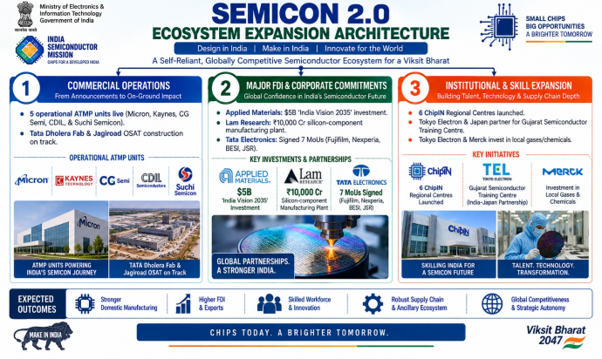
- While Semicon 1.0 established initial credibility (training 70,000 design engineers and deploying EDA tools across 500+ entities), Semicon 2.0 scales domestic capability across six core pillars: Design, Equipment & Materials, Fabs, Advanced Packaging (ATMP/OSAT), Applied R&D, and Talent.
Key Highlights:
-
- Transition from Policy to Production: Commercial DRAM and NAND production went live at Micron’s Sanand facility (Gujarat), alongside operational lines at CDIL Mohali (discrete devices) and Suchi Semicon Surat (packaging), bringing the total count of operational commercial ATMP/OSAT units to five.
- Semicon 2.0 Budget Scale-Up: ISM funding expanded to USD 13.5 billion, shifting focus upstream toward localized equipment, ultra-pure chemicals, specialty gases, and wafer-level photoresists.
- Massive Global Industry Investments:
- Applied Materials: Announced $5 Billion ‘India Vision 2035’ for a 10x supply-chain expansion over the next decade.
- Lam Research: Announced ~₹10,000 crore for its first silicon-component manufacturing and vertical ingot-processing plant in India.
- Tokyo Electron: Partnering with Japan to establish a specialized semiconductor training center in Gujarat.
- Tata Electronics: Confirmed 7 strategic MoUs with global leaders (Fujifilm, Nexperia, BESI, JSR) for wafer fabrication chemicals and advanced packaging.
- Bilateral & Country Roundtables: Co-hosted the India–USA and India–Japan Semiconductor Roundtables to accelerate joint ventures, technology transfers, precision equipment supply chains, and workforce exchange.
UPSC Quick Reference Table
| Feature | Detailed Specification |
| Nodal Ministry | Ministry of Electronics & IT (MeitY) |
| Event Venue & Dates | Yashobhoomi, New Delhi (17–19 September 2026) |
| Mission Budget | Semicon 1.0 ($8 Billion) Semicon 2.0 ($13.5 Billion) |
| Newly Operational Units | CDIL Semiconductor (Mohali) & Suchi Semicon (Surat) |
| Key Pillars (Semicon 2.0) | Design, Equipment/Materials, Fabs, Advanced Packaging, R&D, Talent |
| Major FDI Announcements | Applied Materials ($5B commitment); Lam Research (₹10,000 Cr plant) |
| Partner Countries | Japan, South Korea, Malaysia, Netherlands, Singapore, Sweden |
Conclusion:
The launch of Semicon 2.0 at SEMICON India 2026 marks India’s transition from foundational design to complete semiconductor ecosystem manufacturing.
Spread the Word