TOPIC-1: India–Nepal Inter-Governmental Sub-Committee (IGSC) Meeting on Trade & Transit
-
- UPSC Relevance: GS Paper 2 (Bilateral, Regional and Global Groupings involving India; India’s Neighbourhood First Policy; India–Nepal Relations) & GS Paper 3 (Indian Economy — Cross-Border Trade, Customs Digitalization, Border Infrastructure, and Anti-Smuggling Controls).
Introduction: The India–Nepal Inter-Governmental Sub-Committee (IGSC) on Trade, Transit, and Cooperation to Control Unauthorised Trade held its bilateral meeting at Vanijya Bhawan, New Delhi, on September 16–17, 2026. The meeting focused on resolving trade bottlenecks, digitizing customs clearance, and improving land-port connectivity.
About IGSC Institutional Framework:
-
- The IGSC is the primary bilateral execution body under the India–Nepal Treaty of Trade and Treaty of Transit.
- Operating beneath the ministerial-level Inter-Governmental Committee (IGC), sub-committee resolves operational bottlenecks, updates market access standards, aligns phytosanitary requirements, and addresses illicit cross-border trade across the 1,850 km porous border.
Key Highlights:
-
- Market Access Alignment: Reviewed regulatory standards for key export sectors including agricultural produce, dairy items, pharmaceuticals, medical devices, and AYUSH formulations to streamline bilateral clearance protocols.
- Digital Customs Integration: Advanced paperless trade mechanisms by proposing the pre-arrival exchange of customs data and the electronic verification of Certificates of Origin (e-CoO) to prevent origin fraud.
- Border Infrastructure & Land Ports: Evaluated operational efficiency across Integrated Check Posts (ICPs), rail transit corridors, and road freight infrastructure to shorten turnaround times for landlocked Nepal’s transit cargo.
- Mitigating Unauthorised Trade: Agreed on coordinated border surveillance between customs agencies to curb illegal transshipment, commercial fraud, and the misuse of preferential tariff schemes under existing bilateral treaties.
UPSC Quick Reference Table
| Feature | Detailed Specification |
| Nodal Body | India–Nepal Inter-Governmental Sub-Committee (IGSC) |
| Delegation Co-Chairs | Shri Ujjwal Kumar Ghosh (JS, India) & Shri Buddha Bahadur Gurung (JS, Nepal) |
| Meeting Venue & Dates | Vanijya Bhawan, New Delhi (16–17 September 2026) |
| Parent Bilateral Treaties | Treaty of Trade & Treaty of Transit |
| Core Pillars | Market Access, Customs Automation, ICP Transit Infrastructure, & Anti-Smuggling |
| Digital Innovation | Pre-arrival information sharing & Electronic Verification of Certificates of Origin |
Conclusion:
The IGSC meeting in New Delhi aligns with India’s Neighbourhood First policy and BBIN (Bangladesh, Bhutan, India, Nepal) regional integration efforts toward digital customs verification, upgrading border land ports and expanding market access for agricultural and medical products strengthens bilateral economic ties and stabilizes regional supply chains.
TOPIC-2: 25th Meeting of SCO Ministers Responsible for Foreign Economic and Trade Activities
-
- UPSC Relevance: GS Paper 2 (Bilateral, Regional and Global Groupings involving India; Shanghai Cooperation Organisation [SCO]; India’s Extended Neighbourhood Policy) & GS Paper 3 (Indian Economy — Multilateral Trade, Supply Chain Resilience, Digital Public Infrastructure, and Cross-Border Payments).
Introduction: The 25th Meeting of Ministers of the Shanghai Cooperation Organization (SCO) Member States Responsible for Foreign Economic and Trade Activities was held in Dushanbe, Tajikistan, on September 17, 2026.
About the SCO Trade Ministerial Framework:
-
- The SCO Trade Ministers Meeting functions under the Council of Heads of Government (CHG) to align commercial, customs, transit, and technological policies across the 10 member states (China, Russia, Kazakhstan, Kyrgyzstan, Tajikistan, Uzbekistan, India, Pakistan, Iran, and Belarus).
- The ministerial framework establishes multi-year economic roadmaps, facilitates paperless trade, and drives cross-border regulatory integration for Eurasian regional markets.
Key Highlights:
-
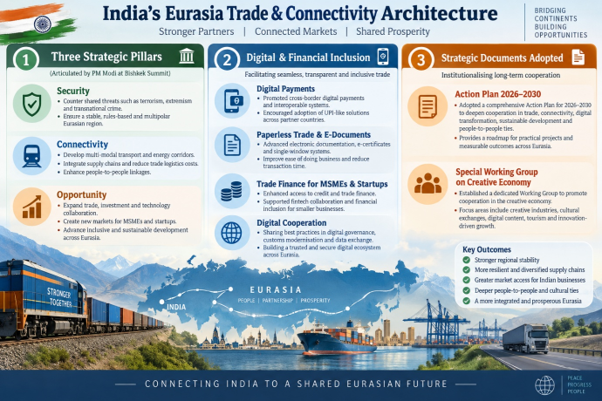
- Focusing on ‘Security, Connectivity, and Opportunity’: Reiterated the Prime Minister’s core vision, linking economic security with resilient supply chains in critical sectors such as agriculture, critical minerals, pharmaceuticals, manufacturing, and green hydrogen.
- Paperless Trade & Customs Automation: Advocated for simplified customs protocols, digital document exchanges, and reduced transit times across Eurasian trade routes to lower costs for businesses.
- Financial Integration for MSMEs: Emphasized the integration of digital payment networks, cross-border settlement solutions, and accessible trade finance to help MSMEs and startups access global value chains.
- Support for Rules-Based WTO Governance: Reaffirmed India’s commitment to an open, inclusive, and non-discriminatory multilateral trading system anchored by the World Trade Organization (WTO).
- Key Strategic Agreements Approved:
- Adopted the Joint Ministerial Statement.
- Finalized the Action Plan for 2026–2030 for the Implementation of the Programme of Multilateral Trade and Economic Cooperation.
- Approved regulations establishing the Special Working Group on the Development of the Creative Economy.
UPSC Quick Reference Table
| Feature | Detailed Specification |
| Nodal Forum | 25th SCO Meeting of Ministers Responsible for Foreign Economic & Trade Activities |
| Venue & Host | Dushanbe, Tajikistan (September 17, 2026) |
| Next Host (2027) | Republic of Uzbekistan |
| Core Policy Pillars | Security, Connectivity, and Opportunity |
| Priority Sectors | Critical Minerals, Pharmaceuticals, Green Hydrogen, Agriculture, & Electronics |
| Key Framework | Action Plan 2026–2030 for Multilateral Trade and Economic Cooperation |
| New Institution | Special Working Group on the Development of the Creative Economy |
Conclusion:
India’s engagement at the 25th SCO Trade Ministers Meeting highlights its commitment to building resilient Eurasian supply chains. Promoting digital trade mechanisms, simplified customs procedures, and MSME integration helps establish sustainable trade corridors while upholding a rules-based multilateral economic framework.
TOPIC-3: Swachh Sagar Surakshit Sagar & International Coastal Cleanup Day 2026
-
- UPSC Relevance: GS Paper 2 (Government Interventions & Citizen-Centric Movements; Multi-Agency Governance) & GS Paper 3 (Environment & Ecology — Marine Pollution, Ocean Conservation, Coastal Ecosystem Protection, and the Blue Economy / Deep Ocean Mission).
Introduction: The 2026 edition of the Swachh Sagar Surakshit Sagar campaign (September 12–19, 2026) emphasized how initiative has evolved from a 75-day inter-ministerial drive in 2022 into an annual “whole-of-government, whole-of-society” movement to protect India’s 11,098 km coastline.
About Swachh Sagar Surakshit Sagar:
-
- Swachh Sagar Surakshit Sagar is India’s flagship coastal environmental protection movement was first launched during India’s 75th year of Independence (Azadi Ka Amrit Mahotsav) in 2022.
- Coordinated by the Ministry of Earth Sciences (MoES) alongside the Indian Coast Guard, Indian Navy, state governments, and civil society, the campaign combines physical waste removal with scientific ocean conservation.
- It links directly to India’s Blue Economy vision and the Deep Ocean Mission, balancing deep-sea resource exploration with sustainable marine ecosystem stewardship.
Key Highlights:
-
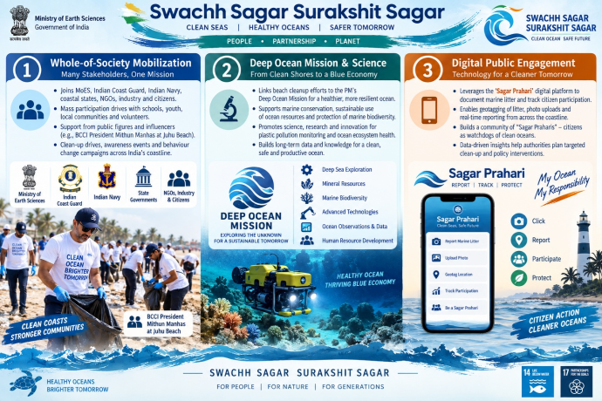
- Multi-Stakeholder Participation: Mobilizes central ministries, coastal States/UTs, academic institutions, volunteers, and public figures—exemplified by BCCI President Mithun Manhas joining the mass Ocean Pledge at Juhu Beach—to widen social reach.
- Synergy with Deep Ocean Mission: Connects shoreline protection with the broader Deep Ocean Mission, emphasizing that harnessing ocean resources (minerals, metals, fisheries, and bio-resources) requires maintaining healthy, plastic-free marine ecosystems.
- Sagar Prahari Citizen Platform: Utilizes the dedicated Sagar Prahari portal to enable community engagement, track volunteer drives, and crowdsource data on marine plastic litter along India’s coastline.
- Observance of International Coastal Cleanup Day: Aligns national efforts with global observances (held annually on the third Saturday of September) to foster long-term behavioral changes against ocean littering.
UPSC Quick Reference Table
| Feature | Detailed Specification |
| Nodal Ministry | Ministry of Earth Sciences (MoES) |
| Inception & Scale | Launched in 2022; Covers India’s 11,098 km Coastline |
| 2026 Campaign Window | September 12–19, 2026 (Peak drive on International Coastal Cleanup Day) |
| Major Event Venue | Juhu Beach, Mumbai (Led by MoS Dr. Jitendra Singh) |
| Citizen Platform | Sagar Prahari Portal (For tracking marine litter and community drives) |
| Strategic Linkage | Deep Ocean Mission & Vision of Blue Economy |
Conclusion:
The Swachh Sagar Surakshit Sagar safeguard India’s coastal ecosystems from marine plastic waste protects coastal livelihoods, preserves ocean biodiversity, and ensures the sustainable growth of India’s Blue Economy.
TOPIC-4: International Conference on ‘The Future of Environment and Climate Dynamics’ & Launch of NGT Mobile App
-
- UPSC Relevance: GS Paper 2 (Statutory, Regulatory & Quasi-Judicial Bodies — National Green Tribunal [NGT]; Judicial Principles & Constitutional Rights) & GS Paper 3 (Environment & Climate Change — Climate Justice, Renewable Energy Targets, Forest Gain, and Digital Initiatives in Environmental Governance).
Introduction: Prime Minister Shri Narendra Modi inaugurated the National Green Tribunal’s (NGT) two-day International Conference on ‘The Future of Environment and Climate Dynamics’ in New Delhi on September 19, 2026. Prime Minister also launched the official National Green Tribunal (NGT) Mobile Application to enhance public accessibility to environmental justice.
About NGT:
-
- The National Green Tribunal (NGT) is a specialized statutory tribunal established under the National Green Tribunal Act, 2010 for effective and expeditious disposal of cases relating to environmental protection and conservation of forests.
- Chief Justice of India Justice Surya Kant highlighted that Indian climate jurisprudence has brought climate-related rights into constitutional focus under Article 21 (Right to Life).
- The evolving foundational principles such as the Precautionary Principle, Polluter Pays Principle, Absolute Liability andPublic Trust Doctrine.
Key Highlights:
-
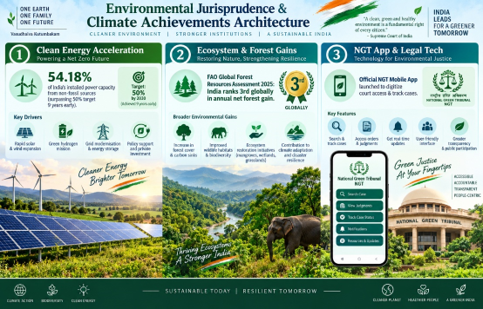
- Early Achievement of Non-Fossil Fuel Target: Union Environment Minister Shri Bhupender Yadav revealed that non-fossil sources now account for 54.18% of India’s installed power capacity, surpassing the Panchamrit/NDC target of 50% well ahead of the 2030 deadline.
- Global Forest Gain Ranking: According to the UN FAO Global Forest Resources Assessment, India maintained its 3rd position globally in annual net forest-area gain, with total forest and tree cover reaching 8.27 lakh square kilometers.
- NGT Mobile Application Launch: Digitalization initiative providing citizens, litigants, and lawyers real-time access to NGT cause lists, judgment tracking, filing status, and case updates.
- Core Technical Sessions:
- Session I: Climate Justice, Equity and Inclusion: From Principles to Action.
- Session II: The Future of Environmental Law, Sustainable Cities, Green Finance, and Just Energy Transition.
UPSC Quick Reference Table
| Feature | Detailed Specification |
| Organizing Body | National Green Tribunal (NGT) |
| Conference Theme | “The Future of Environment and Climate Dynamics” |
| Key Tech Launch | NGT Mobile Application |
| Non-Fossil Power | 54.18% of total installed capacity (Exceeded 2030 target of 50%) |
| FAO Forest Gain | Ranked 3rd Globally in net annual forest area gain (8.27 lakh sq km cover) |
| Participating Bodies | Delegates from 17 Nations, UNEP, and Asian Development Bank (ADB) |
Conclusion:
The NGT International Conference highlights how judicial mechanisms and proactive environmental governance support sustainable development. Launching NGT Mobile Application alongside exceeding renewable energy targets demonstrates India’s commitment to climate justice, public accessibility, and environmental stewardship.
Spread the Word