
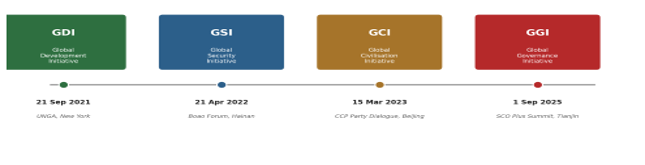
Context: China launched GGI on 1 September 2025 (SCO Plus Summit, Tianjin) as its 4th major global initiative after GDI, GSI and GCI. ORF report was released to analyse this new initiative of China & expose its dual-use nature i.e. soft diplomacy + mass HUMINT/intelligence gathering and flag strategic risks for India as China exploits vacuum left by US retrenchment under President Trump.
China’s four strategic pillars:
-
- The Physical Pillar (BRI): Economic and physical infrastructure development.
- The Developmental Pillar (GDI): Providing alternative models for the Global South.
- The Security Pillar (GSI): Redefining collective security and non-interference.
- The Governance Pillar (GGI): Reforming international organizations to legalize these new norms.
Why Released
-
- GGI is China’s fourth global initiative in five years which aim to reform global governance institutions while embedding a uniquely scaled human intelligence (HUMINT) network under cover of public diplomacy and ‘South-South solidarity’.
Key Findings by ORF
i. China now funds ~20% of the UN’s regular budget and ~23% of peacekeeping costs (vs <1% in 1994). It is 2nd-largest contributor after the US.
ii. China has held UNDESA’s under-secretary-general post since 2007 and FAO’s director-general post since 2019.
iii. China submitted 830 technical documents to ITU (2021) for wired communications more than South Korea, US, and Japan combined.
iv. China rated top obstructionist state at the UN NGO Committee which posed 18% of all questions to NGO applicants (2020-24), surging to 28% in 2024.
v. China builds parallel bodies too like IOMed (Hong Kong-based mediation body in force Aug 2025) and WAICO/GAIGI for AI governance.
vi. GGI operations are underpinned by mass HUMINT which is a ‘thousand grains of sand’ approach using students, tourists, and diaspora as low-level collectors.
vii. GGI has received declared support from 140+ countries/organisations and endorsement from Russia’s President Putin.
Impact on india
i. Chinese dominance of ITU 6G standard-setting risks forcing Huawei/ZTE tech with hidden surveillance features into Indian networks.
ii. ‘China Inspection Quarantine’ delay tactics on water-soluble fertiliser exports threaten India’s horticulture sector (1/3rd of agri-GDP; 80% import reliance on China).
iii. China blocks UNHRC scrutiny of Uyghur rights/religious freedoms i.e. issues that overlap with India’s Xinjiang border-security concerns.
iv. China accounted for 83 of 418 NGO-application deferrals at UNHRC (Sep 2022 session), affecting India-linked NGOs too
v. India forced into costly continuous counterbalancing of a Sino-centric multilateral order.
China’s Four Global Initiatives
GGI’s Seven Governance-Deficit Domains
Domain-wise Foothold
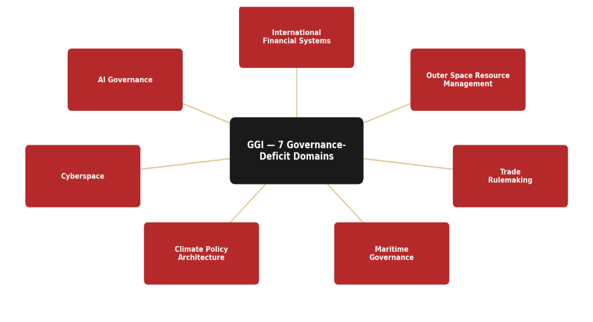
| Domain | China's Strategy | Institutional Foothold |
|---|---|---|
| International Finance | Elevate RMB role, restructure IMF/World Bank voting power for emerging economies | IMF, World Bank, UNCTAD, BRICS, SCO |
| AI Governance | Push 'state control & data sovereignty' norms over transparency/privacy | WAICO, GAIGI, ECOSOC |
| Cyberspace | Export 'cyber sovereignty' doctrine; sell surveillance tech to client regimes | Digital Silk Road, standards bodies |
| Climate Policy | Champion CBDR & South-South cooperation; embed HUMINT in climate diplomacy | UNFCCC forums, Pacific Islands talks |
| Maritime Governance | Legitimise 9-dash line claims; fund ISA/ITLOS; expand fishing fleet as HUMINT cover | IMO Council (Cat. A seat), ISA, UNCLOS |
| Trade Rulemaking | Rally Global South against US tariffs; forgo new S&D treatment to assert reform leadership | WTO (164-member coalition, 2025) |
| Outer Space | Selective OST interpretation enabling resource extraction; overseas ground stations for SIGINT | COPUOS; Espacio Lejano (Argentina) |
Way Forward for India
i. Strengthen India’s presence and voting coalitions in UN specialised agencies (FAO, ITU, WHO, IMO) to counter unilateral Chinese capture.
ii. Build indigenous/trusted alternatives in frontier standard-setting (6G, AI, cyber) to reduce dependence on Chinese-influenced ITU norms.
iii. Diversify horticultural input supply chains away from over-reliance on Chinese fertiliser/agro-input exports.
iv. Deepen counter-intelligence and HUMINT-awareness protocols for diaspora, academic, and business exchanges with Chinese entities.
v. Partner with like-minded middle powers (Quad, G20, Global South coalitions) to jointly contest GGI’s narrative of ‘inclusive multilateralism’.
vi. Actively engage in emerging governance domains (AI, deep-sea, space) early, rather than reactively, to avoid ceding first-mover norm-setting to Beijing.
Conclusion:
The GGI completes China’s four-pillar global initiative architecture by working inside existing bodies (UN, WTO, IMO) while building parallel ones (IOMed, WAICO). Beijing is positioning itself as rule-shaper across both legacy institutions and frontier domains. For India, these demands sustained institutional vigilance, coalition-building and early engagement in emerging governance spaces to safeguard its strategic autonomy.
Spread the Word