Indian Polity & Governance
Supreme Court Upholds ECI’s Special Intensive Revision (SIR):
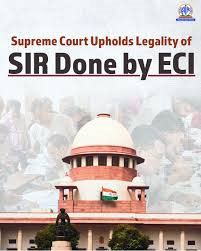
Context: The Supreme Court of India upheld the constitutional validity of the Special Intensive Revision (SIR) of electoral rolls conducted by the Election Commission of India (ECI), dismissing a batch of petitions that challenged the process.
-
- Constitutional Backing: The Supreme Court ruled that the ECI is fully empowered under Article 324 of the Constitution to examine and verify citizenship for the limited purpose of inclusion in electoral rolls.
- Core Purpose: The apex court emphasized that the SIR is a vital exercise undertaken in furtherance of the constitutional principle of holding free and fair elections.
- Not Final Adjudication: The judgment clarified that verification by the ECI during SIR is not the final word on a person’s citizenship.
- Referral Mechanism: If a person fails to produce required proof during the inquiry, the ECI can forward the case to the competent Central government authorities for final adjudication under the Citizenship Act.
- Statutory Harmony: Although SIR stretches the typical modalities of standard roll revisions under the Representation of the People Act and the Registration of Electors Rules, it cannot be deemed invalid or “manifestly excessive.”
- Burden of Proof: The court explicitly rejected contentions by petitioners (including the Association for Democratic Reforms) that SIR ipso facto reverses the burden of proof of citizenship onto voters arbitrarily.
- Role of Aadhaar: The SC highlighted its own judicial intervention during the Bihar SIR hearings, which added Aadhaar as the 12th ‘indicative’ document acceptable for identity/residence proof.
- Transparency Mandate: The court reiterated that transparency is the hallmark of an open democracy and pushed the ECI to publish district-wise, booth-level searchable lists of purged voters along with exact deletion reasons.
- Scale of Impact: The ruling heavily impacts Phase 2 of the SIR, which covers nearly 51 crore voters across 12 States and Union Territories (including West Bengal, Tamil Nadu, and Assam).
- Judicial Review: The Bench, headed by Chief Justice of India Surya Kant, affirmed that any final decision taken during the administrative SIR process remains strictly subject to judicial review.
(TH)
Economy
Vice President’s Vision Document on Inclusive Development for Viksit Bharat 2047:
Context: Prime Minister Narendra Modi shared a prominent vision document and article authored by the Vice President of India, Shri C. P. Radhakrishnan, detailing the roadmap for inclusive development during the Amrit Kaal.
-
- Target Year: The core objective of the vision document is to outline the structural reforms needed to transform India into a completely developed nation (Viksit Bharat) by the year 2047, marking 100 years of independence.
- Primary Demographics: The article identifies four foundational pillars for targeted state welfare: Nari Shakti (Women empowerment), youth, farmers, and the socio-economically marginalized.
- Civilizational Inspiration: The Vice President draws heavy philosophical inspiration from the timeless teachings of Swami Vivekananda, Thiruvalluvar, and Subramania Bharati to define modern civic duties and statecraft.
- Amrit Kaal Strategy: The strategy highlights the transition from entitlement-based welfare to empowerment-driven economic policies during the ongoing Amrit Kaal phase.
- Jan Bhagidari Movement: The document emphasizes that achieving a $Viksit Bharat$ cannot be a purely bureaucratic or top-down government exercise; it must transform into a mass citizen-led movement (Jan Bhagidari).
- Economic Inclusivity: It stresses the elimination of regional economic disparities through targeted infrastructural funding in historically lagging districts (e.g., Aspirational Districts Programme).
- Technological Leverage: The blueprint details how digital public infrastructure (DPI) like India Stack must be scaled further to ensure leak-proof, direct delivery of financial benefits to rural households.
- Agricultural Revitalization: For farmers, the document advocates for rapid integration of climate-resilient agriculture, digital crop surveys, and drone technologies to boost per-acre productivity.
- Gender-Led Development: It calls for shifting the narrative from merely “welfare of women” to “women-led development,” ensuring higher female labor force participation rates (LFPR) across corporate and manufacturing sectors.
- Global Standard Rules: To sustain high GDP growth rates over the next two decades, India must build robust domestic manufacturing supply chains while remaining committed to green energy commitments.
(PIB)
Analysis of the RBI’s Largest-Ever Surplus Transfer:
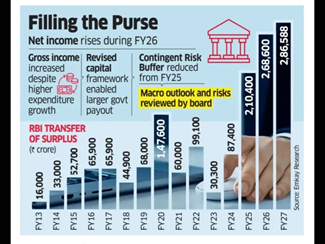
Context: Economic experts analyzed the implications of the Reserve Bank of India’s (RBI) approval of its historic, largest-ever dividend transfer of ₹2.87 lakh crore to the Central Government.
-
- Statutory Provision: The RBI transfers its surplus profits to the Union Government in strict accordance with Section 47 of the Reserve Bank of India Act, 1934.
- Fiscal Cushion: This record transfer is highly strategic as it is expected to cover roughly 20% of the government’s fiscal deficit, providing immense relief against expanding fuel and fertilizer subsidy bills.
- Sources of RBI Profit: The central bank generates its disposable income primarily through interest earned on domestic and foreign bond investments, as well as foreign exchange interventions.
- The Valuation Effect: When the Indian Rupee depreciates against the US Dollar, the RBI’s aggressive dollar-selling operations to defend the currency automatically generate substantial fiscal dividends.
- Jalan Committee Compliance: Surplus distribution strictly follows the conservative risk-management framework recommended by the Bimal Jalan Committee.
- Contingency Risk Buffer (CRB): The RBI maintained its maximum Contingency Risk Buffer at 7.5% of its total asset position, ensuring its financial health was not stretched thin to pay the dividend.
- Volatility Risks: Economists warn that central bank profits are inherently volatile compared to tax revenues and cannot serve as a permanent, reliable source of structural fiscal consolidation.
- Exchange Rate Policy Impact: If the RBI shifts toward allowing the Rupee to float more freely in the global market, its profits from active foreign exchange interventions will progressively decrease.
- Bond Yield Fluctuations: Global and domestic bond yield volatility directly impacts the valuation of the RBI’s portfolio, imparting an element of unpredictability to future sovereign payouts.
- Macroeconomic Balance: While the massive dividend eases immediate borrowing pressures for the exchequer, it highlights the complex political economy of relying heavily on central bank balance sheets for fiscal breathing room.
(IE)
Geography, Mapping, Ecology & Environment and DM
Forest Fires in Kasauli Hills and IAF’s Operation Bambi Bucket:
Context: Multiple massive forest fires broke out across the pine-dominated forest tracts near Kasauli (Himachal Pradesh), prompting the deployment of the Indian Air Force (IAF) to assist in firefighting operations.
-
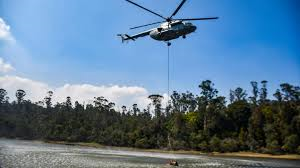
- IAF Deployment: Due to the rugged, inaccessible terrain of the Shivalik hill ranges, the Indian Air Force deployed its heavy-duty Mi-17 helicopters to contain the spreading blaze.
- Bambi Bucket Operation: The IAF helicopters utilized specialized “Bambi Buckets” (aerial firefighting buckets suspended by cables) to drop thousands of liters of water directly onto the active fire zones.
- Water Sourcing: Water for the aerial operations was rapidly sourced from nearby major water bodies and reservoirs to ensure rapid, continuous round-trips.
- Vulnerable Ecosystem: The forests around Kasauli primarily consist of Chir Pine (Pinus roxburghii), an ecosystem highly susceptible to forest fires during peak summer due to resin-rich, dry pine needles.
- Climatic Triggers: Rising summer temperatures, prolonged dry spells, and high wind speeds in the hill stations accelerated the lateral spread of the ground fires into dangerous crown fires.
- Inter-Agency Coordination: The operation marked a highly synchronized disaster response involving the IAF, the Himachal Pradesh State Forest Department, and local district disaster management authorities.
- Civic & Infrastructure Threat: The fires posed a direct threat to vital civil infrastructure, defense establishments, and prominent tourist resorts scattered around the Kasauli hill circuit.
- NDMA Guidelines: The disaster response aligned directly with the National Disaster Management Authority (NDMA) guidelines on forest fire mitigation, emphasizing swift aerial intervention when ground teams hit physical limits.
- Ecological Loss: The fires caused widespread damage to local biodiversity, destroying micro-habitats of endemic avian species and inducing severe topsoil degradation.
- Public Health Impact: Dense smoke columns drifting from the Kasauli ridges led to a sharp drop in ambient air quality across surrounding foothills, including parts of Chandigarh and Panchkula.
(IE)
History, Art & Culture
Death of Renowned Archaeologist Shereen Ratnagar:
Context: Shereen Ratnagar, one of India’s most influential and pioneering voices on the Harappan (Indus Valley) Civilization, passed away at the age of 82.
-
- Academic Profile: Shereen Ratnagar was a highly distinguished archaeologist and a former Professor of Archaeology and Ancient History at the Jawaharlal Nehru University (JNU), New Delhi.
- Area of Expertise: Her extensive lifetime research focused primarily on the socio-economic structures, urban planning, trade routes, and eventual decline of the Indus Valley Civilization.
- External Trade Focus: Ratnagar pioneered the structural study of long-distance bronze age trade networks connecting the Indus Valley with ancient Mesopotamia and the Persian Gulf.
- Methodological Paradigm: She was known for moving away from purely descriptive artifact cataloging toward analytical, sociological interpretation of past material culture.
- Major Publications: She authored several seminal, standard reference books, including Encounters: The Westerly Trade of the Harappan Civilization and Understanding Harappa.
- Decline Theory: Contrary to outdated invasion theories, her work scientifically analyzed how ecological shifts, changing river courses, and breaking trade links contributed to the gradual de-urbanization of Harappan cities.
- Public Archaeology: Ratnagar was a passionate advocate for public archaeology, arguing that historical and archaeological findings must be accessible and cleanly separated from political myth-making.
- Interdisciplinary Approach: Her research methodologies seamlessly integrated structural geology, ancient metallurgy, ethnography, and textual records of contemporary West Asian civilizations.
- Informed Critique: She provided highly respected, evidence-based academic critiques on controversial structural excavations, insisting on rigorous scientific dating and stratigraphy.
- Educational Legacy: Through her decades of teaching and mentorship, she trained multiple generations of modern Indian historians and field archaeologists, deeply shaping the contemporary historiography of ancient South Asia.

(IE)
Spread the Word