TOPIC-1: India and Ghana Sign MoU for Agricultural Research and Technology Transfer
-
- UPSC Relevance: GS Paper 2 (Bilateral Groupings and Agreements involving India; India–Africa Relations & South–South Cooperation) & GS Paper 3 (Agriculture — Crop Yields, Post-Harvest Management, Seed Technology, & Technology Transfer).
Introduction: In a step toward strengthening South–South cooperation and India–Africa strategic partnership, the Indian Council of Agricultural Research (ICAR) signed a 5-year Memorandum of Understanding (MoU) with Ghana’s Crops Research Institute (CSIR-CRI) in New Delhi on October 7, 2026. The agreement focuses on joint R&D, germplasm exchange and agricultural technology commercialization.
South–South Agriculture Framework:
-
- Agricultural cooperation between India and African nations is a core pillar of the India–Africa Forum Summit (IAFS)
- Ghana, reliant on imported horticultural produce, seeks to modernize its domestic farming through high-yielding crop varieties and post-harvest management.
- The partnership couples ICAR’s public R&D with a private commercialization partner (Arima Farms Ltd., Ghana) to bridge laboratory innovations with field deployment.
Core Areas of Cooperation:
-
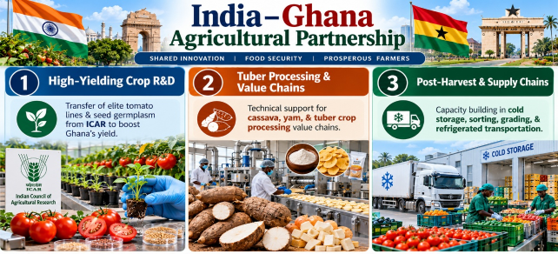
- Phase-1 Focus (Vegetable Crop Research): Focuses on tomato breeding, introducing climate-resilient and high-yielding Indian tomato varieties to reduce Ghana’s dependence on vegetable imports.
- Tuber Crop Value Addition: Expands R&D into processing cassava, yam, and tropical tubers to improve shelf-life and industrial utilization.
- Post-Harvest Infrastructure Support: Technical guidance from ICAR to reduce post-harvest losses via cold storage, refrigerated transport networks, and automated sorting/grading technologies.
- Institutional Governance: Joint implementation overseen by a Joint Working Group (JWG) comprising representatives from ICAR and CSIR-CRI, alternating meetings between New Delhi and Accra.
UPSC Quick Reference Table
| Feature | Detailed Specification |
| Nodal Bodies | ICAR (India) & CSIR-Crops Research Institute (Ghana) |
| Diplomatic Level | Signed in presence of EAM Dr. S. Jaishankar & Foreign Minister Samuel Okudzeto Ablakwa |
| Tenure | 5-Year Agreement (governed via a periodic Joint Working Group) |
| Commercial Partner | Arima Farms Ltd. (Ghana) for field trials & market deployment |
| Phase-1 Target | Tomato crop R&D, seed technology, & yield enhancement |
| Key Focus Areas | Tuber crop processing (cassava/yam), germplasm exchange, & post-harvest cold chains |
Conclusion:
The India–Ghana agricultural MoU reflects India’s commitment to South–South cooperation and capacity building in Africa. Transferring ICAR’s agricultural research, seed germplasm, and post-harvest technology to Ghana supports food security, reduces post-harvest losses, and deepens bilateral economic engagement.
TOPIC-2: 3rd Edition of Sagarmanthan — The Great Oceans Dialogue 2026
-
- UPSC Relevance: GS Paper 2 (Bilateral, Regional, and Global Groupings; Bilateral Agreements — IMEC, India–EU, India–ROK; SAGAR & Maritime Diplomacy) & GS Paper 3 (Infrastructure — Ports, Shipbuilding Ecosystems, Maritime Amrit Kaal Vision 2047, Green Shipping Corridors, & Sustainable Blue Economy).
Introduction: The 3rd edition of Sagarmanthan: The Great Oceans Dialogue opened in New Delhi on October 7, 2026 is organised by the Ministry of Ports, Shipping and Waterways (MoPSW) in partnership with the Observer Research Foundation (ORF).
Vision Framework:
-
- Sagarmanthan serves as India’s premier ocean dialogue platform, aligning international maritime governance with Prime Minister Narendra Modi’s vision of SAGAR (Security and Growth for All in the Region) and the Maritime Amrit Kaal Vision 2047.
- The dialogue seeks to address global shipping disruptions, promote decarbonization, and position India as an anchor for resilient maritime supply chains across the Indo-Pacific and global ocean commons.
International Initiatives:
-
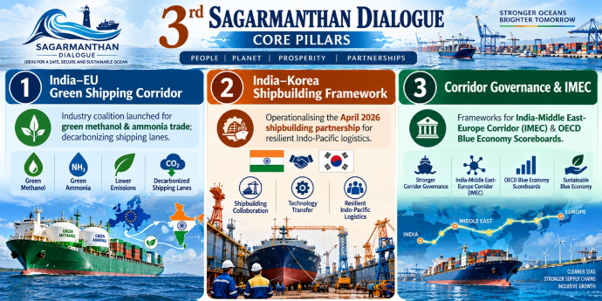
- India–EU Green Shipping Corridor: Formally launched the industry coalition following the 2025 pre-feasibility study. The corridor creates commercial pathways for trading green ammonia and methanol between Indian production hubs and European ports to advance maritime decarbonization.
- India–Korea Partnership Framework: Advanced the implementation of the India-Korea Comprehensive Framework for Partnership in Shipbuilding, Shipping and Maritime Logistics (agreed at the April 2026 summit), focusing on joint shipyard modernization, technology transfer, and supply chain integration.
- IMEC Governance Architecture: Plenary sessions evaluated the institutional governance required to translate the India-Middle East-Europe Economic Corridor (IMEC) from a strategic vision into a functional multimodal trade corridor.
- OECD Blue Economy Scoreboards: Partnered with the OECD to introduce evidence-based benchmarking tools for measuring sustainable blue economy progress, coastal ecosystem health, and sustainable ocean investments.
- Africa’s Maritime Corridors: Discussed transforming African trade routes (including the Lobito Corridor) into resilient trade engines, deepening South–South maritime cooperation.
UPSC Quick Reference Table
| Feature | Detailed Specification |
| Organising Nodal Bodies | Ministry of Ports, Shipping and Waterways (MoPSW) & Observer Research Foundation (ORF) |
| Summit Name | 3rd Sagarmanthan: The Great Oceans Dialogue 2026 |
| Overarching Vision | Maritime Amrit Kaal Vision 2047 & SAGAR Framework |
| Green Shipping | India–EU Green Shipping Corridor (Focus on Green Ammonia & Methanol) |
| Industrial Alliances | India–Republic of Korea Shipbuilding Framework & IMEC Governance |
| Key Analytics Tool | OECD Blue Economy Scoreboards for sustainable ocean policy measurement |
Conclusion:
The 3rd Sagarmanthan Dialogue highlights India’s expanding role in global maritime governance. Integrating green shipping corridors, shipbuilding partnerships and robust corridor governance supports the targets of Maritime Amrit Kaal Vision 2047.
TOPIC-3: Strategy for Environmental Economic Accounts in India 2026–2030
-
- UPSC Relevance: GS Paper 3 (Indian Economy & Environment — Green GDP, Natural Capital Accounting, System of Environmental-Economic Accounting [SEEA], MoSPI Initiatives, & Sustainable Development Goals [SDG] Monitoring).
Introduction: The National Statistical Office (NSO), under the Ministry of Statistics and Programme Implementation (MoSPI), released the strategic document titled “Strategy for Environmental Economic Accounts in India 2026–2030”.
Conceptual Framework:
-
- The document outlines a comprehensive roadmap to mainstream natural resource accounting, expand environmental-economic data coverage.
- It aligns India’s statistical ecosystem with global frameworks like SEEA and SNA 2025.
- Environmental-economic accounting measures the multi-dimensional interactions between the economy and the natural environment.
Historical Evolution:
-
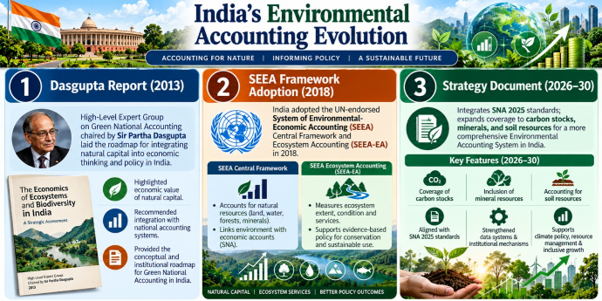
- Expert Group Report (2013): Rooted in the recommendations of the expert group chaired by Prof. Sir Partha Dasgupta (“Green National Accounts in India – A Framework”).
- UN System Alignment: Follows the System of Environmental-Economic Accounting (SEEA) framework endorsed by the United Nations Statistical Commission (UNSC). It covers both:
1. SEEA Central Framework (SEEA-CF): Stocks and physical/monetary flows of environmental assets (water, energy, materials).
2. SEEA Ecosystem Accounting (SEEA-EA): Ecosystem extent, condition, and ecosystem services.
-
- Alignment with SNA 2025: Integrates with the System of National Accounts (SNA) 2025, which formally recognizes natural resource accounting within national accounting boundaries.
Key Focus Areas(2026–2030):
-
- Expanded Coverage of Natural Assets: Expands accounting from basic land cover to specialized domains including forests, minerals, soil resources, water quality, carbon stocks, cropland, and wetlands.
- Ecosystem Services & Biodiversity: Incorporates accounting for urban ecosystems, pollination services, and biodiversity metrics to support the Kunming-Montreal Global Biodiversity Framework (GBF) targets.
- Addressing Statistical Data Gaps: Delineates data sources, harmonizes inter-departmental statistical flows, and creates standardized methodologies for State and Union Territory statistical bureaus to compile local environmental accounts.
- Policy Application (Green GDP): Facilitates the transition towards Green GDP calculations by measuring natural capital depletion and environmental degradation costs against gross value added (GVA).
UPSC Quick Reference Table
| Feature | Detailed Specification |
| Nodal Body | National Statistical Office (NSO), Ministry of Statistics and Programme Implementation (MoSPI) |
| Document Name | Strategy for Environmental Economic Accounts in India 2026–2030 |
| Guiding Global Framework | SEEA (SEEA Central Framework & SEEA Ecosystem Accounting) endorsed by UNSC |
| Foundational Panel | High-Level Expert Group chaired by Prof. Sir Partha Dasgupta (2013) |
| Key Domains Covered | Forests, minerals, soil, water quality, carbon stocks, urban ecosystems, & biodiversity |
| Annual MoSPI Report | EnviStats India (Vol. 1: Environment Statistics; Vol. 2: Environment Accounts) |
Conclusion:
The release of the Strategy for Environmental Economic Accounts in India 2026–2030 reflects India’s progress in natural capital accounting. Standardizing environmental accounting across States and central ministries strengthens data collection and helps monitor India’s progress toward the Sustainable Development Goals (SDGs).
TOPIC-4: Inauguration of the 10th India Mobile Congress (IMC) 2026
-
- UPSC Relevance: GS Paper 2 (Government Policies & Interventions for Digital Inclusion; Direct Benefit Transfer [DBT] & E-Governance) & GS Paper 3 (Science & Technology — Telecom Infrastructure [5G/6G], Deep-Tech Ecosystems, Artificial Intelligence, Digital Public Infrastructure, & Indigenous Manufacturing).
Introduction: Prime Minister Narendra Modi inaugurated the 10th edition of the India Mobile Congress (IMC) 2026 at Yashobhoomi, New Delhi, co-hosted by the Department of Telecommunications (DoT) and Cellular Operators Association of India (COAI) under the theme “Scale Without Boundaries”.
Digital Transformation Context:
-
- It is an Asia’s flagship telecom and digital technology forum convened global technology leaders, startups and policymakers from over 100 countries.
- The 10th IMC highlights India’s evolution from a digital technology consumer to a deep-tech innovator and exporter marking a decade since its inception in 2017 (“Connecting the Next Billion”).
- Over the past 12 years, monthly data consumption per user surged from 26 GB to over 36 GB, while data costs fell by 97% (from ₹268/GB to ₹8/GB).
- India’s 5G deployment now spans 5,50,000 base stations covering 9% of all districts, laying the foundation for connecting 1 billion 5G users by 2030 and advancing pre-6G AI-native networks.
Key Highlights:
-
- Transition to Indigenous Product Design: Emphasized shifting from local assembly to indigenous product design, intellectual property (IP) creation, and homegrown semiconductor design.
-
- Direct Benefit Transfer (DBT) Milestones: Highlighted how high-speed mobile connectivity enabled over ₹50 lakh crore in direct transfers to citizens’ bank accounts, preventing leakage of nearly ₹5 lakh crore.
- DoT “Samridh Gram” Pavilion: Featured citizen-centric applications including Sanchar Saathi (anti-phishing and mobile security) and the Financial Fraud Risk Indicator (FRI) to secure rural digital finance.
- Emerging Tech Demonstrations: Showcased sovereign cloud platforms, Terahertz communications, direct-to-device (D2D) satellite connectivity, Integrated Sensing and Communication (ISAC), and industrial robotics.
UPSC Quick Reference Table
| Feature | Detailed Specification |
| Nodal Body | Department of Telecommunications (DoT) & COAI |
| Event & Theme | 10th India Mobile Congress (IMC) 2026 — “Scale Without Boundaries” |
| Date & Venue | October 8, 2026 (Yashobhoomi, New Delhi) |
| 5G Milestone | 5,50,000 Base Stations | 99.9% District Coverage | Target: 1 Billion users by 2030 |
| Data Economics | Data cost dropped from ₹268/GB (2014) to ₹8/GB (2026); consumption at 36 GB/month |
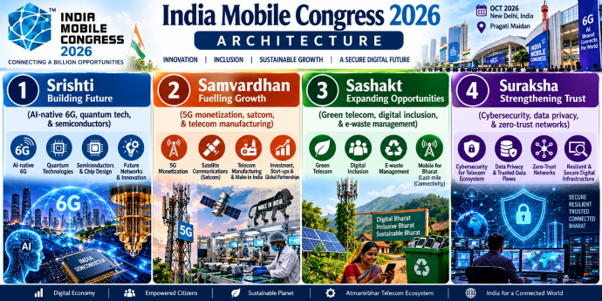
| Four Pillars | Srishti (Future), Samvardhan (Growth), Sashakt (Access), & Suraksha (Trust) |
Conclusion:
The 10th edition of the India Mobile Congress is transitioning from nationwide 5G rollout to indigenous 6G R&D and digital safety frameworks supports digital governance, accelerates manufacturing, and advances the national vision for Viksit Bharat 2047.
TOPIC-5: World Bank Group’s World Development Report 2026 — “The Promise of Artificial Intelligence”
-
- UPSC Relevance: GS Paper 2 (Important International Institutions — World Bank Group; E-Governance & Technology in Public Delivery) & GS Paper 3 (Science & Technology — IndiaAI Mission, Artificial Intelligence in Agriculture & Healthcare, Deep-Tech Infrastructure, & Digital Public Infrastructure).
Introduction: India launched the World Bank Group’s flagship publication “World Development Report (WDR) 2026: The Promise of Artificial Intelligence” in New Delhi jointly hosted by the IndiaAI Mission (MeitY) and World Bank Group. The launch highlighted how developing economies can harness AI for inclusive development through a three-stage framework: Adoption, Adaptation, and Advancement.
Global WDR Framework:
-
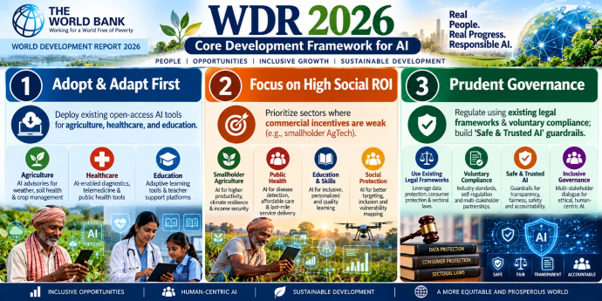
- The World Development Report 2026 emphasizes that developing countries should adopt a “full-stack approach”—combining software, human talent and institutional mechanisms to adapt open-access AI tools to local social contexts rather than spending billions building foundation models from scratch.
Key Highlights:
-
- Seven Pillars of the IndiaAI Mission:
1. IndiaAI Compute Capacity (Accessible GPU infrastructure)
2. IndiaAI Innovation Centre (Indigenous foundation models)
3. IndiaAI Datasets Platform (AIKosh)
4. IndiaAI Application Development Initiative
5. IndiaAI FutureSkills & Talent Mission
6. IndiaAI Startup Financing
7. Safe & Trusted AI (Bias mitigation, explainable AI, & deepfake detection)
-
- Real-World Impact Case Studies:
-
-
- Agriculture (Baramati, Maharashtra): AI voice advisories increased sugarcane yields by 40% using 30% less water and fertilizer.
- AgriStack & Livestock Health: Over 5 lakh farmers in Gujarat use AgriStack, while the Sarlaben AI platform benefits 3 crore cattle.
- Healthcare & Monsoon Forecasting: AI-enabled screening raised TB detection by 35%, while AI-driven monsoon forecasting models predicted the unusual 2025 monsoon (a model now being replicated by Ethiopia).
-
-
- State AI Showcase Innovations:
-
-
- Navachetana (Andhra Pradesh): Early AI screening for children (0–6 years) to detect developmental delays.
- MahaVISTAAR AI (Maharashtra): Connected digital advisory platform for farmers.
- EdskGrid (Meghalaya): GeoAI governance intelligence solution for school education monitoring.
- Vyuhaa-Cerviai: Point-of-care cervical cancer screening solution.
-
UPSC Quick Reference Table
| Feature | Detailed Specification |
| Document Title | World Development Report 2026: The Promise of Artificial Intelligence |
| Publishing Organization | World Bank Group (Launch hosted by IndiaAI Mission / MeitY) |
| Strategic Roadmap | Three-stage approach: Adoption Adaptation Advancement |
| Core Domestic Program | IndiaAI Mission (Operating across 7 structural pillars) |
| Key Sectoral Examples | Baramati Sugarcane Yields (+40%), AgriStack, & AI TB Detection (+35%) |
| Regulatory Philosophy | Flexible, risk-proportionate regulation relying on existing legal mechanisms |
Conclusion:
The launch of the World Development Report 2026 influence Digital Public Infrastructure (DPI), and expanding localized AI applications across healthcare & agriculture creates a model for leveraging AI to achieve development goals across the Global South.
Spread the Word