TOPIC-1: State Visit of the President of the Swiss Confederation to India
-
- UPSC Relevance: GS Paper 2 (Bilateral Groupings & Agreements involving India; India–EFTA Relations, Migration & Mobility Frameworks) & GS Paper 3 (Infrastructure Technologies, Tunnels/Ropeways, Daily& Technology Innovation, & Start-Up Ecosystems).
Introduction: The bilateral engagement resulted in the signing of key agreements covering Migration and Mobility Partnership (MMP), Young Professionals Scheme (YPS), Transport Infrastructure Collaboration and scientific research innovation frameworks following the rollout of the India–EFTA TEPA (Trade and Economic Partnership Agreement).
Bilateral Trade Architecture:
-
- India and Switzerland share a relationship anchored by the historic 1948 Treaty of Friendship.
- Switzerland is a leading investor in India and a core member of the European Free Trade Association (EFTA)—alongside Iceland, Liechtenstein, and Norway.
- The implementation of the India–EFTA Trade and Economic Partnership Agreement (TEPA) provides an institutional framework for expanding Swiss capital investments, high-tech manufacturing, and clean energy technology transfers into India.
Key Highlights:
-
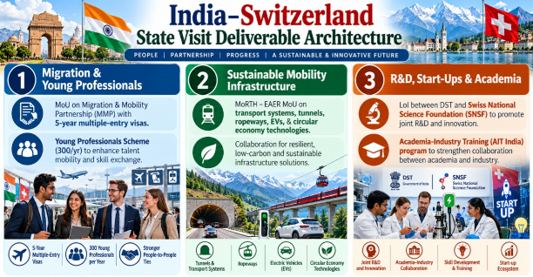
- Migration and Mobility Partnership (MMP) MoU: Establishes a legal framework for regularized mobility, combatting human trafficking, and issuing 5-year multiple-entry visas (allowing up to 6 months per stay) along with renewable 1-year student permits.
- Agreement on Young Professionals Scheme (YPS): Permits 300 young professionals annually (expandable to 500) aged 18–35 to gain temporary professional employment and skill exposure in the host country.
- Transportation & Tunneling Infrastructure Collaboration: Agreement between India’s Ministry of Road Transport and Highways (MoRTH) and Switzerland’s EAER to share expertise in complex alpine tunneling, ropeway systems, electric vehicle infrastructure, and circular economy mobility solutions.
- Deep-Tech & Startup Ecosystems: Signed a Letter of Intent (LoI) between DST and the Swiss National Science Foundation (SNSF), alongside an Implementation Arrangement with Zurich University of Applied Sciences for the Indo–Swiss Academia–Industry Training (AIT India) program to mentor early-stage startups.
UPSC Quick Reference Table
| Feature | Detailed Specification |
| Visiting Dignitary | H.E. Mr. Guy Parmelin (President of the Swiss Confederation) |
| Nodal Body (India) | President’s Secretariat & Ministry of External Affairs |
| Key Economic Treaty | India–EFTA Trade and Economic Partnership Agreement (TEPA) |
| Mobility Agreements | Migration & Mobility Partnership (MMP) & Young Professionals Scheme (YPS) |
| Infrastructure Focus | Sustainable transportation, tunneling technology, EVs, & ropeways (MoRTH) |
| Science & Tech Body | Department of Science and Technology (DST) & SNSF (Switzerland) |
Conclusion:
The State Visit of the Swiss President strengthens India–Switzerland partnership across economic, and translating India–EFTA TEPA framework into actionable agreements across tunneling infrastructure, talent mobility.
TOPIC-2: World Habitat Day 2026 Celebrations & PMAY-U 2.0 Performance Awards
-
- UPSC Relevance: GS Paper 2 (Government Policies & Interventions — Pradhan Mantri Awas Yojana–Urban [PMAY-U], PMAY-U 2.0, Affordable Rental Housing Complexes [ARHCs], & Urban Governance) & GS Paper 3 (Urbanization Issues, Infrastructure Development, Low-Cost Housing Technologies, & Sustainable Cities [SDG 11]).
Introduction: The Ministry of Housing and Urban Affairs (MoHUA) celebrated World Habitat Day 2026 on October 5, 2026, under the central theme “Adequate Housing for All.”
World Habitat Day Framework:
-
- World Habitat Day focuses on urban planning and human settlements which is celebrated annually on the first Monday of October,
- Building on PMAY-U, PMAY-U 2.0 targets the construction, purchase, or rental of 1 crore all-weather pucca houses for urban EWS, LIG, and MIG families over a 5-year period (2024–2029) with a total investment outlay of ₹10 lakh crore (including ₹2.3 lakh crore in Central Assistance).
Award Winners:
-
- State & Regional Level Performance Awards:
- PMAY-U BLC Completion (Large States): Uttar Pradesh (1st), Gujarat (2nd), Madhya Pradesh (3rd).
- PMAY-U BLC Completion (Hilly/NE/UTs): Arunachal Pradesh (1st), Nagaland (2nd), Ladakh (3rd).
- PMAY-U 2.0 Grounding Progress: Andhra Pradesh (1st), Bihar (2nd), Uttar Pradesh (3rd).
- Highest Urban Reforms Achieved: Gujarat.
- Special Recognition & Sectoral Excellence:
- Best Primary Lending Institution (PLI): HDFC Bank (highest loan sanctions under Interest Subsidy Scheme [ISS]).
- Affordable Rental Housing Complexes (ARHCs) Leader: Tamil Nadu / SIPCOT (Public sector: 18,720 beds operationalized) and SPR India Pvt. Ltd. (Private sector: 11,154 beds).
- Land Reservation Practices: Chhattisgarh (mandatory land reservations for EWS/LIG in private colonies under AHP).
- Digital Platforms & Institutional Frameworks:
- Launched the revamped PMAY-U & PMAY-U 2.0 mobile portals/apps to enhance real-time beneficiary tracking and direct benefit transfers (DBT).
- Institutionalized the PMAY-U Awards as an annual event to be conducted on World Habitat Day.
- State & Regional Level Performance Awards:
UPSC Quick Reference Table
| Feature | Detailed Specification |
| Nodal Ministry | Ministry of Housing and Urban Affairs (MoHUA) |
| Event & Theme | World Habitat Day 2026 — “Adequate Housing for All” |
| Top State (BLC Completion) | Uttar Pradesh (Large States) | Arunachal Pradesh (NE/Hilly/UTs) |
| Top State (PMAY-U 2.0 Grounding) | Andhra Pradesh |
| Best PLI (Interest Subsidy) | HDFC Bank |
| Public Leader in ARHCs | Tamil Nadu / SIPCOT (18,720 beds operational) |
| Target of PMAY-U 2.0 | 1 Crore urban houses across BLC, AHP, ARH, and ISS verticals |
Conclusion:
The World Habitat Day 2026 celebrations highlight the momentum of India’s urban housing policies which combines technology sub-missions (TISM), land-use reforms and private sector participation in rental housing supports urban infrastructure development and advances SDG 11 (Sustainable Cities and Communities).
TOPIC-3: India Advocating Equity & Coastal Technology Transfer at Pre-COP31 (Fiji)
-
- UPSC Relevance: GS Paper 2 (Bilateral, Regional and Global Groupings and Agreements involving India; Global South & Pacific Island Engagement [FIPIC]) & GS Paper 3 (Environment & Climate Change — UNFCCC COP Architecture, Common but Differentiated Responsibilities [CBDR-RC], Adaptation vs. Mitigation, Blue Economy, & Space Applications for Disaster Management).
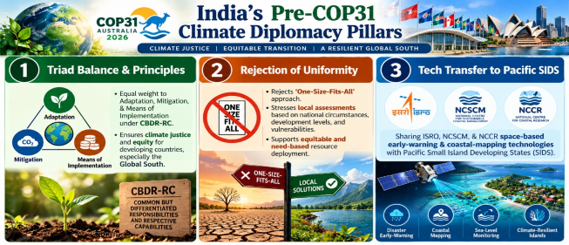
Introduction: Union Minister for Environment, Forest and Climate Change Shri Bhupender Yadav led the Indian delegation at the UNFCCC Pre-COP31 meetings co-hosted by Australia, Fiji, and Tuvalu in Fiji. India called for equal weight to be given to Adaptation, Mitigation, and Means of Implementation while emphasizing that climate action must adhere to the principles of Equity and Common but Differentiated Responsibilities and Respective Capabilities (CBDR-RC).
Strategic Rationale:
-
- Pre-COP serves as an informal ministerial preparatory conference held weeks prior to the annual UN Climate Summit (COP31 in Antalya, Türkiye, November 2026).
- Co-hosting the Pre-COP in the Pacific (Fiji & Tuvalu) highlights the existential threats faced by Small Island Developing States (SIDS) due to rising sea levels.
- India utilized the forum to oppose “one-size-fits-all” transition pathways and advocate for localized vulnerability assessments paired with adequate finance and technology transfers.
Technical Offerings:
-
- Core Negotiating Stance (CBDR-RC & Equity): Reaffirmed that historical responsibility must guide global climate obligations. Pushed for robust Means of Implementation (climate finance, technology transfer, and capacity building) so developing nations can achieve their Nationally Determined Contributions (NDCs).
- Space & Coastal Resilience Technology Sharing: Offered India’s space-based Earth observation assets and marine science capabilities to Pacific Island nations. Key institutions highlighted include:
- Indian Space Research Organisation (ISRO): Satellite-based cyclone tracking, inundation mapping, and extreme weather early-warning systems.
- National Centre for Sustainable Coastal Management (NCSCM) & National Centre for Coastal Research (NCCR): Shoreline change mapping, marine spatial planning, and coastal vulnerability indexing.
- Tuvalu Coastal Adaptation Project Showcase: Cited the project as a practical model demonstrating how international means of implementation translate into ground-level adaptation and resilience.
- Expansion of South-South Cooperation: Complements India’s engagements under the Forum for India–Pacific Islands Cooperation (FIPIC), Coalition for Disaster Resilient Infrastructure (CDRI), and the Infrastructure for Resilient Island States (IRIS) facility.
UPSC Quick Reference Table
| Feature | Detailed Specification |
| Nodal Body | Ministry of Environment, Forest and Climate Change (MoEF&CC) |
| Event & Location | Pre-COP31 Meetings (Fiji & Tuvalu) | Co-hosted by Australia, Fiji, & Tuvalu |
| Upcoming Summit | UNFCCC COP31 (Antalya, Türkiye, November 2026) |
| Core Negotiation Line | Equal weight to Adaptation, Mitigation, & Means of Implementation |
| Foundational Principles | Equity and CBDR-RC (Common but Differentiated Responsibilities) |
| Tech Transfer Offer | Space-based early warnings & coastal spatial mapping via ISRO, NCSCM, and NCCR |
Conclusion:
India’s stance at the Pre-COP31 meeting reinforces its role as a leading voice for the Global South by linking the principles of equity and CBDR-RC with tangible offers of space-based and coastal management technologies.
Spread the Word