TOPIC-1: Structural and Procedural Reforms in the Coal Sector
-
- GS Paper 3 (Indian Economy and issues relating to planning, mobilization of resources, growth, development; Infrastructure: Energy; Clean coal technology, logistics, and environmental sustainability).
Overview: The Ministry of Coal has undertaken a series of structural, regulatory, and technological reforms over the past five years to modernize coal allocation, enhance transparency, and promote sustainable mining. Driven by commercial coal auctions and digital monitoring, domestic coal production crossed the 1 Billion Tonne mark for two consecutive years, reaching 1,047.52 MT in FY 2024–25 and 1,039 MT in FY 2025–26.
Market-Based Reforms
1. Commercial Mining & Price Discovery
-
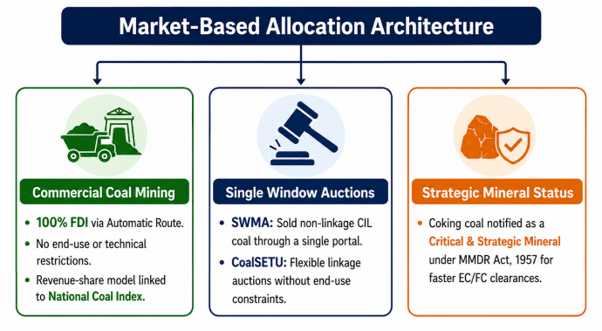
- Market-Linked Allocations: Transitioned from physical allotment to competitive open auctions based on a percentage revenue-share model linked to the National Coal Index (NCI).
- Investment Facilitation: 100% Foreign Direct Investment (FDI) allowed under the automatic route with zero technical/financial entry barriers.
- Insurance Surety Bonds: Permitted as an alternative to Bank Guarantees for Performance Security in Coal Block Agreements to release blocked working capital.
2. Allocation Streamlining & Coal Exchange
-
- CoalSETU & SWMA: Single Window Mode Agnostic (SWMA) auction unifies non-linkage coal sales. CoalSETU allows non-regulated sector linkage buyers complete flexibility for self-consumption, washing, or export.
- Coal Exchange Rules, 2026: Formally notified to establish a regulated online trading platform for spot and forward delivery-based coal contracts.
Technology Adoption
-
- Mission Coking Coal: Scaling national coal washery capacity to 58 MT by FY 2030 to reduce coking coal import dependency for steel making.
-
- First Mile Connectivity (FMC): Part of the Integrated Coal Logistics Plan to replace road transportation with mechanized conveyor belts and rapid loading systems; 72 out of 139 FMC projects (~589 MT capacity) are already operational.
- Mine Modernization: Deployment of Surface Miners for blast-free extraction, drone/satellite mapping, RFID-enabled weighbridges, and AI-based video analytics in Coal India’s Integrated Command and Control Centres (ICCC).
UPSC Quick Reference Table
| Reform Area | Key Feature / Indicator |
| Nodal Ministry | Ministry of Coal |
| Production Benchmark | >1 Billion Tonnes (1,047.52 MT in FY 25; 1,039 MT in FY 26) |
| Commercial Mining FDI | 100% FDI via Automatic Route |
| Statutory Status | Coking Coal classified as Critical & Strategic Mineral (MMDR Act, 1957) |
| Trading Regulatory Tool | Coal Exchange Rules, 2026 |
| Clean Coal Target | 100 MT Coal Gasification by 2030 (backed by ₹46,000 Cr schemes) |
| Logistics Plan | 139 FMC Projects (1,319 MT total target capacity) |
Conclusion:
Transitioning from administrative allotment to market-based revenue sharing, introducing the Coal Exchange Rules 2026, and scaling clean coal gasification align the coal sector with India’s energy needs. Balancing production growth above 1 billion tonnes with First Mile Connectivity logistics and renewable energy targets helps maintain energy security while advancing industrial decarbonization.
TOPIC-2: 200th Report of Parliamentary Standing Committee on Commerce: Evaluation of India–US Trade Relations
-
- GS Paper 2 (Bilateral, regional, and global groupings involving India; Effect of policies and politics of developed/developing countries on India’s interests – US Tariff & Trade Policy; Parliamentary Committees and their reports);
- GS Paper 3 (Effects of globalization on the economy; Changes in industrial policy; Export promotion, MSMEs, and Supply Chain Resilience).
Context: The Department-Related Parliamentary Standing Committee on Commerce presented its 200th Report on ‘Evaluation of India – US Trade Relations’ to Parliament. The report evaluates the impact of fluctuating US tariff measures (including an 18% tariff regime and Section 232/301 actions), non-tariff barriers (NTBs), and exchange rate volatility (~₹95/USD) on key Indian export sectors.
Strategic Framework
-
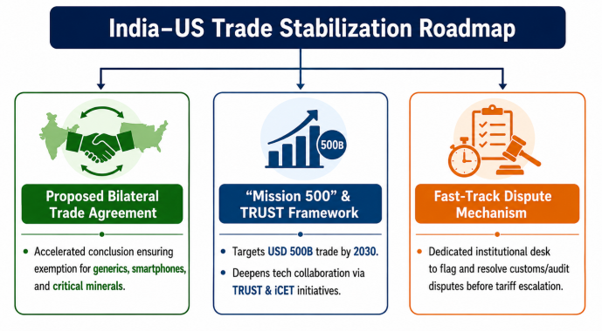
- Mission 500 & TRUST Framework: Time-bound roadmap to reach $500 billion in two-way trade, leveraging the Transforming the Relationship Utilizing Strategic Technology (TRUST) and iCET (Initiative on Critical and Emerging Technologies) frameworks for semiconductors, clean energy, AI, and critical minerals.
- Bilateral Trade Agreement (BTA): Recommends concluding a comprehensive BTA while securing explicit tariff exemptions for key Indian exports like generic pharmaceuticals, smartphones, critical minerals, auto components, and steel/aluminum products.
- Services Trade Dynamics: Services trade doubled from $40.53 billion (2014) to $98.52 billion (2024). India’s services exports stand at $51.20 billion (11.58% CAGR), while imports reached $47.32 billion (18.68% CAGR), highlighting the need to boost high-value knowledge exports (AI, digital health, Global Capability Centres).
Sectoral Vulnerabilities
1. Engineering & Automotive Sector
-
- MSME Export Resilience Scheme: Targeted interest subsidies and technical guidance for small component makers facing buyer-specific specification constraints.
- National Re-Tooling Fund: Matching grants for product re-design, prototype development, and foreign technical certifications needed to pivot to new global supply chains.
2. Gems & Jewellery Sector
-
- Tariff Parity Efforts: Urgent bilateral talks to address the 48% export decline caused by 2025 US tariff measures and achieve parity with competitors like Mexico, Canada, and Switzerland.
- Alternative Hubs: Institutionalize “India Jewellery Trade and Distribution Hubs” in Hong Kong, Thailand, and the UK with duty-free consignment warehousing.
3. Marine Products & Aquaculture
-
- Overcoming US Trawl Bans: Fast-track subsidized deployment of ICAR-CIFT developed Turtle Excluder Devices (TEDs) on mechanized trawlers to secure US NOAA compliance and lift restrictions on wild-caught shrimp.
- Aquaculture Self-Reliance: Reduce reliance on US imports for broodstock and feed by promoting domestic Specific Pathogen Free (SPF) broodstock breeding.
4. Textiles, Handlooms & Artisans
-
- PM MITRA & MMF Clusters: Create dedicated Man-Made Fibre (MMF) clusters within PM MITRA parks to shift away from cotton dependency.
- US Warehousing Hubs: Establish government-subsidized textile warehousing near major US ports to reduce delivery lead times and bypass middle-agent costs.
- RoSCTL Emergency Relief: Compensate MSME exporters facing price-cut demands from US buyers to prevent factory closures and job losses.
5. Agriculture, Chemicals & Critical Minerals
-
- Phytosanitary Infrastructure: Establish automated Irradiation and Vapour Heat Treatment (VHT) facilities near export hubs to meet US standards; set up a Permanent Agricultural Trade Facilitation Cell.
- Pre-Clearance Protocols: Establish joint pre-clearance testing with the USFDA at Indian ports to prevent food consignment rejections at US borders.
- National Critical Minerals Mission: Leverage frameworks like FORGE, IPEF, and QUAD to integrate Indian processors into global value chains for rare earths and battery materials.
UPSC Quick Reference Table
| Aspect / Indicator | Details & Parliamentary Recommendation |
| Nodal Committee | Department-Related Parliamentary Standing Committee on Commerce |
| Chairperson | Ms. Dola Sen, M.P. (Rajya Sabha) |
| Report Title | 200th Report: ‘Evaluation of India – US Trade Relations’ |
| Core Target | “Mission 500” — USD 500 Billion Bilateral Trade by 2030 |
| Key Macro Factors | Exchange rate (~₹95/USD) & elevated US tariff regime (~18%) |
| Services Trade (2024) | $98.52 Billion (Exports: $51.20B | Imports: $47.32B) |
| Marine Seafood Mandate | Mandatory rollout of ICAR-CIFT Turtle Excluder Devices (TEDs) |
| Institutional Mechanisms | DGFT Watch Desk for US Customs Audits & Trade Policy Forum (TPF) revival |
Conclusion:
By combining defensive measures—such as MSME resilience schemes, TED rollouts, and pre-clearance facilities—with offensive strategies like PLI expansion, MMF textile clusters, and critical mineral partnerships, the report provides a roadmap to protect domestic employment while working toward the $500 billion trade target.
TOPIC-3: GOBARdhan – National Circular Bioenergy Scheme
-
- GS Paper 2 (Government policies and interventions for development in various sectors);
- GS Paper 3 (Energy Security, Renewable Energy – Compressed Biogas; Sustainable Agriculture, Circular Economy, and Environmental Conservation).
Overview of the Scheme: The Union Cabinet, chaired by Prime Minister Shri Narendra Modi, approved GOBARdhan: The National Circular Bioenergy Scheme, with a total outlay of ₹23,731 crore. Implemented by the Ministry of Petroleum and Natural Gas (MoPNG) from FY 2026–27 to FY 2035–36 (10-year period), the Central Sector Scheme consolidates existing initiatives (such as SATAT, MDA, BAM, and DPI) into a single national framework to accelerate Compressed Biogas (CBG) production nearly ten-fold.
Strategic & Economic Rationale
The Six Growth Engines under GOBARdhan
| Component | Policy Mechanism & Financial Features |
|---|---|
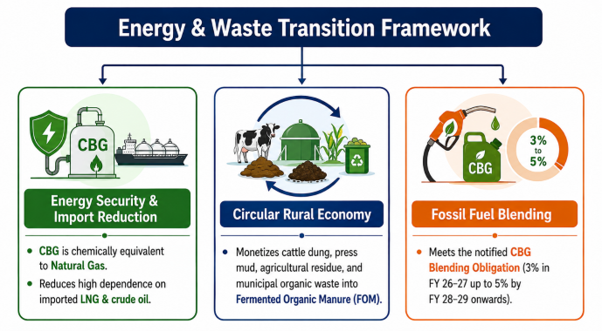
| 1. Assured CBG Offtake | Enforces the CBG Blending Obligation for City Gas Distribution (CGD) networks: 3% (FY 2026–27), 4% (FY 2027–28), and 5% (FY 2028–29 onwards) across CNG (Transport) and PNG (Domestic) segments. |
| 2. Stable CBG Pricing Framework | Introduces a stable administered CBG price of ₹2,110 per MMBTU (Metric Million British Thermal Unit) with a 10-year minimum horizon to ensure bankability and stable developer returns. |
| 3. Capital Assistance | Provides capital subsidy of up to ₹2 crore per Ton Per Day (TPD) of installed capacity for greenfield/brownfield CBG plants, covering core machinery, feedstock aggregation, and organic manure processing assets. |
| 4. Pipeline Infrastructure | Supports cluster-based and standalone pipeline connections linking CBG units directly to regional trunk pipelines and City Gas Distribution (CGD) grids. |
| 5. Credit Guarantee Support | Institutional risk-sharing mechanism providing credit guarantees to MSMEs, women entrepreneurs, and rural developers to reduce collateral requirements. |
| 6. CBG Ecosystem Challenge Fund | District-level fund supporting biomass resource mapping, feedstock aggregation, technology adoption, capacity building, and organic manure value addition. |
UPSC Quick Reference Table
| Feature | Detailed Specification |
| Nodal Ministry | Ministry of Petroleum and Natural Gas (MoPNG) |
| Total Scheme Outlay | ₹23,731 Crore |
| Implementation Window | FY 2026–27 to FY 2035–36 (10 Years) |
| Administered Price | ₹2,110 per MMBTU |
| Capital Subsidy | Up to ₹2 Crore per TPD installed capacity |
| Blending Mandate | 3% (2026–27) → 4% (2027–28) → 5% (2028–29 onwards) |
| Key By-Products | Fermented Organic Manure (FOM) & Liquid FOM (LFOM) |
Conclusion:
The GOBARdhan scheme unifies earlier bioenergy programs under a single platform offering assured offtake, stable pricing, and capital assistance. Converting agricultural waste, cattle dung, and municipal organic matter into Compressed Biogas helps expand domestic clean energy production, reduce LNG imports, and support rural bioeconomy growth.
TOPIC-4: Government Initiatives to Boost Space Technology Manufacturing & Private Participation
-
- GS Paper 3 (Science & Technology – Developments and their applications, indigenization of technology, space technology, private sector participation in space, and start-up ecosystem).
Overview: In a written reply in the Rajya Sabha, Dr. Jitendra Singh outlined key initiatives implemented by the Department of Space and IN-SPACe (Indian National Space Promotion and Authorization Centre). These measures support non-government entities (NGEs), space startups, and MSMEs to transition India’s space ecosystem from a state-monopolized sector toward commercial manufacturing, indigenous innovation, and private participation.
Core Financial
1. Specialized Financial & Funding Mechanisms
-
- ₹1,000 Crore Space Venture Capital (VC) Fund: Dedicated fund designed to address early-stage capital requirements and scale up space technology startups.
- ₹500 Crore Technology Adoption Fund (TAF): Created to accelerate the development, demonstration, and commercialization of indigenous, flight-ready space technologies.
- Liberalized FDI Policy: Eased Foreign Direct Investment limits across satellite manufacturing, launch vehicle operation, and component fabrication to attract global capital.
2. Infrastructure Access & Technology Transfer
-
- Discounted Infrastructure Pricing: Allows Non-Government Entities (NGEs) affordable access to ISRO’s launch pads, environmental test facilities, and ground tracking stations.
- Technology Transfer (ToT): Facilitates the transfer of ISRO-developed technologies, patents, and manufacturing processes to domestic private enterprises.
- Dedicated Technical Centre: Establishes centralized facilities providing low-cost testing, thermal-vacuum validation, and hardware-in-the-loop simulation for private payloads.
3. Platform-Level & Industrial Initiatives
-
- POEM (PSLV Orbital Experimental Module): Provides private space entities, academia, and startups with a low-cost microgravity platform to validate satellite subsystems and space payloads in orbit using the spent fourth stage () of the PSLV.
- Satellite Bus as a Service (SBaaS): Standardized, indigenous satellite bus architecture to help startups rapidly integrate payloads without building basic spacecraft systems from scratch.
- Manufacturing Clusters: Encourages State Governments to establish dedicated space manufacturing hubs and common test infrastructure.
UPSC Quick Reference Table
| Initiative / Platform | Primary Strategic Objective |
| Nodal Agencies | Department of Space (DoS) & IN-SPACe |
| Venture Capital Fund | ₹1,000 Crore for early and growth-stage space startups |
| Technology Adoption Fund | ₹500 Crore for commercializing indigenous space tech |
| In-Orbit Testing Tool | POEM Platform (PSLV orbital experimental stage) |
| Modular Platform Scheme | Satellite Bus as a Service (SBaaS) |
| Regulatory & Outreach Body | IN-SPACe (PAN-India authorization & technical support) |
Conclusion:
Combining liberalized FDI rules, dedicated venture capital funding, technology transfers, and in-orbit testing via POEM creates a supportive regulatory and financial framework for private space enterprises. Streamlining access to ISRO facilities and supporting modular satellite platforms (SBaaS) helps move the domestic private space industry from basic research toward commercial satellite manufacturing and launch services.
Spread the Word