Introduction:
On 31 March 2026, India achieved a historic internal security milestone by becoming effectively free from Left Wing Extremism (LWE), with no district remaining LWE-affected. This transformation resulted from a multi-dimensional strategy combining security operations, infrastructure development, rehabilitation of surrendered cadres and improved governance.
What is Left Wing Extremism (LWE)?
Left Wing Extremism (LWE), commonly known as Naxalism, is an armed insurgency inspired by Maoist ideology, advocating the overthrow of the State through violent revolution.
Background
-
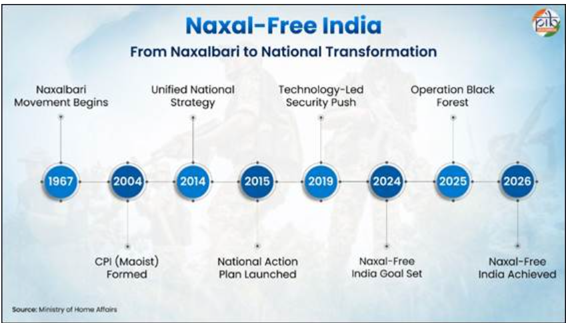
- Originated from the Naxalbari Movement (West Bengal, 1967).
- Several extremist groups merged to form the CPI (Maoist) in 2004.
- The movement primarily affected tribal and forest regions across the Red Corridor.
- At its peak, it was regarded as India’s biggest internal security challenge.
Evolution
Why Did Naxalism Flourish?
-
- Poor governance and weak State presence.
- Underdevelopment of tribal and remote regions.
- Lack of road, telecom and banking connectivity.
- Limited access to education, healthcare and livelihoods.
- Exploitation and alienation of tribal communities.
- Weak coordination among States in counter-insurgency operations.
Peak of Violence (2004–2014): The decade between 2004 and 2014 witnessed the most violent phase of Left-Wing Extremism.
| Indicator | Status |
|---|---|
| Violent incidents (2004–14) | 17,542 |
| Security personnel killed | 1,913 |
| Civilians killed | 5,019 |
| Peak year | 2010 |
| Incidents in 2010 | 1,936 |
| Civilian deaths in 2010 | 720 |
Policy Shift after 2014: A major strategic shift occurred with the adoption of the National Policy & Action Plan (2015), replacing the earlier fragmented approach with a Whole-of-Government strategy. Unlike earlier incident-driven responses, the Government adopted an integrated framework based on: Dialogue, Security, and Coordination. This ensured simultaneous action against insurgency while addressing its socio-economic roots.
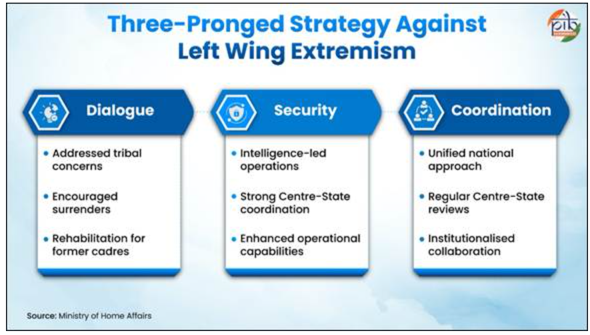
National Policy- The National Policy & Action Plan became the cornerstone of India’s anti-LWE strategy like-
-
- Deployment of Central Armed Police Forces (CAPFs).
- Modernisation of State Police Forces.
- Security Related Expenditure (SRE) Scheme. ₹3,805.04 crore released since 2014–15 to support Security operations, Capacity building, Training, Rehabilitation of surrendered cadres & Ex gratia assistance to martyrs’ families.
- Special Infrastructure Scheme (SIS).
- ₹4,289.20 crore released for development of LWE-affected districts.
Why was the New Strategy Successful?
The strategy worked because security, development and welfare reinforced each other.
-
- Security restored State control.
- Development generated livelihoods and connectivity.
- Welfare strengthened public trust.
- Trust encouraged surrender and rehabilitation.
- Governance ensured long-term peace and stability.
Strategies Adopted:
i). The Government systematically eliminated the security vacuum in LWE-affected areas by expanding security infrastructure, strengthening specialised forces and improving operational coordination. These measures significantly improved area domination, troop mobility, intelligence gathering and rapid response capability in remote forest regions.
| Infrastructure | Achievement |
|---|---|
| Fortified Police Stations | 663 (compared to only 66 before 2014) |
| New CAPF Camps | 408 |
| Night Landing Helipads | 68 |
| Bullet & Blast-proof Vehicles | 400 |
| Hospitals for Security Forces | 5 |
ii. A multi-layered counter-insurgency architecture was developed by integrating Central and State security forces like CoBRA (Commando Battalion for Resolute Action), CRPF, District Reserve Guard (DRG), Special Task Force (STF), Greyhounds (Andhra Pradesh), Jharkhand Jaguar, etc.
iii. Modern technology transformed India’s counter-LWE strategy from reactive policing to intelligence-driven operations like Unmanned Aerial Vehicles (UAVs), Surveillance Drones, Artificial Intelligence (AI)-based analytics, etc. These technologies enabled real-time surveillance, intelligence-based targeting and precision operations.
iv. The Government adopted a proactive operational doctrine based on:
-
-
- Trace extremist networks through intelligence.
- Target leadership and logistics.
- Neutralise armed cadres through coordinated operations.
-
v. Several coordinated operations significantly weakened Maoist organisational capabilities like Operation Black Forest, Operation Octopus, Operation Double Bull, Operation Thunderstorm, Operation Bhimbarg, Operation Chakrabandha.
-
-
- Operation Black Forest eliminated more than 30 Maoists. Destroyed a major Maoist stronghold.
- Operation Double Bull resulted in: Gumla, Lohardaga, Latehar becoming Naxal-free districts.
-
vi. A dedicated Naxal Investigation Vertical was established within the NIA. Achievements (up to June 2026)
-
-
- 112 LWE cases
- 100 charge sheets
- Assets worth over ₹40 crore
-
vii. Role of Enforcement Directorate (ED)- Assets worth ₹12 crore attached.
viii. Surrender & Rehabilitation Policy- Government implemented a rehabilitation-oriented policy to encourage Maoist cadres to return to the mainstream.
Infrastructure & Connectivity:
1. Road Connectivity- Road infrastructure was expanded to improve mobility, security access and economic integration.
-
-
- 15,189 km of roads constructed under:
- Road Requirement Plan (RRP), and
- Road Connectivity Project for LWE Affected Areas (RCPLWEA).
- 15,189 km of roads constructed under:
-
2. Digital & Mobile Connectivity- Telecommunication infrastructure became a key enabler of governance and socio-economic development.
-
-
- 9,497 mobile towers commissioned.
- 44,728 villages (around 96% of villages in the most affected areas) now have mobile connectivity.
-
3. Financial Inclusion-The Government significantly expanded formal financial infrastructure in erstwhile LWE-affected districts.
| Infrastructure | Number |
|---|---|
| Bank Branches | 1,804 |
| ATMs | 1,321 |
| Banking Correspondents | 74,720 |
| Post Offices | 6,025 |
4. Education & Skill Development- Education emerged as a central pillar of long-term peace and development.
-
-
- 259 Eklavya Model Residential Schools (EMRS) sanctioned.
- 179 EMRS made functional.
- 47 Industrial Training Institutes (ITIs) established.
- 49 Skill Development Centres (SDCs) developed.
- Investment of nearly ₹800 crore.
- Over 90,000 tribal youth and women provided skill training.
-
5. Tribal Youth Exchange Programme (TYEP)- The programme promotes national integration and leadership development among tribal youth.
-
-
- 37,655 tribal youth participated since 2014.
-
6. Civic Action Programme (CAP)- The Civic Action Programme strengthens trust between security forces and local communities.
Inclusive Development: The Government complemented security operations with targeted welfare programmes aimed at improving the socio-economic conditions of tribal communities. Initiatives like
-
-
- National Policy & Action Plan (2015).
- Special Central Assistance (SCA).
- Aspirational Districts Programme (ADP).
- PM-JANMAN for Particularly Vulnerable Tribal Groups (PVTGs).
- Dharti Aaba Janjatiya Gram Utkarsh Abhiyan.
- Expansion of Eklavya Model Residential Schools (EMRS).
Case Study: Bastar Transformation (Chhattisgarh)
Bastar represents one of India’s most successful examples of development-led counter-insurgency.
-
- 1,143 personnel recruited. Around 400 local tribal youth recruited from Bijapur, Dantewada and Sukma.
- More than 3,240 km of roads constructed & 889 mobile towers installed.
- Plan prepared for around 3,000 surrendered cadres.
-
- Initial allocation of ₹20 crore for skill development and livelihood.
-
- Around 70 CAPF camps transformed into Shaheed Veer Gunda Dhur Seva Deras.
- Community Participation through Bastar Pandum & Bastar Olympics.
-
Significance of India’s Naxal-Free Achievement
i. The elimination of LWE from affected districts marks one of the largest counter-insurgency successes in independent India, restoring the authority of the State in previously inaccessible regions.
ii. India’s experience demonstrates that security operations alone cannot eliminate insurgency. Sustainable peace requires simultaneous investment in development, welfare, infrastructure and community participation.
iii. Expansion of roads, education, healthcare, financial inclusion and livelihood programmes has integrated tribal communities into the mainstream development process while reducing alienation.
iv. Improved connectivity, banking, telecom and public services have enhanced economic opportunities and investment in former conflict-affected districts.
v. Weakening Maoist networks reduces internal security threats, strengthens law and order, and allows security forces to focus on other emerging security challenges.
vi. The success reflects close coordination between the Union Government, State Governments, CAPFs, intelligence agencies and local communities, making it a successful model of cooperative federalism in internal security.
Challenges
i. The Ministry of Home Affairs (MHA) has retained 37 Legacy & Thrust Districts and 1 District of Concern, indicating the need for continued vigilance to prevent any resurgence.
ii. MP-IDSA (formerly IDSA) has consistently argued that long-term success depends on sustained governance, livelihood generation and effective implementation of welfare schemes after security operations.
iii. Studies by ORF and the Parliamentary Standing Committee on Home Affairs emphasise that issues relating to land rights, forest rights, displacement and livelihood security must continue to receive priority to prevent renewed alienation.
iv. The MHA has highlighted that dismantling the financial, logistical and ideological support ecosystem of extremist organisations remains essential for durable peace.
v. The Second Administrative Reforms Commission (ARC) and Parliamentary Committees have emphasised strengthening State Police Forces through modernisation, intelligence capabilities and community policing for long-term internal security.
Way Forward
i. Drawing lessons from Colombia’s Disarmament, Demobilisation and Reintegration (DDR) programme, rehabilitation should continue to focus on livelihood generation, education and community reintegration of surrendered cadres.
ii. Adopt community policing models similar to Japan’s Koban System, strengthening trust between local communities and police while improving intelligence gathering and early conflict resolution.
iii. Accelerate implementation of the Forest Rights Act (FRA), PESA Act and livelihood programmes to strengthen tribal self-governance and inclusive development in former LWE regions.
iv. Expand the use of AI, drones, satellite surveillance, GIS mapping and predictive analytics for continuous monitoring of vulnerable areas and prevention of extremist regrouping.
v. Continue investments in education, healthcare, digital connectivity, skill development and employment generation, ensuring that development gains remain irreversible.
Conclusion:
However, challenge now is to consolidate these gains so that the regions once affected by Left Wing Extremism become enduring examples of peace and balanced development.
Spread the Word