
Indian Polity & Governance
Progress of Digital Public Infrastructure in India:
Context
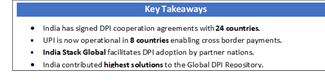
The government highlighted the role of Digital Public Infrastructure (DPI) in expanding financial inclusion and digital services.
-
- Digital Public Infrastructure refers to shared digital platforms that support public services and economic activities.
- Key components of India’s DPI include:
- Aadhaar
- Unified Payments Interface
- DigiLocker.
- Aadhaar provides a unique digital identity to residents of India.
- UPI enables instant real-time bank-to-bank digital payments.
- DigiLocker allows citizens to store and access official documents digitally.
- DPI supports financial inclusion and digital governance.
- Digital platforms reduce transaction costs and improve transparency.
- India’s DPI model is being studied by several developing countries.
(PIB)
International Relations
India–European Union Trade Negotiations:
Context
India and the European Union continued negotiations for a comprehensive Free Trade Agreement (FTA) aimed at increasing bilateral trade, investment, and technology cooperation.
-
- The EU is one of India’s largest trading partners, accounting for a significant share of India’s external trade.
- An FTA seeks to reduce or eliminate tariffs on goods and services between countries.
- Negotiations between India and the EU also include investment protection agreements.
- The EU consists of 27 member states and operates a single market allowing free movement of goods, services, capital and people.
- Trade agreements often include provisions related to:
- Intellectual property rights
- Sustainable development
- Digital trade.
- The EU has exclusive competence over trade policy for all its member states.
- India already has FTAs with several partners including ASEAN and Japan.
- Trade agreements aim to boost exports, foreign investment and supply chain integration.
- However, they also raise concerns regarding domestic industry protection and regulatory standards.
(TH)
Economy
RBI and Financial Stability Monitoring:
Context
The Reserve Bank of India reiterated its focus on maintaining financial stability amid global economic uncertainties.
-
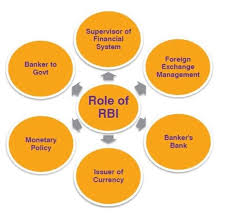
- The RBI is India’s central banking institution, established in 1935.
- It regulates the banking system and monetary policy.
- Monetary policy tools used by RBI include:
- Repo rate
- Reverse repo rate
- Cash Reserve Ratio (CRR)
- Statutory Liquidity Ratio (SLR).
- The repo rate is the rate at which RBI lends money to commercial banks.
- CRR refers to the minimum proportion of deposits banks must maintain with RBI in cash.
- RBI also manages foreign exchange reserves of India.
- Financial stability involves ensuring the sound functioning of banks and financial institutions.
- RBI acts as the lender of last resort.
- It supervises banks through mechanisms such as prudential regulations and inspections.
(ET)
Geography, Mapping, Ecology & Environment and DM
Global Biodiversity Conservation Efforts:
Context
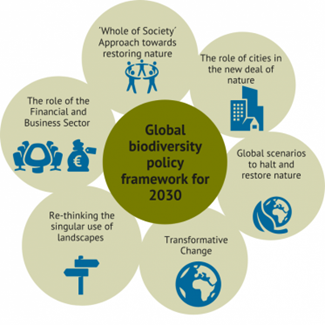
Countries discussed strengthening implementation of global biodiversity conservation commitments.
-
- Global biodiversity conservation is guided by the Convention on Biological Diversity (CBD).
- The CBD was adopted at the Rio Earth Summit in 1992.
- It has three main objectives:
- Conservation of biodiversity
- Sustainable use of biological resources
- Fair sharing of benefits arising from genetic resources.
- Member countries prepare National Biodiversity Strategies and Action Plans (NBSAPs).
- Biodiversity includes genetic, species and ecosystem diversity.
- Major threats to biodiversity include:
- Habitat loss
- Climate change
- Pollution
- Overexploitation.
- Protected areas such as national parks and biosphere reserves help conserve biodiversity.
- Biodiversity is essential for ecosystem services, including pollination, nutrient cycling and climate regulation.
- Loss of biodiversity can reduce ecosystem resilience.
(TH)
Expansion of India’s Green Hydrogen Programme:
Context
The Government highlighted progress under the National Green Hydrogen Mission, aimed at making India a global hub for production and export of green hydrogen.
-
- Green hydrogen is hydrogen produced through electrolysis of water using renewable electricity.
- It produces zero carbon emissions at the point of production.
- Hydrogen can be used as:
- Industrial fuel
- Energy storage medium
- Clean transportation fuel.
- Electrolysis splits water into hydrogen and oxygen using electric current.
- Hydrogen can be stored and transported in the form of:
- Ammonia
- Liquid hydrogen
- Compressed gas.
- Green hydrogen is considered crucial for decarbonizing hard-to-abate sectors such as:
- Steel
- Fertilizers
- Shipping.
- India aims to become a major exporter of green hydrogen and derivatives.
- Hydrogen is the most abundant element in the universe, but it rarely occurs freely on Earth.
- Unlike fossil fuels, hydrogen combustion produces water as the primary by-product.
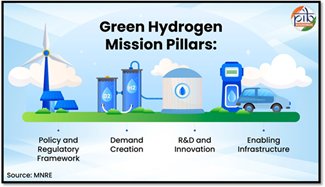
(PIB)
Conservation of Mangrove Ecosystems:
Context
Environmental experts highlighted the ecological importance of mangrove ecosystems and the need for their conservation.
-
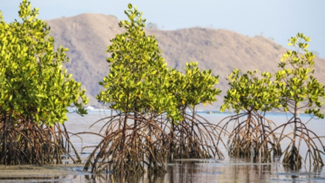
- Mangroves are salt-tolerant trees and shrubs found in tropical and subtropical coastal areas.
- They grow in intertidal zones where seawater and freshwater mix.
- Mangrove ecosystems provide natural coastal protection against storms and erosion.
- They serve as nursery habitats for many marine species.
- Mangroves store large amounts of blue carbon in their biomass and sediments.
- India has significant mangrove cover in regions such as the Sundarbans.
- Mangrove loss is caused by coastal development, aquaculture, and pollution.
- Conservation programmes aim to restore degraded mangrove ecosystems.
(TH)
Global Climate Monitoring Report:
Context
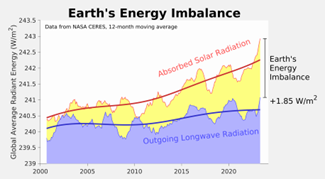
Climate scientists highlighted continuing increases in global temperatures and greenhouse gas concentrations.
-
- Climate change is primarily driven by increased greenhouse gas emissions.
- Major greenhouse gases include:
- Carbon dioxide (CO₂)
- Methane (CH₄)
- Nitrous oxide (N₂O).
- CO₂ remains the largest contributor to anthropogenic climate change.
- Methane has a higher global warming potential than CO₂ over short periods.
- Rising temperatures contribute to:
- Melting glaciers
- Sea-level rise
- Extreme weather events.
- The Paris Agreement aims to limit global warming to well below 2°C above pre-industrial levels.
- Countries submit Nationally Determined Contributions (NDCs) under the agreement.
- Climate mitigation includes renewable energy, energy efficiency, and carbon sequestration.
(TH)
Science & Technology
Advances in India’s Space Technology:
Context
India’s space sector continues to expand with new missions and increased participation of private companies.
-
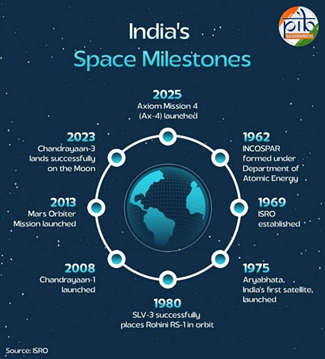
- India’s space programme is managed by the Indian Space Research Organisation.
- ISRO was established in 1969.
- Major launch vehicles include:
- PSLV
- GSLV
- LVM3.
- The PSLV is known for its high reliability and capability to launch multiple satellites.
- India launched the Mars Orbiter Mission (Mangalyaan) in 2013.
- The Chandrayaan missions focus on lunar exploration.
- Satellite applications support:
- Communication
- Navigation
- Weather forecasting
- Disaster management.
- India has opened its space sector to private participation through reforms.
- Space technology plays an important role in national security and economic development.
(IE)
India’s Semiconductor Manufacturing Initiative:
Context
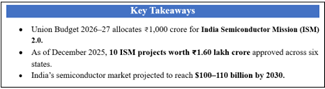
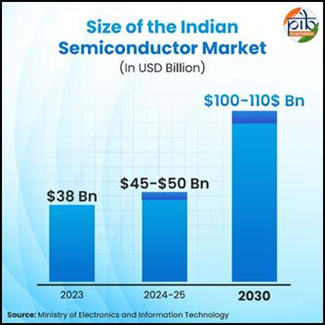
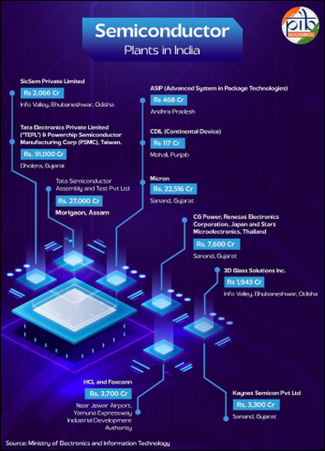
India intensified efforts to develop a domestic semiconductor manufacturing ecosystem to reduce import dependence and strengthen supply chains.
-
- Semiconductors are materials whose electrical conductivity lies between conductors and insulators.
- Silicon is the most widely used semiconductor material.
- Semiconductor chips are essential for:
- Computers
- Smartphones
- Automobiles
- Telecommunications equipment.
- Chip manufacturing requires ultra-clean fabrication facilities called fabs.
- Semiconductor fabrication involves complex processes such as:
- Photolithography
- Etching
- Doping.
- Global semiconductor production is heavily concentrated in East Asia.
- Semiconductor shortages during the pandemic exposed global supply chain vulnerabilities.
- Countries are promoting domestic chip production to ensure technological sovereignty.
- The semiconductor industry is highly capital intensive and technologically complex.
(ET)
Spread the Word