Indian Polity & Governance
Expansion of Supreme Court Judge Strength:
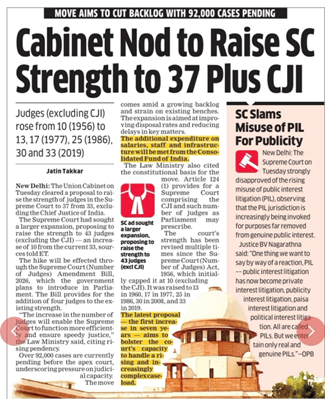
Context: The Cabinet approved raising the Supreme Court of India’s authorized judge strength, taking it to 37 (including the CJI) from 33, aimed at reducing case pendency.
-
- Constitutional provision: Article 124(1) authorizes Parliament to determine the number of judges.
- Appointment: Judges are appointed by the President via the Collegium system.
- Eligibility: Must be a citizen and served as a High Court judge for 5 years or an advocate for 10 years.
- Age limit: Retirement age for Supreme Court judges is 65 years.
- Removal: Impeachment process by Parliament, followed by a Presidential order.
- Ad-hoc appointments: Article 127 allows for ad-hoc judges when a quorum is lacking.
- Impact: Aims to enhance judicial capacity for faster dispute resolution.
- Historical precedent: The strength has been increased periodically to manage workload.
(PIB)
SC Flags “Danger” of Masquerading as Transgender for Benefits:
Context: The Supreme Court flagged the potential misuse of transgender status to claim reservations and welfare benefits while hearing challenges to the Transgender Persons (Protection of Rights) Amendment Act, 2026.
-
- Core issue: The court highlighted the “danger” of individuals falsely identifying as transgender to avail himself of government jobs and quotas.
- Amendment Act 2026: The new law mandates a government-appointed medical board recommendation for a District Magistrate to issue a transgender certificate.
- Controversy: Petitions argue that mandatory medical screening violates the right to self-identification established in the NALSA vs. Union of India (2014)
- Article 21 relevance: The right to choose one’s gender identity is considered a part of the Right to Life and Liberty.
- State vs. Individual: The government argues that “objective verification” is necessary to prevent fraud in public employment.
- Reservations: Transgender persons in several states (like Karnataka) have been granted horizontal reservations in government services.
- District Magistrate role: The DM remains the certifying authority but now lacks discretionary power without the medical board’s report.
- International standards: Many global bodies advocate for self-declaration without medical intervention.

(TH)
Economy
Medical and Wellness Tourism Strategy:
Context: Medical and Wellness Tourism as a strategic sector combining healthcare, economy, and soft power.
|
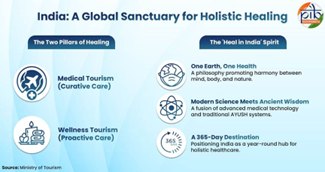
India is emerging as a leading hub for Medical Value Travel (MVT) by integrating advanced medical infrastructure with traditional wellness systems such as AYUSH. Strong policy support, digital facilitation, and initiatives like AYUSH Visa and Regional Medical Hubs are strengthening the ecosystem. Rising global healthcare costs and demand for holistic care are driving international patients to India for affordable, high-quality treatment and preventive wellness solutions. |
-
- Medical Value Travel (MVT): Combines curative tourism (surgeries) with wellness (AYUSH).
- Heal in India Initiative: A government portal to facilitate foreign patients’ medical journeys.
- AYUSH Visa: A special visa category introduced to promote traditional Indian medicine systems.
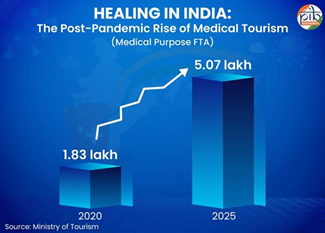
- Economic impact: Medical tourism is expected to grow significantly, contributing billions to India’s GDP.
- Soft power: Positioning India as the “Pharmacy of the World” and a global hub for holistic health.
- Accreditation: Role of the National Accreditation Board for Hospitals & Healthcare Providers (NABH).
- Cost advantage: Medical procedures in India cost 1/10th of those in the US or UK.
- JCI standards: Several Indian hospitals are Joint Commission International (JCI) accredited.
|
Institutional Mechanism for Medical and Wellness Tourism To ensure coordinated development of Medical Value Travel, the Government has established an institutional framework. National Medical & Wellness Tourism Promotion Board (NMWTB): Constituted by the Ministry of Tourism in 2015, chaired by the Union Minister for Tourism. It promotes and facilitates medical and wellness tourism in India. Multi-stakeholder platform: The Board brings together ministries, state governments, hospitals, wellness centres, accreditation bodies, and industry stakeholders. Together, they strengthen the Medical Value Travel ecosystem. State-level coordination: States are encouraged to establish dedicated Medical and Wellness Tourism Promotion Boards or cells to support regional development and promotion. |
(PIB)
Science & Technology
National Conference on Rare Diseases:
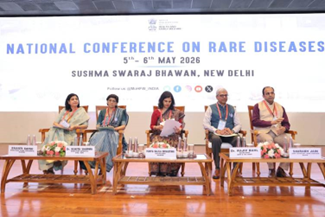
Context: The Union Ministry of Health and Family Welfare inaugurated a two-day National Conference on Rare Diseases in New Delhi, to address diagnosis and affordable treatment.
-
- Definition: Rare diseases are health conditions with low prevalence (less than 1 in 1,000–2,500 people globally).
- National Policy for Rare Diseases (NPRD) 2021: Aimed at lowering the cost of treatment through domestic R&D.
- Financial support: Provides up to ₹50 lakh for patients of all categories of rare diseases at identified Centres of Excellence.
- Categorization: Group 1 (one-time curative), Group 2 (long-term/permanent but low cost), and Group 3 (high cost/long-term).
- Diagnosis challenges: Average time for diagnosis in India is often several years due to a lack of awareness.
- Genetic basis: Nearly 80% of rare diseases have a genetic origin.
- Crowdfunding: The policy includes a digital platform for voluntary crowdfunding.
- Orphan drugs: Drugs for rare diseases are called “orphan drugs” because they are not profitable to produce without government incentives.
(PIB)
Cabinet Approval for Semiconductor Units:
Context: The Union Cabinet approved two new semiconductor manufacturing units, with an investment exceeding ₹3,900 crore.
-
- Semicon India Programme: Aimed at making India a global hub for semiconductor design and manufacturing.
- Incentives: Modified Programme for Development of Semiconductors and Display Manufacturing Ecosystem.
- Fiscal support: 50% of the project cost on a pari-passu basis for semiconductor fabs.
- Strategic importance: Reducing dependence on imports, especially for the automotive and electronics sectors.
- Technology transfer: Collaborations with global players for advanced nodes.
- Employment: Expected to create thousands of high-tech direct and indirect jobs.
- Supply chain resilience: Aimed at mitigating global supply chain shocks (like those seen in 2021).
- Compound semiconductors: Focus on specialized chips used in EVs and power electronics.

(PIB+DD)
Government Schemes & Initiatives
“Mission for Cotton Productivity” launched:
Context: The Union Cabinet approved the “Mission for Cotton Productivity” with an outlay of ₹5,659.22 crore to boost yield and achieve self-sufficiency by 2030-31.
-
- Objective: Enhancing cotton yield to bridge the gap between current production and global averages, aiming for self-sufficiency by 2030-31.
- Implementation: Nodal responsibility falls under the Ministry of Agriculture and Farmers Welfare.
- Key techniques: Promotion of High-Density Planting System (HDPS) and climate-resilient, pest-resistant seed varieties.
- Quality control: Utilization of blockchain technology to ensure quality in “Kasturi Cotton India.”
- Value chain: Focus on strengthening the textile sector’s competitiveness through improved productivity.
- Coordination: Involves inter-ministerial efforts (Agriculture, Textiles, Commerce).

(PIB)
Spread the Word