
Indian Polity & Governance
Structural Deficits in Indian Healthcare (CHC Shortfalls):
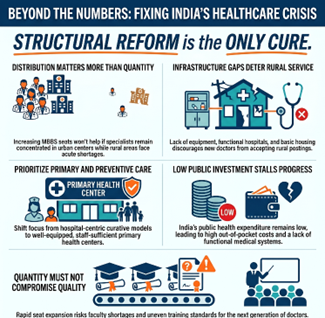
Context: A persistent 79.9% specialist vacancy rate in Community Health Centres (CHCs).
-
- The gap: Only 4,413 specialists are available against a required 21,964.
- Infrastructure paradox: While 5,491 CHCs exist, only 882 are fully functional with required staff.
- Medical colleges: 43 new colleges were approved for 2025-26, but 27 of these are private with no public service obligations.
- Aspirational districts: Zero specialists in many CHCs in these districts, forcing patients to travel hundreds of kilometres.
- Constitutional obligation: Failure to staff CHCs is seen as a violation of Article 21 (Right to Life).
- Legal Precedent: Paschim Banga Khet Mazdoor Samity v. State of WB is cited regarding the state’s duty to provide healthcare.
- Urban bias: Tertiary hospitals in cities are often overstaffed compared to rural primary/secondary tiers.
- Resource waste: States often build infrastructure to claim central funds but fail to provide operational budgets for salaries.
- Shortfall: A specialist deficit of approximately 17,500 has persisted for a decade.
- Specialities: Most vacant roles are for surgeons, obstetricians, gynaecologists, and paediatricians.
(TH)
Supreme Court on Election Commission Appointments:
Context: The Supreme Court (SC) clarified its stance on the appointment process of the Chief Election Commissioner (CEC) and ECs.
-
- Temporary role: The SC stated that the inclusion of the Chief Justice (CJI) in the selection committee was a temporary measure.
- Legislative prerogative: The 2023 ruling was meant to fill a vacuum until Parliament enacted a specific law.
- Current law: A new law (The Chief Election Commissioner and other Election Commissioners Act) now governs appointments.
- Separation of Powers: The court emphasised it cannot permanently usurp the legislative domain for executive appointments.
- Selection panel: Under the current law, the panel consists of the PM, a Union Cabinet Minister, and the Leader of the Opposition.
- Constitutional provision: Appointments are made under Article 324(2).
- Judicial review: While the court stepped back, it remains open to reviewing if the current process maintains “institutional integrity”.
- Independence: The debate continues over the exclusion of the CJI from the selection panel.
- Tenure: The Act fixes the tenure at six years or up to 65 years of age.
- Historical context: Responds to petitions challenging the 2023 legislative change that removed the CJI from the panel.
(TH)
International Relations
India-Japan Quantum & Health Research Pact:
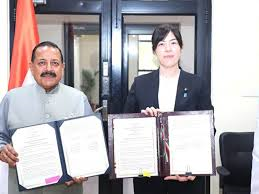
Context: India and Japan signed major agreements to bolster cooperation in emerging technologies.
-
- Quantum tech: Collaboration on quantum computing and cryptography for secure communications.
- Health research: Joint research on genomics and personalized medicine.
- Innovation hub: Proposal to set up a joint India-Japan “Deep-Tech” startup hub.
- Supply chain: Strengthening the Supply Chain Resilience Initiative (SCRI) for semiconductors.
- AI governance: Mutual agreement on ethical standards for Artificial Intelligence.
- Disaster resilient infra: Japan to assist in deploying smart sensors for landslide and flood monitoring.
- Clean energy: Expanding the “Green Hydrogen” partnership to include marine transport.
- Space: Joint lunar exploration mission (LUPEX) progress review.
- Education: Skill development programs for Indian youth in Japanese nursing and caregiving.
- Global context: Aimed at countering regional technological dominance by non-partner states.
(TOI)
India-EU EV Battery Recycling Initiative:
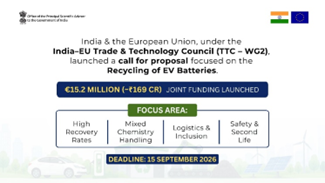
Context: Launched €15.2 Million/~₹169 Crore Joint Initiative under the India-EU Trade & Technology Council (TTC) to boost circular economy practices.
-
- Forum: Working Group 2 on Green and Clean Energy Technologies.
- Primary goal: To secure critical raw materials like Lithium, Cobalt, and Nickel.
- Circular economy: Aims to develop a “closed-loop” system for Electric Vehicle (EV) batteries.
- SMEs support: Focuses on matching Indian startups with EU recyclers.
- Strategic autonomy: Reducing dependence on single-source suppliers (notably China) for battery materials.
- Standards: Aligning Indian recycling standards with the EU’s strict “Battery Passport” regulations.
- Environmental impact: Reducing the carbon footprint of battery production.
- Technology transfer: Facilitating the exchange of high-efficiency hydrometallurgical recycling techniques.
- Urban mining: Promotion of “urban mining” to recover minerals from spent batteries.
- Bilateral ties: Strengthens the green partnership pillar of the India-EU 2025 Roadmap.
(PIB)
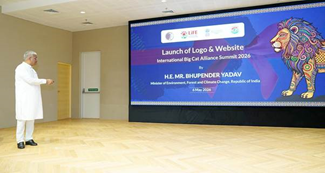
International Big Cat Alliance (IBCA) Summit:
Context: India announced it would host the first Big Cat Summit in June 2026.
-
- Participation: 95 “range countries” are set to participate.
- Species covered: Focuses on the seven big cats: Tiger, Lion, Leopard, Snow Leopard, Cheetah, Jaguar, and Puma.
- India’s leadership: India is the only country in the world to have five of these seven big cats in the wild.
- Headquarters: The IBCA is headquartered in India (notified in 2024-25).
- Conservation model: Aims to share India’s successful “Project Tiger” experience with other range countries.
- Finance: India has committed a one-time grant for the initial five years.
- Knowledge hub: The summit will launch a global database for big cat conservation techniques.
- Technology: Emphasis on using AI and drones for wildlife monitoring.
- Cheetah reintroduction: The summit will evaluate the progress of the Cheetah project in Kuno.
- Sustainable tourism: Focus on balancing conservation with eco-tourism revenue for local communities.
(TH+DD)
Geography, Mapping, Ecology & Environment and DM
Rusty-spotted Cat Sighting near Delhi:
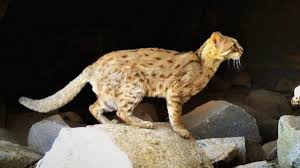
Context: The Rusty-spotted cat, one of the world’s smallest wildcat species, was sighted in the Aravalli belt close to Delhi.
-
- Size: It is one of the smallest wildcats, roughly half the size of a domestic cat.
- Conservation status: Listed as ‘Near Threatened’ on the IUCN Red List.
- WPA status: Included in Schedule I of the Wildlife Protection Act, 1972.
- Habitat: Endemic to India and Sri Lanka.
- Characteristics: Nocturnal and partly arboreal; feeds on rodents and small birds.
- Threats: Habitat loss and fragmentation are the primary dangers.
- Delhi context: Sighting indicates a potentially recovering ecosystem in the Asola Bhatti Wildlife Sanctuary.
- Appearance: Characterized by rufous-coloured spots on a greyish background.
- Cites: Listed in Appendix I of CITES.
- Discovery: This sighting is significant as the species is typically found in moist and dry deciduous forests of South and Central India.
(IE)
Important data/facts
Internal Security
NCRB ‘Crime in India 2024’ Report (Released May 2026):
Context: The National Crime Records Bureau (NCRB) released data highlighting a paradoxical trend in Indian crime statistics.
-
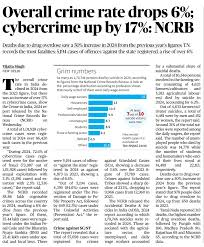
- Overall trend: Total cognizable crimes fell by 6% to 58.86 lakh cases.
- Cybercrime spike: Cybercrimes rose sharply by 17-18%, reaching over 1 lakh registered cases.
- Fraud dominance: Approximately 6% of cybercrimes were motivated by fraud.
- Suicide data: ADSI 2024 reported 1.70 lakh suicides; daily wagers constitute the largest group at 31%.
- Agrarian distress: Agricultural labourer suicides (5,913) exceeded farmer suicides (4,633).
- Drug overdose: Deaths due to drug overdose rose by 50%, with Tamil Nadu reporting the highest numbers.
- Delhi safety: Delhi remains the “most unsafe” for women and children among major metros.
- Under-reporting: Analysts suggest the 6% dip might reflect police capacity gaps or under-reporting rather than an actual crime drop.
- Violence against state: The report noted an increase in offences against the state.
- Data source: NCRB operates under the Ministry of Home Affairs.
(TH)
Miscellaneous
World Migration Report 2026:
Context: The International Organization for Migration (IOM) released its 2026 report, highlighting India’s dominance in global migration and remittances.
-
- Global migrants: Reached 304 million (3.7% of the global population).
- Forced displacement: Crossed 120 million people due to conflict and climate.
- Remittances: Global total hit $905 billion; India remains the top recipient ($137 billion).
- Largest diaspora: India maintains the largest overseas population globally.
- Top corridor: The Mexico-US corridor is first globally, followed closely by India-UAE.
- Disaster displacement: Natural disasters caused 65.8 million internal movements worldwide.
- India’s internal displacement: India recorded the 2nd highest disaster-induced displacement in Asia (>5M).
- Brain gain: Shift from “brain drain” to “brain gain” through technology and investment transfer.
- Climate drivers: Floods and droughts are now major drivers of migration in South Asia.
- IOM status: The IOM is a United Nations-related organization (joined UN in 2016).
(IE)
Spread the Word