
Indian Polity
IMPEACHMENT / REMOVAL OF HIGH COURT JUDGE:
-
- Constitutional Provision: Article 217(1)(b) (removal) read with Article 124(4) & Judges Inquiry Act, 1968.
- Grounds:
- Proved misbehaviour OR
- Incapacity (same as Supreme Court judge).
- Authority to Remove: Only the President of India.
- Initiation: Motion signed by 100 Lok Sabha MPs or 50 Rajya Sabha MPs.
- Pre-Investigation: Chairperson of Lok Sabha/Rajya Sabha admits or rejects the motion.
- Inquiry Committee: If admitted, a 3-member committee is set up under the Judges Inquiry Act, 1968:
1. Chief Justice or Supreme Court Judge
2. Chief Justice of High Court
3. Distinguished jurist
-
- Committee Report:
- If charges not proved → process ends.
- If charges proved → motion moves to Parliament.
- Parliamentary Approval:
- Motion must pass both Houses by special majority:
- Majority of total membership, AND
- 2/3rd of members present and voting.
- Motion must pass both Houses by special majority:
- Final Step: President issues an order of removal.
- No impeachment by courts: Judiciary cannot remove its judge; only President + Parliament.
- Security of Tenure: High Court judges have strong protection against arbitrary removal to ensure judicial independence.
- Committee Report:
(TH)
First meeting of constituent assembly:
-
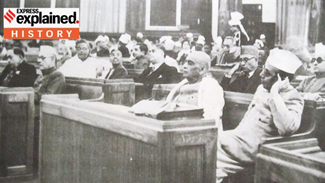
- The Constituent Assembly held its first meeting on 9 December 1946 in the then Parliament House (now Samvidhan Sadan).
-
- Members represented British Indian provinces, princely states and Chief Commissioner provinces, the Assembly was constituted under the 1946 Cabinet Mission Plan.
- Inaugural session presided by Sachchidananda Sinha (temporary Chairman), who read greetings from foreign countries (US, China, Australia), showing global goodwill for India’s constitution making.
- In his opening address, Sinha invoked a poem by Iqbal, emphasising India’s enduring civilizational legacy and quoted from the Bible: “Where there is no vision the people perish.”
- 207 members attended the first session; they submitted credentials and signed the register, beginning the mammoth task of framing a constitution for a diverse nation.
- Reflects how the Constituent Assembly was envisioned as a representative microcosm of pre‑Independence India, integrating provinces, princely states and smaller units, ensuring wide representation albeit indirectly.
(IE)
International Developments
Yellow Line:
-
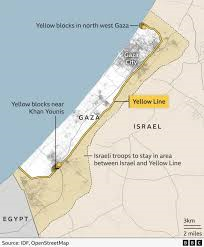
- The “Yellow Line” is a demarcation line inside the Gaza Strip, drawn in late 2025 after a ceasefire deal.
- It divides Gaza into two areas: an area under Israeli military control and the rest under reduced or no Israeli presence.
(IE)
Economy
HEJMADI KODI FISHING HARBOUR PROJECT IN KARNATAKA:
-
- The project concerns the development of an existing fish landing centre at Hejamadi Kodi in Udupi district, Karnataka.
- Approved by the Government of India on 13 August 2018 under the Sagarmala Programme, at a total cost of ₹ 138.60 crore, with ₹ 34.65 crore as central financial assistance.
- As of the latest update, physical progress of the project stands at 87%, with a target date of March 2026 for completion.
- Significance:
- Enhances coastal infrastructure and fisheries sector capacity, crucial for livelihoods of fishing communities and boost to marine economy.
- Alignment with Sagarmala’s goals: development of ports/harbours, supports blue economy, port-led development, coastal livelihoods, and maritime logistics.
- Demonstrates Centre–State cooperation and targeted investment in maritime infrastructure: important for coastal states’ economic development, employment, and fishery exports.
- Once complete, the harbour could improve fish landing, storage, processing & export infrastructure, which helps in value addition, reducing post harvest losses, and strengthening coastal supply chains.
(PIB)
Geography, Mapping, Ecology & Environment
Gannon’s storm:
-
- Context: India’s first solar observatory Aditya-L1, along with six U.S. satellites, in a breakthrough, has revealed why the May 2024 solar storm also known as Gannon’s storm behaved so unusually.
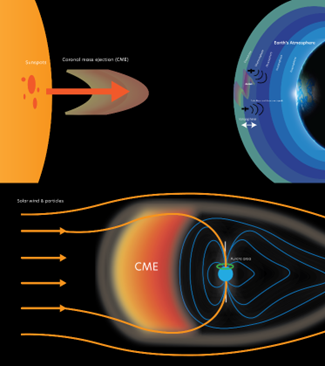
- The solar storm is composed of a series of giant explosions on the Sun, called coronal mass ejections (CMEs).
-
- CMEs are like massive bubbles of hot gas and magnetic energy thrown out from the Sun into space.
- When these bubbles hit Earth, they can shake our planet’s magnetic shield and cause serious trouble for satellites, communication systems, GPS, and even power grids.
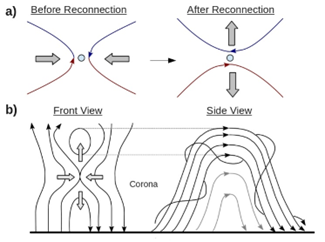
- According to ISRO, during the May 2024 solar storm, the Sun’s magnetic fields, which are like twisted ropes inside a solar storm, were breaking and rejoining within the storm.
- Usually, a CME carries a twisted “magnetic rope” that interacts with Earth’s magnetic shield as it approaches Earth. But this time, two CMEs collided in space and squeezed each other so firmly that the magnetic field lines inside one of them snapped and rejoined in new ways, a process called magnetic reconnection.
-
- This sudden reversal of the magnetic field made the storm’s impact stronger than expected.
(TH)
Science & Technology
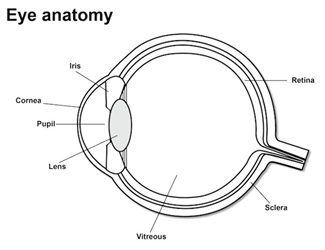
Why can’t we see well right after entering a darker room?
-
- The eyes are made of three layers: sclera and cornea, the pupil, and the retina.
- The pupil is like a camera’s aperture: by changing how much it opens, it can say how much light reaches the retina.
- Light that’s too bright can damage the retina, so in bright conditions, the pupil shrinks.
- If the retina is damaged, it can lead to blurry vision and, in severe cases, permanent vision loss.
- Conversely, in a dimmer room, there’s not enough light, so the pupil opens wider and the retina can sense more light.
- The retina contains rod cells and cone cells.
- The rod cells sense brightness using a light-sensitive protein called
- Bright light breaks down rhodopsin quickly and the rod cells become inactive.
- When the eyes adjust to the darkness, the protein’s levels are building back up.
(TH)
Defence & Security
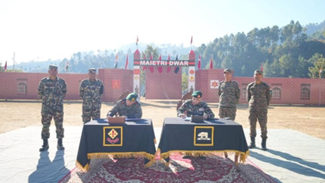
Exercise, SURYAKIRAN-XIX:
-
- Bilateral India–Nepal military exercise (armies only).
- 19th edition (2025) held at Pithoragarh, Uttarakhand.
- Focus: counter-terrorism, mountain/jungle warfare, HADR, peacekeeping (UN Chapter VII).
- Indian side: Assam Regiment; Nepal side: Devi Datta Regiment.
- Uses emerging technologies – drones, UAS, AI-enabled surveillance, advanced sights.
- Includes battalion-level validation exercise; observed by both nations’ DGMOs.
- Strengthens interoperability, border security cooperation, and disaster-response readiness.
(TH)
Terms in news
Q-day:
-
- Q-day refers to the day a cryptographically relevant quantum computer becomes powerful enough to break public-key encryption. It would not instantly expose all secrets, but any encrypted data stored today could be decoded later if intercepted now — a risk known as “harvest now, decrypt later.”
(TH)
Important data/facts
Society & Social Justice
-
- Only 30% of people in low-income countries, and just 14% of those in rural areas, have reliable access to potable water.
(TH)
Geography & Environment
-
- The ancestor to all modern domestic cats, the genetic findings revealed, is the African wildcat, presently distributed across northern Africa and the Near East.
(TH)
Spread the Word