Introduction:
National Single Window System (NSWS) is a digital platform implemented by DPIIT that lets investors identify, apply for, and track the regulatory approvals their business needs, all through a single interface. It was launched in 2021 to replace the old model of investors running between dozens of Central and State departments for permits. NSWS is one of the Government’s key instruments for improving the Ease of Doing Business (EoDB) and advancing the philosophy of “Minimum Government, Maximum Governance.”
UNDERSTANDING THE NSWS
What Problem Does It Solve?
-
- Before NSWS, an investor setting up even a small factory needed a clutch of separate clearances like environmental permit, factory licence, fire safety approval, power connection, trade licence, building plan sanction, etc each from a different office, with its own form and queue. This fragmented, multi-agency maze was long identified as one of the biggest deterrents to investment in India.
- NSWS was conceived as a single digital gateway addressing this i.e. it does not replace the approving authorities but sits atop them. Thus, guiding investors to the right approvals and letting them apply, pay fees and track status centrally.
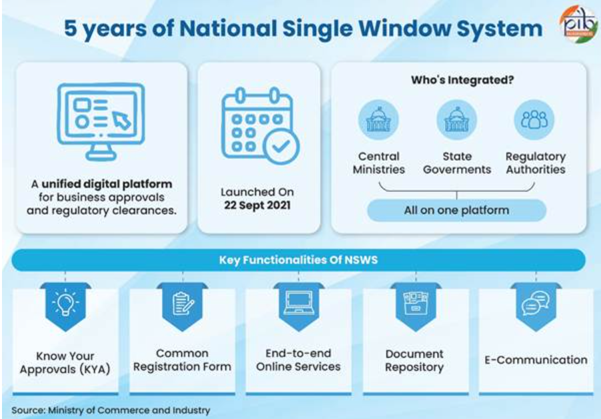
Key Functionalities of NSWS
| Module | Function |
|---|---|
| Know Your Approvals (KYA) | Identifies approvals applicable to a business based on its proposed activities (advisory only) |
| Common Registration Form | Captures investor information once and reuses it across multiple applications |
| State Registration Form | Provides seamless access to integrated State Single Window Systems |
| Applicant Dashboard | Submit applications, track status in real time, respond to departmental queries |
| Document Repository | One-time upload and reuse of documents across approvals |
| E-Communication Module | Online query/clarification exchange between applicant and authorities |
Expanding Digital Integration:
-
- NSWS now uses PAN as the Single Business ID with authentication via Digital Signature Certificate or DigiLocker.
- The Foreign Investment Facilitation Portal has been integrated for FDI applications requiring Government approval.
- The Industrial Entrepreneur Memorandum and Industrial Licence processes were fully migrated and digitised by October 2025 and March 2026 respectively. Thereby, enabling auto-populated data and instant acknowledgements.
- A Production Investment Business Registration module (November 2025) now supports Sponsorship Letters for the e-Business Visa (e-B-4) route.
- Petroleum and Explosives Safety Organisation became the first department to achieve complete transaction-level integration across all 74 of its licensing modules.
Implementation Experience:
| Indicator | Figure |
|---|---|
| Central approvals available | 327, across 32 Ministries/Departments |
| State/UT approvals available | 3,452, across 34 States and UTs |
| Business entities onboarded | 5.69 lakh (proprietorships, companies, LLPs, foreign entities) |
| Average annual applications | 3.06 lakh+ |
| Average annual approvals processed | 2.26 lakh+ |
| States with most integrated approvals | Assam (335), Karnataka (327), Tamil Nadu (223), Manipur (190) |
| Common gateway for approvals under flagship schemes | National Green Hydrogen Mission, Ethanol Policy, Vehicle Scrapping Policy, Indian Footwear and Leather Development Programme |
Challenges:
1. Most business approvals in India like land, labour, factory, power, environment are State subjects & not all States have fully integrated their single-window systems with NSWS.
2. Independent legal-industry analysis (Law.asia, Jan 2026) notes land titles still require manual validation. State electricity boards remain outside system and environmental clearances still need in-person appraisal committee interactions despite what the portal displays.
3. RBI and UIDAI licences cannot yet be tracked or processed through NSWS forcing legal teams to continue filing through older fragmented channels.
4. Being a web-based platform integrating dozens of backend government systems. Therefore, NSWS remains exposed to server downtime, inter-departmental integration failures and cybersecurity risk.
5. With World Bank’s Doing Business Report discontinued since 2021 and new B-Ready Assessment only now including India (2026). There is currently no independent, internationally comparable benchmark to rigorously validate NSWS’s on-ground impact on investor experience.
Way Forward:
1. Centre should use instruments like the Business Reform Action Plan (BRAP) already in its seventh edition with over 9,700 reforms recorded to incentivise full API-based integration of all State single-window systems with NSWS.
2. Prioritise bringing high-friction approvals like land title validation, State electricity connections, RBI/UIDAI fintech licences, and environmental appraisal committee processes fully onto the digital backend rather than leaving them as parallel offline requirements.
3. Build on PESO’s full transaction-level integration (all 74 licensing modules) as a template, and replicate this model across other regulator-heavy sectors such as power, telecom and pharmaceuticals.
4. Continue Regulatory Compliance Burden and Jan Vishwas-style decriminalisation efforts which have already reduced over 47,000 compliances.
5. As India enters the World Bank’s B-Ready Assessment cycle, use NSWS transaction data (approval timelines, rejection rates, pendency) as an internal, real-time proxy to identify and fix regulatory bottlenecks proactively rather than waiting for external rankings.
Conclusion:
Yet NSWS’s ultimate test lies in what Indian federalism has always made difficult i.e. getting every state, regulator and sector to operate on one digital rail without leaving offline detours for land, power, environment and finance-sector approvals. That will determine whether NSWS becomes the genuine “cornerstone of a unified business regulatory framework” that the Government envisions and a durable pillar of India’s Ease of Doing Business story.
Spread the Word