Introduction:
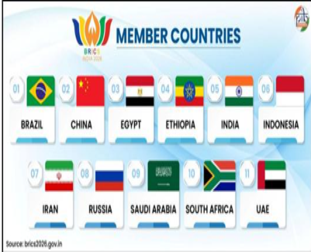
BRICS began in 2001 as a Goldman Sachs acronym for four promising emerging markets. It is now an 11-country grouping hosting its 18th Summit in New Delhi on 12-13 September 2026 under India’s fourth Chairship under the theme:
“Building for Resilience, Innovation, Cooperation and Sustainability.”
What Is BRICS?
-
- Origin: ‘BRIC’ was coined in 2001 by Goldman Sachs economist Jim O’Neill, in a paper projecting that Brazil, Russia, India and China would become major economies over the following decades. It began as an analyst’s label, not a country’s idea.
- From acronym to institution: BRIC became a formal political forum in 2006 & first Summit held was in 2009 (Yekaterinburg). South Africa joined in 2010-11, making it BRICS.
- BRICS Plus / expansion (2024-25): Egypt, Ethiopia, Iran, Saudi Arabia and UAE joined as full members in January 2024. Indonesia joined in January 2025 taking full membership to 11.
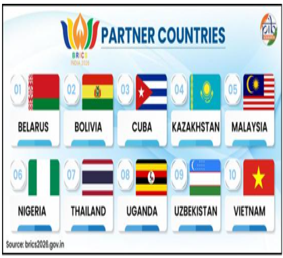
- Partner Country category: A new lighter-touch tier created in 2025. Ten countries (Belarus, Bolivia, Cuba, Kazakhstan, Malaysia, Nigeria, Thailand, Uganda, Uzbekistan, Vietnam) joined this framework, engaging with BRICS without full membership.
- Consensus-based decision-making: BRICS has no voting system & every member effectively holds a veto. This is core to its identity as a non-hierarchical forum and also root of many of its current problems.
India’s Chairship Through The Years
| Year | Summit & Theme | Outcomes |
|---|---|---|
| 2012 | New Delhi- "BRICS Partnership for Global Stability, Security and Prosperity" | Proposed the New Development Bank (NDB); Delhi Declaration; local-currency credit facility agreement |
| 2016 | Goa- "Building Responsive, Inclusive and Collective Solutions" | NDB's first loans rolled out; stronger anti-terrorism language; BIMSTEC Outreach Summit; BRICS Agriculture Research Platform |
| 2021 | Virtual (15th anniversary)- "BRICS@15: Continuity, Consolidation and Consensus" | Unified Counter-Terrorism Action Plan; first BRICS Digital Health Summit; BRICS Vaccine R&D Centre; Remote Sensing Satellite Constellation |
| 2026 | New Delhi- "Building for Resilience, Innovation, Cooperation and Sustainability" | 350+ meetings across 25 cities; new frameworks on agro-ecology, MSMEs, skilling, urban mobility, standardisation and more (see below) |
Key Outcomes of India’s 2026 Chairship:
India convened over 350 meetings across 25 cities in 2026, spanning BRICS’s three pillars: political-security, economic-financial, and cultural/people-to-people cooperation. Selected outcomes:
a). Agriculture and food security:
i. BRICS Centres of Excellence on Agro-Ecology coordinated by ICAR-IIFSR, Modipuram.
ii. BRICS Network on Digital Agriculture (IIT Delhi).
iii. BRICS AGRIN for seeds and genetic resources.
b). Health:
i. BRICS Mission for Healthy Lifestyle (2026-2029).
ii. Traditional/Complementary Medicine expert group.
iii. A mental-health training hub network coordinated by NIMHANS.
c). Economy, trade and MSMEs:
i. BRICS MSME Cooperation Portal & a Global Value Chains Action Plan (2026-2030).
ii. Customs mutual-assistance agreement (in-principle).
iii. Logistics Supply-Chain Cooperation Framework.
d). Innovation and skilling:
i. BRICS Incubator Network and Startup Innovation Fund.
ii. BRICS CONNECT for skilling and digital public infrastructure cooperation.
iii. Science and Research Repository.
e). Energy and urban development:
i. Guiding Principles on Energy Storage and Smart Grids.
ii. Digital Centre of Excellence for the same.
iii. BRICS Urban Mobility Hub and climate-resilient infrastructure principles.
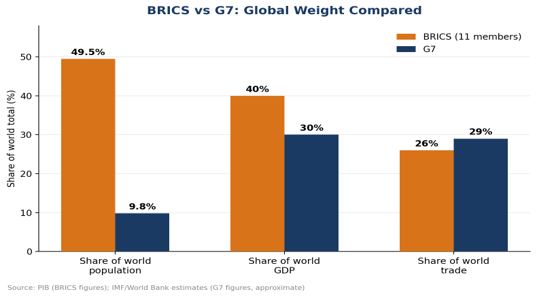
Fig. 1 – BRICS dwarfs the G7 in population, and now nearly matches it in GDP share, but still trails in trade share.
New Development Bank vs World Bank
A grouping’s real weight is tested not by population or GDP share alone, but by whether its own institutions can compete with the incumbents. The NDB, BRICS’s flagship bank set up in 2015, is the clearest test case.
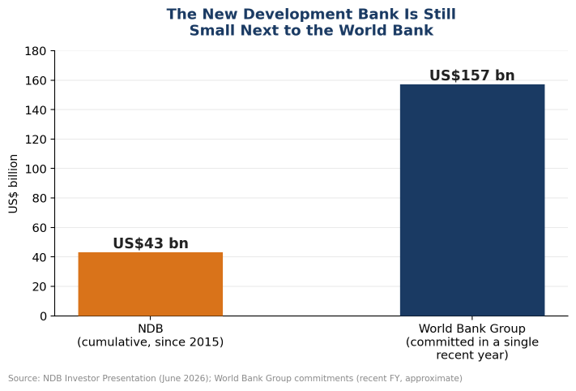
Fig. 2 – Eleven years of NDB lending still totals less than one year of World Bank Group commitments.
-
- What the NDB offers instead of scale: Faster approvals, no policy conditions attached to loans, and a growing share of lending in members’ own local currencies rather than the US dollar.
- What this means: The NDB is not trying to replace the World Bank; it competes on speed and non-interference, offering borrowers an alternative source of financing, not necessarily a bigger one.
What This Comparison Really Teaches
-
- Demographic weight is not the same as institutional weight: Half the world’s people live in BRICS countries, but its flagship bank is still a fraction of the size of the older, Western-led institutions it was meant to challenge.
- BRICS competes on terms, not just on size: Like the NDB’s no-conditionality lending, BRICS’s real value proposition to the Global South is often about offering an alternative model, not simply out-resourcing the incumbent.
- A large GDP share does not equal a unified voice: As the Challenges section shows, size has made BRICS harder to manage internally, not easier to project outward.
Why This Matters
i. BRICS gives India a platform to advance Global South priorities in institutions like the IMF, World Bank and WTO.
ii. Repeated Indian Chairships (2012, 2016, 2021, 2026) build India’s credibility as a bridge-builder between developed and developing economies.
iii. The NDB offers India and other members financing without the policy conditions attached to Western-led lenders.
iv. BRICS forums on agriculture, health, skilling and urban development translate broad diplomacy into practical, technical cooperation.
Challenges
i. ORF’s on the May 2026 BRICS Foreign Ministers’ Meeting held in New Delhi ahead of the Summit, could not agree on a full joint statement due to sharp divisions between Iran and UAE over the escalating US-Israel-Iran confrontation. Thus, terming it as ‘paradox of BRICS expansion’: greater visibility and demographic weight, but weaker internal cohesion.
ii. The Carnegie Endowment for International Peace (June 2026) argues that India’s central challenge as Chair is not any single flashpoint but the deeper, structural tension between BRICS’s expansion and its institutional coherence.
iii. ORF’s highlighted that China has pushed to welcome more members, while India and Brazil have resisted, preferring to consolidate the existing 11 rather than dilute cohesion further.
iv. India and China are BRICS partners, yet remain each other’s largest bilateral trade deficit, and continue to manage unresolved border tensions even as they cooperate inside the bloc.
v. On de-dollarisation i.e. Russian officials have said Russia conducts around 90% of its BRICS trade in local currencies but the bloc has never agreed on a common BRICS currency and members like India have been cautious about being seen as an anti-Western, anti-dollar bloc.
vi. Coverage of the NDB’s own strategy documents shows the bank’s lending remains heavily concentrated in sovereign-guaranteed loans to founding members (over 84% of financing through 2023), well short of its own target of 30% private-sector.
Way Forward
i. India, as the 2026 Chair should continue using the Chair’s Statement mechanism pragmatically, to keep BRICS functioning through disagreement rather than forcing a false consensus or letting the grouping fracture publicly.
ii. BRICS members collectively should agree on clear, objective criteria for any future expansion as India and Brazil have urged before adding more members.
iii. The New Development Bank should keep expanding local-currency and non-sovereign lending as it has committed to under its 2022-2026 strategy to genuinely differentiate itself from, not just imitate.
iv. India and China should keep the border de-escalation process (including recent senior commander-level talks) moving forward. Since political stability between the bloc’s two largest economies is a precondition for BRICS functioning as more than a talking shop.
v. India’s diplomatic establishment (MEA) should continue converting 2026 Chairship’s 350-plus technical meetings into durable institutions as done with the Agro-Ecology Centres and MSME Portal.
vi. India should keep resisting pressure to frame BRICS as an anti-Western bloc preserving its own strategic autonomy and ensuring BRICS remains.
Conclusion:
BRICS has travelled a long way from a Goldman Sachs acronym to a bloc representing half the world’s population. However, its comparison with G7 and World Bank shows that scale has not yet translated into matching institutional weight. India’s real test as Chair and test for BRICS is whether an consensus-only grouping can still act with one voice when its members disagree on the world’s biggest questions.
Spread the Word