Context: The Department of Science and Technology (DST) has released an update on the National Mission on Interdisciplinary Cyber-Physical Systems (NM-ICPS), showing it has now enabled over 1,100 technologies, incubated more than 1,100 start-ups and expanded into technology translation and commercialisation through four new Technology Translation Research Parks (TTRPs). This is a good moment to look at what Cyber-Physical Systems (CPS) are, why India is investing in them, and what stands between this ecosystem and real-world, at-scale impact.
Understanding Cyber-Physical Systems:
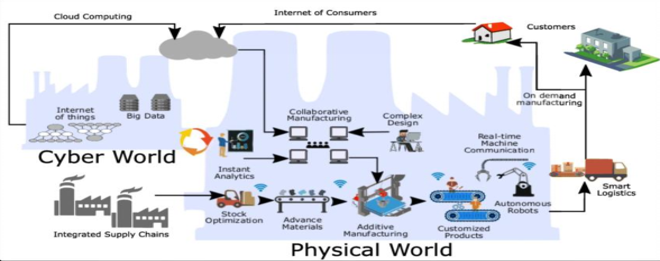
A Cyber-Physical System connects computing technologies with the physical world through sensors, software and communication networks. It lets machines sense their surroundings, process information, and respond in real time. For example, a driverless car reading road, a smart factory adjusting its own production line, a medical device tracking a patient continuously. At its core, CPS is computation, communication and physical action working as one loop, not three separate steps.
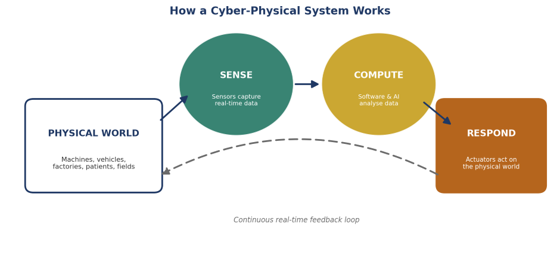
Fig 1: The sense-compute-respond loop at the heart of every Cyber-Physical System
This convergence matters strategically. CPS increasingly runs the systems a country depends on — power grids, hospitals, factories, transport, defence platforms. Whoever controls the sensors, algorithms and standards behind these systems has real influence over how reliably, safely and independently that country’s critical infrastructure functions. That is why India treats indigenous CPS capability as a matter of technological self-reliance, not just innovation.
India’s Response through NM-ICPS:
The Union Cabinet approved the National Mission on Interdisciplinary Cyber-Physical Systems (NM-ICPS) in December 2018 with an outlay of ₹3,660 crore to be implemented by the DST over nine years (mission period has since been extended to December 2027). It brings academia, industry, government and international partners onto one platform, covering the full innovation chain from research and translational work to product development, start-up incubation and commercialisation.
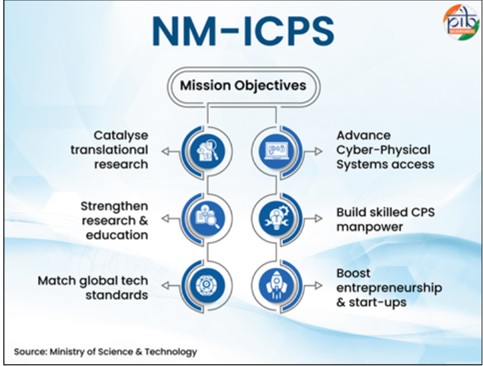
Key Highlight of NM-ICPS
1. The mission has established 25 Technology Innovation Hubs (TIHs) as Section 8 companies hosted at premier academic institutions.
2. Each TIH works across four areas: technology development, human resource and skill development, innovation and start-up development and international collaboration.
3. In 2025, four high-performing TIHs were upgraded into Technology Translation Research Parks (TTRPs), marking a shift from research towards deployment and commercialisation:
-
- IIT Kanpur: Cybersecurity
- IISc Bengaluru: Robotics and AI Systems
- IIT (ISM) Dhanbad: Mining Technologies
- IIT Indore: Digital Healthcare
4. The CHANAKYA Fellowship Programme funds undergraduate, postgraduate, PhD and postdoctoral researchers working on real-world CPS problems through the TIHs. The mission has also trained over 2.46 lakh professionals in specialised CPS skills.
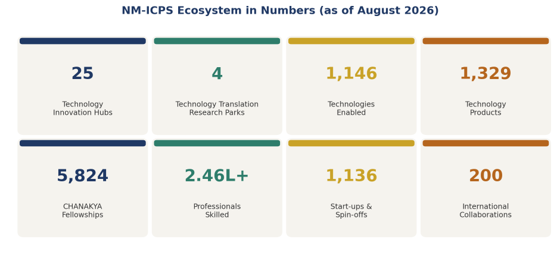
Fig 2: NM-ICPS output — technology, talent and enterprise, as of August 2026
Source: PIB, Ministry of Science and Technology (31 Aug 2026).
Difference between CPS vs IoT
| IoT | Cyber-Physical Systems |
|
|
|
|
|
|
BharatGen a Sovereign AI Layer for CPS
-
- BharatGen, supported under NM-ICPS and led by IIT Bombay is building sovereign AI models tailored to Indian languages and contexts. Its Param-2 foundation model has 17 billion parameters and supports all 22 Scheduled Indian languages.
- Complementary tools such as Shrutam (speech-to-text), Sooktam (text-to-speech) and domain models like Ayur Param, Agri Param and Legal Param extend this intelligence layer into healthcare, agriculture and law.
Sectoral Applications of NM-ICPS
-
- Healthcare: CharakDT is a digital twin of the human body built at IIT Indore’s Drishti CPS Foundation, simulates lungs, eyes and heart to study disease and test treatments virtually.
- Agriculture: IIT Bombay’s Agri-IoT Farm Management System tracks soil, weather and micro-climate data to help farmers use water and fertiliser more efficiently.
- Mining: TEXMiN at IIT (ISM) Dhanbad has built drones that transmit data up to 50 km, enabling remote monitoring of hazardous mining sites.
- Communication: IIIT Bengaluru’s indigenous 5G-Advanced ORAN Massive MIMO Radio Unit supports affordable, high-speed connectivity for remote regions.
- Cybersecurity: IHUB NTIHAC at IIT Kanpur runs an IT-OT Security Operations Centre and has built crypto-forensic tools for law enforcement.
- Mobility: TiHAN at IIT Hyderabad operates India’s first dedicated testbed for autonomous vehicles; IISc’s iRASTE flags accident-prone spots in real time and is being piloted in Nagpur.
Challenges
1. India’s Gross Expenditure on Research and Development (GERD) stands at about 0.64% of GDP which is far behind China (2.43%), USA (2.8%), South Korea (4.2%) and Israel (4.3%). A mission-based approach like NM-ICPS can build islands of excellence, but without a broader rise in national R&D intensity, scaling CPS innovation economy-wide will remain difficult.
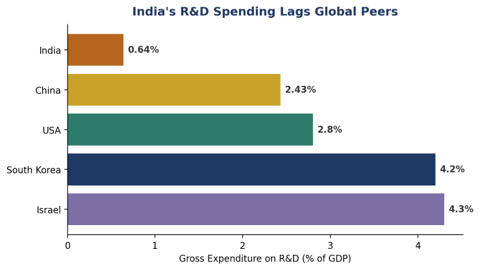
Fig 3: India’s R&D spending relative to global peers (% of GDP)
Source: PRS Legislative Research; Parliamentary Standing Committee data; media reports on GERD 2023-24 estimates.
2. Every additional sensor or connected device in a CPS is also a potential point of attack. Globally, Triton malware attack on a Saudi petrochemical plant showed that industrial control systems can be targeted to trigger real-world harm, not just service disruption. In India, cybersecurity incidents more than doubled between 2022 and 2024 (from about 10.29 lakh to 22.68 lakh), and analysts flag a shortage of specialised talent in AI-forensics, quantum cryptography and OT security, along with fragmented intelligence-sharing across agencies like CERT-In, NCIIPC and I4C.
3. India’s start-up capital continues to favour fast-scaling, low-risk sectors like e-commerce and fintech over capital-intensive deep-tech areas such as robotics, semiconductors and space technology.
4. Nearly all 25 TIHs and all four TTRPs are hosted at premier, already well-resourced institutions (IITs, IISc, IIITs). This concentrates CPS capacity in a small set of elite institutions and a few States, similar to the pattern seen in general higher education.
5. Cyber-physical systems depend on large volumes of real-time data but without common technical standards and a clear data-governance framework, hardware and software from different hubs and start-ups may not interoperate smoothly.
Way Forward
1. The newly approved ₹1-lakh-crore Research, Development and Innovation (RDI) Fund, with ₹20,000 crore released as a first tranche is meant to catalyse private-sector-driven R&D including in deep tech.
2. NITI Aayog highlighted critical sectors should adopt regular security audits, network segmentation, incident-response mechanisms and secure supply chains.
3. India needs sector-specific cybersecurity standards for CPS in power, health, transport and manufacturing.
4. Closer coordination between CERT-In, NCIIPC and sectoral regulators and dedicated training pipelines for OT security and AI-forensics talent.
Conclusion:
Cyber-Physical Systems represent the transition from connected machines to intelligent, responsive systems. For India, objective should be to combine its strengths in software, AI and scientific talent with indigenous hardware, manufacturing and cybersecurity capabilities. The real opportunity is not merely to adopt CPS, but to build a secure, interoperable and indigenous CPS ecosystem that converts technological capability into inclusive development.
Spread the Word