TOPIC-1: List of Outcomes: Prime Minister’s State Visit to Uzbekistan
-
- GS Paper 2 (Bilateral, Regional, and Global Groupings involving India and/or affecting India’s Interests — Central Asia & India-Uzbekistan Partnership).
Context: During Prime Minister Shri Narendra Modi’s State Visit to Uzbekistan (29–30 August 2026), India and Uzbekistan formally elevated their bilateral strategic ties to a Comprehensive Strategic Partnership. The visit resulted in key announcements and signing of 11 bilateral agreements spanning trade, digital payments (UPI), critical minerals, environmental protection, traditional medicine, and cultural conservation.
About India-Uzbekistan Strategic Outcomes
The bilateral engagement anchored bilateral ties around economic integration, regional environmental action, digital public infrastructure, and historical preservation. In addition to expanding developmental grants and academic exchanges, the outcome framework signed a commercial agreement between NPCI International Payments Ltd (NIPL) and Uzbekistan’s National Interbank Processing Centre (NIPC) to enable UPI cross-border merchant payments via the national UZQR system.
Key Highlights:
-
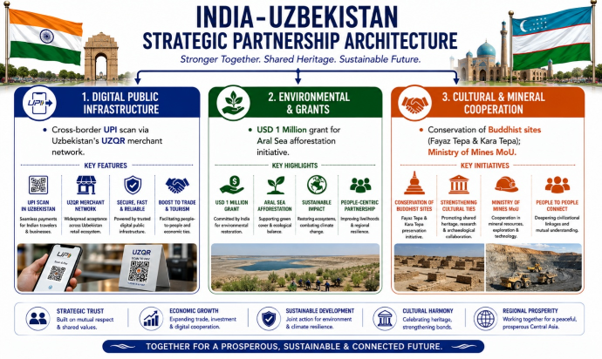
- Strategic Level Upgrade: Elevated the India-Uzbekistan Strategic Partnership to a Comprehensive Strategic Partnership to deepen long-term engagement across Central Asia.
- Digital Public Infrastructure (UPI Expansion): Signed a commercial agreement between NIPL and NIPC (Uzbekistan) to allow Indian UPI applications to scan UZQR for merchant payments across Uzbekistan.
- Environmental Aid & Afforestation: Announced a USD 1 million grant for afforestation and ecological rehabilitation in the Aral Sea region, aligning Uzbekistan’s Yashil Makon with India’s Ek Ped Maa Ke Naam initiative.
- Critical Minerals & Energy Cooperation: Signed an MoU between the Ministry of Mines (India) and the Ministry of Mining Industry and Geology (Uzbekistan) for geology and mineral exploration.
- Cultural & Heritage Preservation: Signed a Letter of Intent to conserve ancient Buddhist heritage sites (Fayaz Tepa and Kara Tepa in Termez) and established an ICCR Sanskrit Chair at Tashkent State University of Oriental Studies.
- Institutional & Sub-National Partnerships: Established an Economic and Financial Dialogue MoU between the Ministries of Finance and signed a sister-state cooperation agreement between Gujarat (India) and the Samarkand region (Uzbekistan).
UPSC Quick Reference Table
| Feature | Detailed Specification |
| Nodal Ministries | Ministry of External Affairs (India) & Ministry of Foreign Affairs (Uzbekistan) |
| Strategic Bilateral Status | Elevated to Comprehensive Strategic Partnership |
| Digital Payment Integration | UPI Apps linked to scan Uzbekistan’s UZQR (NIPL–NIPC Agreement) |
| Environmental Grant | USD 1 Million Grant for Aral Sea region afforestation |
| Buddhist Heritage Sites | Restoration of Fayaz Tepa and Kara Tepa (Termez, Uzbekistan) |
| Sub-National Agreement | Gujarat State partnered with Samarkand Region |
| Educational Initiatives | 100 Lal Bahadur Shastri Hindi Scholarships & ICCR Sanskrit Chair |
Conclusion:
The elevation to a Comprehensive Strategic Partnership and the integration of UPI payments, mineral cooperation, and heritage restoration strengthen India’s strategic footprint in Central Asia. These outcomes align developmental assistance with regional connectivity, economic engagement, and cultural ties.
TOPIC-2: India–Chile Comprehensive Economic Partnership Agreement (CEPA) Negotiations
-
- GS Paper 2 (Bilateral, Regional, and Global Groupings involving India; Engagement with the Global South)
- GS Paper 3 (Indian Economy — Trade Agreements, Foreign Direct Investment, and Supply Chain Resilience).
Introduction:
The India–Chile CEPA negotiations build upon the existing bilateral trade framework and shared identity as members of the Global South. The proposed agreement aims to expand bilateral commerce beyond the current Preferential Trade Agreement (PTA) by establishing a balanced, mutually beneficial economic framework across goods, services, and investment.
Key Highlights:
-
- Target Completion Timeline: Reaffirmed commitment to conclude the CEPA negotiations by the end of 2026 to deliver equitable commercial outcomes.
- Priority Economic Sectors: Identified high-potential areas for economic cooperation, including healthcare, pharmaceuticals, energy, critical minerals, agriculture, machinery, and engineering.
- Global South Synergy: Anchored negotiations on shared strategic vision and Global South solidarity to advance mutual economic prosperity.
- Supply Chain Resilience: Focuses on deepening trade and investment ties while fostering technology sharing, talent exchange, and resilient supply chain networks.
UPSC Quick Reference Table
| Feature | Detailed Specification |
| Nodal Ministries | Ministry of Commerce and Industry (India) & Ministry of Foreign Affairs / SUBREI (Chile) |
| Pact Under Negotiation | Comprehensive Economic Partnership Agreement (CEPA) |
| Key Representatives | Shri Rajesh Agrawal (Commerce Secretary) & Ms. Paula Estévez Weinstein (Vice-Minister) |
| Target Completion Date | End of 2026 |
| Key Priority Sectors | Healthcare, Pharma, Energy, Minerals, Agriculture, Machinery, and Engineering |
Conclusion:
The advancement of the India–Chile CEPA negotiations provides a framework to expand India’s trade footprint in Latin America. Concluding the agreement by year-end will help diversify supply chains, boost bilateral investments, and create commercial opportunities across key industrial sectors.
TOPIC-3: Release of “Mission Rangeen Machhli 2031” Strategic Action Plan
-
- GS Paper 2 (Government Policies & Interventions for Development)
- GS Paper 3 (Indian Economy — Fisheries Sector, Blue Economy, Mariculture, and Sustainable Livelihoods).
Introduction:
Vice President Shri C. P. Radhakrishnan released “Mission Rangeen Machhli 2031”, a Strategic Action Plan for Ornamental Fisheries Development during a national outreach programme at Agatti, Lakshadweep. The initiative aims to harness the untapped potential of India’s marine resources, establish standardized biosecurity protocols, and position island territories like Lakshadweep as hubs for the blue economy.
About “Mission Rangeen Machhli 2031”
“Mission Rangeen Machhli 2031” establishes a uniform, nationwide operational framework to regulate, standardize, and scale the ornamental fisheries sector. The mission focuses on leveraging India’s vast maritime domain—including an 11,099 km coastline, an Exclusive Economic Zone (EEZ) of ~2.2 million sq. km, and Lakshadweep’s EEZ of nearly 4 lakh sq. km (accounting for 17% of India’s total EEZ)—to promote scientific rearing, exports, and sustainable coastal livelihoods.
Key Highlights:
-
- Standardized Operational Framework (SOPs): Establishes national guidelines for broodstock management, breeding, hatchery operations, quarantine, disease management, traceability, and export transport.
- Cluster-Based Fisheries Growth: Aligns with cluster development strategies, supporting Lakshadweep’s notification as a dedicated Seaweed Cluster alongside its marine ornamental fisheries initiatives.
- Support via PMMSY: Complements projects under the Pradhan Mantri Matsya Sampada Yojana (PMMSY)—including over ₹62 crore approved for Lakshadweep—covering deep-sea fishing vessels (DSFVs), ornamental hatcheries, and recreational fishing units.
- Quality Assurance & Biosecurity: Strengthens product certification, biosecurity standards, and quality control to enhance global market access for Indian ornamental fish.
- Focus on Ocean Resources & Livelihoods: Integrates island communities, women fishers, and self-help groups (SHGs) into non-capture fisheries value chains such as seaweed farming, ornamental rearing, and recreational fisheries.
UPSC Quick Reference Table
| Feature | Detailed Specification |
| Nodal Ministry | Ministry of Fisheries, Animal Husbandry & Dairying |
| Strategic Action Plan | Mission Rangeen Machhli 2031 |
| Launch Location | Agatti, Lakshadweep |
| Key Maritime Metrics | India Coastline: 11,099 km; EEZ: 2.2 Million sq. km; Lakshadweep EEZ Share: ~17% |
| Core Operational Pillars | Broodstock management, biosecurity, traceability, quarantine, and export certification |
| Notified Island Cluster | Dedicated Seaweed Cluster in Lakshadweep |
Conclusion:
“Mission Rangeen Machhli 2031” provides a structured roadmap to transform India’s ornamental fisheries into an organized, globally competitive sector. Standardizing biosecurity, scientific breeding, and market access supports sustainable marine resource management and drives blue economy-led growth across island and coastal communities.
TOPIC-4: ASDC Annual Conclave 2026: Skilling India’s Automotive Workforce
-
- GS Paper 2 (Government Policies & Interventions for Skill Development; Human Resource Development)
- GS Paper 3 (Indian Economy — Automotive Industry, Industry 4.0, Employment Generation, and Global Mobility).
Introduction:
The Automotive Skills Development Council (ASDC) is an industry-led skill development council under the Ministry of Heavy Industries and Ministry of Skill Development and Entrepreneurship. It focuses on upskilling, reskilling, and certifying talent tailored to vehicle manufacturing, battery technology, charging infrastructure, servicing, and auto component supply chains.
Key Highlights:
-
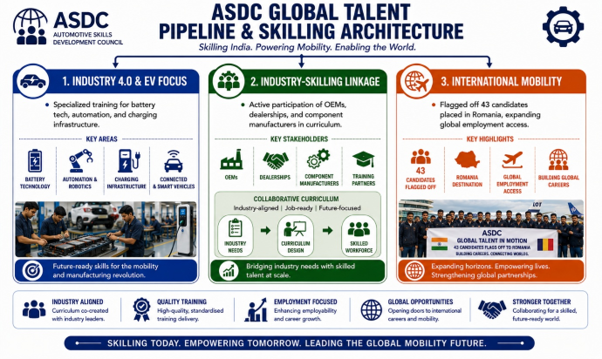
- Global Talent Footprint: Emphasized building a future-ready workforce suited for both domestic manufacturing and international labor markets, highlighted by flagging off 43 ASDC-trained candidates placed in Romania.
- ASDC Annual Performance (FY 2025–26): Impacted over 5.08 lakh learners, conducted 1.53 lakh assessments, and created 2.88 lakh apprenticeship contracts across ~3,700 industrial establishments.
- Focus on Advanced Automotive Technologies: Directed training priorities toward electric mobility, smart manufacturing, battery assembly, connected vehicle systems, and post-sales technical support.
- Industry-Led Apprenticeship Integration: Urged original equipment manufacturers (OEMs) and auto-component companies to align curriculum design directly with workplace demands to eliminate skill-mismatches.
UPSC Quick Reference Table
| Feature | Detailed Specification |
| Nodal Ministry | Ministry of Heavy Industries |
| Event Name | ASDC Annual Conclave 2026 |
| Key Dignitary | Shri H.D. Kumaraswamy (Union Minister for Heavy Industries) |
| Implementation Agency | Automotive Skills Development Council (ASDC) |
| FY 2025–26 Outreach | 5.08 Lakh+ Learners & 2.88 Lakh+ Apprenticeship Contracts |
| Global Mobility Benchmark | Flag-off of 43 candidates placed in Romania |
Conclusion:
Aligning auto sector training with Industry 4.0 and electric mobility ensures India builds an adaptable, future-ready workforce. Institutionalizing industry-skilling partnerships and international placements helps transform India’s demographic dividend into a globally competitive asset for Viksit Bharat @2047.
TOPIC-5: Depalpur Triumphs in Tackling Legacy Waste under Swachh Shehar Jodi
-
- GS Paper 2 (Government Policies & Interventions for Development; Urban Governance)
- GS Paper 3 (Environmental Pollution and Degradation; Municipal Solid Waste Management & Swachh Bharat Mission-Urban 2.0).
Introduction:
Depalpur Nagar Parishad (Madhya Pradesh) became the first city under the Swachh Shehar Jodi initiative to achieve “Zero Legacy Waste” under Swachh Bharat Mission-Urban 2.0 (SBM-U 2.0). Facilitated by a peer-mentorship pairing with Indore Municipal Corporation, Depalpur completely remediated 1,250 metric tonnes of legacy waste accumulated over 5 years.
Key Highlights:
-
- Scientific Dumpsite Remediation: Over 500 ragpickers and heavy machinery were deployed to segregate accumulated waste into recyclables, inert material, and Refuse Derived Fuel (RDF).
- Resource Recovery & Circular Economy: Recovered 4.5 tonnes of recyclable plastics/metals and processed 50–60 tonnes of RDF for co-processing in cement plants via NEPRA Indore.
- Urban Renewal: Transformed the cleared dumpsite into a public space featuring a 200-sapling plantation drive, alongside the ecological revival of the historic Surajkund Bawdi.
- National Mentorship Scale: The Swachh Shehar Jodi network includes 1,600+ activities driven through MoUs between mentor and mentee cities nationwide.
UPSC Quick Reference Table
| Feature | Detailed Specification |
| Nodal Ministry | Ministry of Housing & Urban Affairs (MoHUA) |
| Overarching Mission | Swachh Bharat Mission-Urban 2.0 (SBM-U 2.0) |
| Mentorship Framework | Swachh Shehar Jodi (“Each One Teach One” model) |
| Mentor & Mentee Cities | Indore Municipal Corporation (Mentor) & Depalpur (Mentee) |
| Milestone Achieved | First city under Swachh Shehar Jodi to reach Zero Legacy Waste |
| Legacy Waste Cleared | 1,250 Metric Tonnes remediated |
Conclusion:
Depalpur’s milestone demonstrates how city-to-city mentorship under SBM-U 2.0 can accelerate dumpsite remediation and scientific waste processing, providing a scalable model for urban local bodies across India.
TOPIC-6: Inauguration of the “Green Forge” Complex at BRIC-NABI Mohali
-
- GS Paper 2 (Government Policies & Interventions in Science and Technology)
- GS Paper 3 (Biotechnology Applications, Genetically Modified Crops, BioE3 Policy, and Agri-Biomanufacturing).
Introduction:
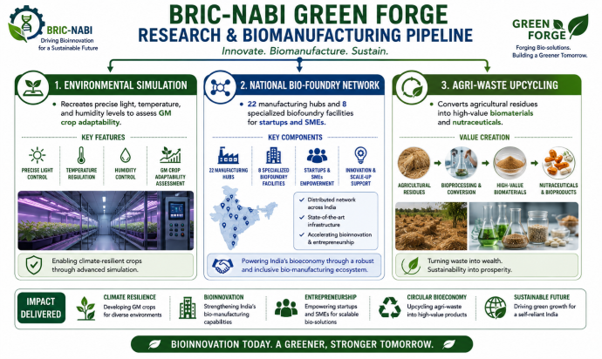
The Green Forge facility is an advanced simulation complex engineered to mimic specific environmental variables—including light quality/quantity, humidity, and temperature. By integrating Artificial Intelligence (AI) with bioprocess engineering, researchers can test GM crop performance and genome-edited traits under varied climate conditions prior to field trial deployment. This facility aligns with the BioE3 (Biotechnology for Economy, Environment, and Employment) policy framework, which targets high-tech, low-carbon bio-manufacturing.
Key Highlights:
-
- Advanced Climate Simulation: Enables pre-field trial assessments of genetically modified crops by simulating diverse micro-climatic conditions using AI-assisted monitoring.
- Expansion of India’s Bioeconomy: India’s bioeconomy expanded from US$ 10 billion to US$ 200 billion, supported by public-private partnerships under the BioE3 framework.
- National Bio-Foundry Infrastructure: Establishes 22 manufacturing hubs and 8 specialized biofoundry facilities nationwide to scale up over 50 process innovations for startups and researchers.
- Carbon Capture & Space Biotechnology: Supports 38 Carbon Capture and Utilization (CCU) projects alongside ISRO-partnered space biotechnology experiments (e.g., myogenesis and cyanobacteria studies).
- Agri-Waste Value Addition: Integrates bioprocess engineering to upcycle agricultural crop residues into functional biomaterials, promoting a circular bio-economy.
UPSC Quick Reference Table
| Feature | Detailed Specification |
| Nodal Ministry | Ministry of Science & Technology (Department of Biotechnology) |
| Host Institution | BRIC-National Agri-Food & Biomanufacturing Institute (NABI), Mohali |
| Facility Name | Green Forge Complex |
| Primary Objective | Controlled environmental simulation for Genetically Modified (GM) crop research |
| Policy Alignment | BioE3 Policy (Biotechnology for Economy, Environment, and Employment) |
| Infrastructure Scale | 22 Manufacturing Hubs & 8 Biofoundry Facilities nationwide |
Conclusion:
The inauguration of the Green Forge facility strengthens India’s agri-biotechnology ecosystem by integrating AI, precision simulation, and genome engineering. Bridging research and commercial bio-manufacturing supports climate-resilient agriculture and advances national sustainability goals under Atmanirbhar Bharat.
Spread the Word