TOPIC-1: India Strengthens Agricultural Cooperation with Malaysia, Timor-Leste, and Myanmar
-
- UPSC Relevance: GS Paper 2 (Bilateral, Regional, and Global Groupings involving India; Act East Policy; ASEAN–India Strategic Partnership) & GS Paper 3 (Agriculture — Research, Germplasm Exchange, Food Security, and Trade Acceleration).
Context: Union Minister of Agriculture and Farmers Welfare Shri Shivraj Singh Chouhan held high-level bilateral meetings with counterparts from Malaysia, Timor-Leste, and Myanmar in New Delhi on September 9, 2026 on the sidelines of the 9th ASEAN–India Ministerial Meeting on Agriculture and Forestry (9th AIMMAF) organized by DARE/ICAR.
About AIMMAF & ASEAN–India Agricultural Engagement:
-
- The ASEAN–India Ministerial Meeting on Agriculture and Forestry (AIMMAF) serves as the primary institutional platform to align agricultural policies, market access and scientific research between India and South East Asian nations under India’s Act East Policy.
- It is coordinated by Department of Agricultural Research and Education (DARE) and Indian Council of Agricultural Research (ICAR).
- These bilateral engagements translate the regional vision into specific bilateral MoUs and technical exchanges.
Key Highlights
-
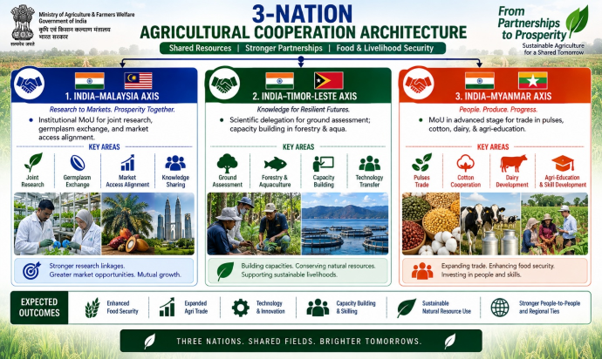
- India–Malaysia Engagement: Agreed to formalize an MoU for joint agricultural research and technology sharing while addressing trade barriers, market access, and germplasm exchange with Malaysian Agriculture Minister Mr. Mohamed Bin Sabu.
-
- India–Timor-Leste Support: Responded to requests from Timor-Leste Agriculture Minister Mr. Marcos Da Cruz by offering technical capacity building and agreeing to depute an Indian scientific expert team to assess ground-level challenges in agriculture, forestry, livestock, and aquaculture.
- India–Myanmar Strategic Trade: Advanced an impending bilateral agricultural MoU with Myanmar Minister Mr. Min Naung. Discussions prioritized enhancing bilateral trade in pulses, cotton, dairy development, and agricultural education along their shared 1,600 km border.
UPSC Quick Reference Table
| Feature | Detailed Specification |
| Nodal Body | Department of Agricultural Research & Education (DARE) / ICAR |
| Event Platform | 9th ASEAN–India Ministerial Meeting on Agriculture and Forestry (AIMMAF) |
| Key Partners | Malaysia, Timor-Leste, and Myanmar |
| Lead Indian Dignitary | Shri Shivraj Singh Chouhan (Union Minister for Agriculture & Farmers Welfare) |
| ore Commodities | Germplasm, Pulses, Cotton, Dairy, and Aquaculture technologies |
| Strategic Framework | Act East Policy & ASEAN-India Comprehensive Strategic Partnership |
Conclusion:
Strengthening agricultural ties with Malaysia, Timor-Leste, and Myanmar advances India’s Act East Policy. Sharing agricultural research, sending expert missions, and streamlining trade in essential food commodities promotes regional food security and economic growth across South East Asia.
TOPIC-2: INS Sudarshini Sails into Livorno, Italy (Lokayan 2026)
-
- UPSC Relevance: GS Paper 2 (Bilateral, Regional, and Global Groupings involving India; India–Italy Strategic Partnership) & GS Paper 3 (Security Challenges & Maritime Security Architecture; Vision MAHASAGAR; Naval Diplomacy).
Introduction: The Indian Navy’s sail training ship INS Sudarshini arrived at Livorno, Italy, on September 09, 2026, as part of Lokayan 2026. The ship has covered over 17,400 nautical miles across 10 countries serving as an ambassador of India’s maritime heritage, seamanship, and international goodwill.
About Lokayan 2026:
-
- Lokayan is the flagship long-range sail training deployment of the Indian Navy, designed to impart traditional seamanship skills to young naval cadets while strengthening bilateral defense diplomacy across ocean regions.
- En route to Livorno, INS Sudarshini conducted a Passage Exercise (PASSEX) with the Italian Navy’s sail training vessel, ITS Palinuro, in the Mediterranean Sea.
- The drills focused on coordinated maneuvering, sail-handling evolutions, and professional exchange between the two navies.
Key Highlights
-
- Passage Exercise in the Mediterranean: Executed joint sailing drills with ITS Palinuro, enabling both crews to exchange best practices in traditional sail-handling and seamanship.
- Institutional Engagement at Accademia Navale: DOCKED at Livorno—home to Italy’s premier Accademia Navale (Italian Naval Academy)—facilitating structured cross-deck visits and exchanges between Indian trainees and Italian officer cadets.
- Operationalizing Vision MAHASAGAR: Advances India’s strategic outreach under MAHASAGAR (Mutual and Holistic Advancement for Security and Growth Across Regions), projecting soft power and maritime cooperation in European waters.
- Public & Diaspora Outreach: The ship will host public visitors, fostering civil society ties and highlighting India’s rich maritime traditions.
UPSC Quick Reference Table
| Feature | Detailed Specification |
| Nodal Force | Indian Navy |
| Vessel Name | INS Sudarshini (Sister ship to INS Tarangini; built by Goa Shipyard Ltd) |
| Expedition Title | Lokayan 2026 |
| Port Call & Location | Livorno, Italy (Home to the Accademia Navale) |
| Joint Naval Drill | Passage Exercise (PASSEX) with Italian Navy’s ITS Palinuro |
| Strategic Framework | Vision MAHASAGAR & Naval Defense Diplomacy |
Conclusion:
The port call of INS Sudarshini in Livorno strengthens India–Italy defense ties and underscores the Indian Navy’s role in global maritime outreach. Combining traditional sail training with institutional cadet exchanges advances Vision MAHASAGAR and builds lasting maritime partnerships in the Mediterranean.
TOPIC-3: Bakhira Lake Sediments Reveal 25,000-Year Climate & Monsoon Record for Central Ganga Plain
-
- UPSC Relevance: GS Paper 1 (Important Geophysical Phenomena, Climate Change & Palaeoclimatology) & GS Paper 3 (Science & Technology — R&D Achievements; Environment, Water Resource Management & Agricultural Resilience).
Introduction: A palaeoclimate study conducted by researchers at the Birbal Sahni Institute of Palaeosciences (BSIP), Lucknow, analyzed 25,000 years of environmental magnetic minerals in sediment layers from Bakhira Lake in Sant Kabir Nagar, Uttar Pradesh.
About Bakhira Lake & Environmental Magnetism Methodology:
-
- Bakhira Lake is a perennial oxbow/floodplain wetland which is designated as a Ramsar Site in 2022, in the Ghaghara–Rapti alluvial system, formed by the migration and subsequent cut-off of the Rapti River.
- Because terrestrial palaeoclimate archives spanning pre-Holocene periods are scarce in the Central Ganga Plain, BSIP researchers integrated environmental magnetic properties (which record soil erosion, weathering, and hydrological shifts) with grain-size, geochemical, and clay mineralogical analyses. The timeline is constrained by seven Accelerator Mass Spectrometry (AMS) radiocarbon dates.
- Published in Palaeogeography, Palaeoclimatology, Palaeoecology study tracks long-term Indian Summer Monsoon (ISM) fluctuations to strengthen future monsoon climate modeling and regional water management across the Central Ganga Plain (CGP).
Key Highlights:
-
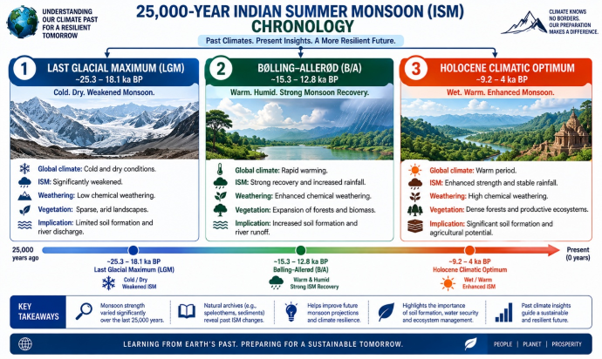
- Last Glacial Maximum (LGM) & Heinrich Stadial 1 (~23–18.1 cal ka BP): Marked by severely cold, dry conditions and a weakened Indian Summer Monsoon (ISM).
- Bølling–Allerød (B/A) Interval (~13–18 cal ka BP): Characterized by a abrupt shift to warm, humid conditions with enhanced monsoon precipitation.
- Younger Dryas (YD) Reversal (~18–11 cal ka BP): Renewed phase of cooling, drying, and weakened monsoon strength.
- Holocene Climatic Optimum (HCO) (~9.2–4 cal ka BP): Peak post-glacial warming, high rainfall, intense pedogenic (soil-forming) activity, and elevated river discharge.
- Late Holocene Drought Phase (~4–2 cal ka BP): Dry, arid conditions marked by reduced monsoon intensity.
- Distinguishing Natural vs. Anthropogenic Climate Change: Establishing an instrumental-free baseline helps climate scientists separate natural monsoonal cycles from modern human-induced global warming.
UPSC Quick Reference Table
| Feature | Detailed Specification |
| Research Institute | Birbal Sahni Institute of Palaeosciences (BSIP), Lucknow (Autonomous DST Institute) |
| Study Site | Bakhira Lake (Sant Kabir Nagar, UP) — Ramsar Site (Designated 2022) |
| Geomorphic Origin | Perennial oxbow wetland formed via Rapti River cutoff |
| Time Horizon | ~25,000 Years (Last Glacial Maximum to Present) |
| Core Methodologies | Environmental Magnetic Minerals + AMS Radiocarbon Dating (7 Control Points) |
| Journal Publication | Palaeogeography, Palaeoclimatology, Palaeoecology (2026) |
| Policy Application | Monsoon modeling, flood/drought mitigation, and agricultural water management in CGP |
Conclusion:
Reconstructing 25,000 years of monsoon history through sediment records at Bakhira Lake fills a critical data gap in the palaeoclimate history of the Central Ganga Plain. Integrating proxy-based historical monsoon data into climate models improves long-term water management, flood mitigation, and agricultural planning in India’s most populous agrarian belt.
TOPIC-4: Legal Notification of the Bankers’ Books Evidence Act, 2026
-
- UPSC Relevance: GS Paper 2 (Government Policies & Interventions for Ease of Doing Business; Governance & Judicial Reforms) & GS Paper 3 (Banking & Financial Sector Reforms, Digital Public Infrastructure, and Technology Integration).
Introduction: The Government of India notified October 1, 2026 as the effective enforcement date for the Bankers’ Books Evidence Act, 2026. Having received Presidential assent on August 13, 2026, the legislation replaces the colonial-era Bankers’ Books Evidence Act, 1891, modernizing the legal framework for producing financial and digital banking records as admissible court evidence.
About the Bankers’ Books Evidence Act, 2026:
-
- The 1891 legacy statute was designed exclusively for paper-based ledgers and physical registers.
- The new 2026 Act establishes a technology-neutral legal framework that explicitly recognizes banking records maintained in physical, electronic, digital, virtual, or cloud-based environments.
- It updates evidentiary procedures to align with modern core banking systems (CBS), digital payment networks, and fintech operations.
Key Highlights:
-
- Technology-Neutral Records Scope: Formally validates financial data across cloud storage, distributed electronic databases, virtual server logs, and digital ledgers as primary admissible evidence.
- Simplified Certification Protocols: Standardizes printouts and digital record certifications using manual, electronic, or digital signatures, removing redundant oral testimony requirements to prove document authenticity.
- Judicial Safeguards for Bank Officials: Restricts the routine summoning of bank officers as witnesses in cases where the bank is not a direct party, requiring courts to record a “special cause” in writing.
- Future-Proof Scope Expansion: Empowers the Central Government to extend these provisions to non-banking financial entities, payment aggregators, and emerging financial sector institutions.
UPSC Quick Reference Table
| Feature | Detailed Specification |
| Nodal Ministry | Ministry of Finance (Department of Financial Services) |
| Enforcement Date | October 1, 2026 (Gazette Notification: Sept 10, 2026) |
| Predecessor Statute | Bankers’ Books Evidence Act, 1891 (Repealed) |
| Presidential Assent | August 13, 2026 |
| Core Innovation | Technology-neutral admissibility (Cloud, Digital, Virtual & Electronic) |
| Evidentiary Standard | Standardized certificates via digital/electronic signatures |
Conclusion:
The Bankers’ Books Evidence Act, 2026 aligns India’s financial evidence framework with modern digital banking practices. Streamlining record certification, reducing unnecessary court appearances for bank personnel, and recognizing electronic records improves judicial efficiency, lowers transaction costs, and supports the nation’s Ease of Doing Business objectives.
Spread the Word