CONTEXT: The report released on 9th APR 2026 by NITI Aayog’s Science & Technology vertical is based on consultations with 110+ universities across all States/UTs. It diagnoses why India’s R&D output especially from State Universities lags its potential despite India’s Global Innovation Index rank improving from 52nd (2019) to 40th (2023).
Parameters taken into consideration:
-
- Consultative exercise structured meetings with Vice Chancellors/Heads of institutions covering 5 regions (NCR, North, East, North-East, South, West & Central).
- R&D activity indicators include faculty strength, PhD enrolment and attrition, full-time equivalent researchers, research proposals submitted/accepted, annual research funding, publications (including TOP25 journals).
- Innovation & IP indicators such as status of IPR cells, patents filed/published/granted, innovation and prototypes supported, copyrights/designs, technology commercialisation and transfers.
- Comparative study of R&D ecosystems in Germany, Japan, and Singapore and India’s Gross Expenditure on R&D (GERD) as % of GDP.
Key Findings of the Report
-
- India’s Global Innovation Index rank improved from 52nd (2019) to 40th (2023).
- India’s GERD stands at only ~0.7% of GDP far below the 2% target set by the Science, Technology and Innovation Policy (STIP) 2013 and behind Germany (~3%), Japan (~3.5%) and other R&D-intensive economies.
- Government remains the dominant funder of India’s R&D.
- Private-sector investment in R&D remains comparatively low, unlike in leading economies where industry funds the bulk of research.
- A strong correlation exists between number of universities and registered R&D units in a State.
- 90% of surveyed universities have an IPR cell but research proposal acceptance and quality not just submission volume remain the binding constraint on research output, especially in State Universities.
- State-funded research proposals appear to receive declining research funding as the number of accepted proposals rises, indicating thin and inconsistent State government support for research.
Recommendations by Level of Action
| Level | Key Recommended Actions |
|---|---|
| University/ Institute-level | • Establish R&D cells & improve infrastructure & instrumentation. • Encourage faculty engagement while incentivise student participation. • Support IP creation & tech transfer & build innovation/entrepreneurship culture. |
| State-level | • Grant greater autonomy & funding. • Identify thrust research areas & enable faculty recruitment autonomy. • Ensure equitable fund distribution & scale up successful projects. • Modernise research instruments. Also enhance fellowships. |
| Central-level | • Accelerate NEP 2020 implementation. • Grant special status for unique institutional needs. • Support maintenance of research equipment & streamline contract-teacher norms. • Ease university establishment rules & exempt State Universities from GST/Income Tax. |
Comparative Chart:
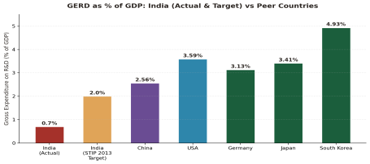
Note: India’s GERD figure is from the report (STIP 2013 base); peer-country figures are OECD/NSF 2022 estimates for reference.
Challenges Highlighted in the Report
-
- Insufficient funding and resources limits acquisition of modern equipment & recruitment/retention of skilled researchers.
- Teaching-research imbalance led to heavy teaching loads leave little time for research.
- Cumbersome administrative processese. bureaucratic approval chains and delayed fund disbursement slow down research execution and deter skilled researchers.
- Weak awareness and outreach around MTech/PhD programmes suppress the research talent pipeline.
- Weak interdisciplinary collaboration, publication-over-substance pressure and brain drain.
Recommendations from the Report
-
- Institutionalise R&D cells in every university/institute aligned with NEP 2020 and UGC guidelines to drive research policy, IPR management and industry linkages.
- Improve infrastructure and faculty incentives like upgraded labs, collaborative spaces, research leave, sabbaticals and research allowances to reward sustained research output.
- Grant States and institutions greater autonomy and funding with equitable needs-based fund distribution and scaled-up support for successful projects.
- Accelerate NEP 2020 implementation, ease establishment/regulatory norms, and consider tax exemptions to free up resources for State Universities.
- Deepen industry-academia and international collaboration to boost applied research, technology transfer and commercialisation, on the model of Germany’s Fraunhofer Society or Japan’s collaborative R&D networks.
Conclusion:
The report is a repository of the multifaceted challenges and considered recommendations for building a vibrant R&D culture in State Universities and Institutes. Therefore, realising India’s ambition to become a global R&D and innovation hub will require sustained investment, greater autonomy for institutions and stronger industry-academia linkages.
Spread the Word