Context: India’s 46 million-plus cities house 30.7% of the urban population and generate ~60% of national GDP, yet remain governed by fragmented, weakly-empowered municipal structures. NITI Aayog Committee report proposes a phased, actionable reform agenda beginning with these cities to build empowered, accountable city governments in support of Viksit Bharat @2047.
Parameters on Which the Report is Based
| Parameter | Scope Used in the Report |
|---|---|
| Scope | 46 Municipal Corporations with population ≥ 10 lakh (Census 2011), covering ~30.7% of India's urban population |
| Core functions reviewed | 6 essential services: Water supply, Sanitation, Solid Waste Management, Urban Planning, Fire Services, Bus Services |
| Fiscal basis | RBI's Report on Municipal Finances, 2024 (232 Municipal Corporations); State Finance Commission (SFC) allocation data |
| Institutional basis | CAG's Compendium of Performance Audits on 74th CAA (2024, 18 States); State Municipal Acts; global comparative study of Mayoral systems (US, UK, Germany, France, China, South Korea, South Africa, Brazil) |
| Legal framework examined | 74th Constitutional Amendment Act, 1992; Articles 243P, 243R, 243S, 243U, 243W, 243-I, 243-Y; Model Municipal Law, 2003 |
Key Terms Used In Report
| Term | Meaning |
|---|---|
| Mayor-in-Council | An apex executive body where the Mayor and selected councillors jointly hold portfolio-based executive charge of departments (contrast: 'Standing Committee' model where power sits with officials/committees, not elected councillors) |
| Parastatal | A state-controlled agency (e.g., Water Board, Development Authority) performing a municipal-type function but reporting to the State Government, not the city government |
| State Finance Commission (SFC) | A body constitutionally mandated (Art. 243-I/243-Y) every 5 years to recommend principles for sharing state revenues with Urban Local Bodies (ULBs) |
| ULB / ULG | Urban Local Body / Urban Local Government are municipal corporation, council or nagar panchayat governing a city |
| 74th CAA | 74th Constitutional Amendment Act, 1992 which gave constitutional status to municipalities and an enabling (not mandatory) list of 18 functions for devolution |
| Million-Plus City | A Municipal Corporation with a population of 10 lakh (1 million) or more as per Census 2011 |
Key Findings
-
- On average, ULBs have full jurisdiction over only 4 of the 18 functions listed in the Twelfth Schedule & core functions like water, sanitation, transport and planning largely remain with State parastatals.
- Weak Mayoral leadership barring 8 States (Bihar, Chhattisgarh, Haryana, Jharkhand, MP, Odisha, UP, Uttarakhand). Mayors are indirectly elected which hold largely ceremonial powers and have tenures ranging from just 1 year (Bengaluru, Delhi) to 5 years (Bhopal) with executive authority vested in the Municipal Commissioner.
- Even in a single city like Bengaluru, six agencies independently handle water (BWSSB), planning (BDA), slums (KSCB), transport (BMTC) and solid waste (BBMP) & none reporting to a unified city government.
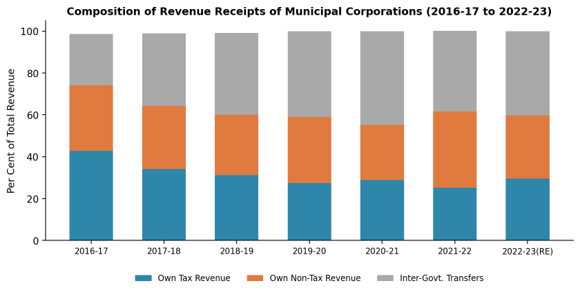
- Own tax revenue’s share of municipal receipts fell from 8% (2016-17) to 29.6% (2022-23 RE), with a corresponding rise in dependence on inter-governmental transfers.
- SFCs suffer chronic delays in constitution (sometimes 3+ years), weak Terms of Reference, poor data and negligible follow-through by States on their recommendations.
- Municipal bond issuance totalled just ₹3,579 crore over 2017–2025 (25 issuances) which is a fraction of what single cities like Tokyo or New York raise annually.
- 61% of ULBs across 17 audited States had no elected council at the time of a 2024 CAG audit & average election delay was 22 months.
Composition of Municipal Revenue (2016-17 to 2022-23)
State-wise Growth in SFC Grants (Select States)
| State | SFC Grants FY13-14 (₹ crore) | SFC Grants FY23-24 (₹ crore) | Growth in Per Capita SFC Grants (%) |
|---|---|---|---|
| Karnataka | 3,300.00 | 4,977.75 | 23.98 |
| Haryana | 118.10 | 2,574.00 | 1521.14 |
| Uttar Pradesh | 4,875.00 | 12,600.00 | 112.54 |
| Kerala | 921.42 | 2,321.41 | 66.18 |
| Odisha | 652.24 | 1,351.65 | 73.32 |
| Tamil Nadu | 2,697.65 | 7,863.85 | 154.63 |
Comparison of Mayoral System
| City/Country | Mayor selection | Executive powers |
|---|---|---|
| New York (USA) | Directly elected | Full executive control over budget, agencies, police |
| London (UK) | Directly elected | Controls transport (TfL), spatial planning, city-wide budget & taxes |
| Seoul (S. Korea) | Directly elected | Powers equivalent to a Provincial Governor; cabinet-level influence |
| Mumbai (India) | Indirect, 2.5 yrs | Ceremonial; Commissioner holds all executive power |
| Delhi (India) | Indirect, 1 yr (rotating) | Ceremonial; Commissioner holds executive power |
|
A GLOBAL STUDY a) Mayor of London: S/He is a directly elected executive head with substantial strategic and operational authority. The Mayor exercises control over city-wide transport through Transport for London (TfL), including buses, metro, and major roads, and plays a central role in spatial planning, housing policy, and environmental regulation3. The Mayor prepares and proposes the Greater London Authority (GLA) budget, levies select city-wide taxes and charges, and appoints heads of key functional bodies, ensuring strong political accountability for metropolitan governance. b) Mayor of the New York: S/He is known for having immense executive power over the city’s vast budget and municipal agencies, including the Police department. The mayor is the clear chief executive, elected directly by the citizens and holding significant administrative and budgetary control. |
Challenges Identified by Report:
-
- Constitutional: Urban governance sits in the State List & 74th CAA is only an enabling, not mandatory, framework which leads to wide inter-state variance.
- Institutional fragmentation: Parallel structures of parastatals, development authorities and State departments dilute municipal authority and accountability.
- Leadership deficit: Short, inconsistent Mayoral tenures and absence of real executive power prevent long-term city planning.
- Fiscal constraints: Weak property tax systems, poor user-charge recovery, and unpredictable SFC-based transfers restrict investment capacity.
- Capacity gaps: Acute shortage of specialised staff (planning, engineering, finance); heavy reliance on deputation causes discontinuity.
- Electoral uncertainty: Delayed elections and prolonged administrator rule undermine democratic accountability at the city level.
Key Recommendations
1. Empowered, directly elected Mayor: 5-year term co-terminus with the council, Mayor to be designated head of city government with overall executive authority (State Municipal Acts to be amended & Model Municipal Law, 2003 to be revised).
2. Mayor-in-Council system: Replace Standing Committees with a portfolio-based Mayor-in-Council & mandatory Zonal Committees for decentralised, ward-level governance.
3. Bring parastatals under city control: Where services are delivered by city-specific SPVs/parastatals, shift administrative reporting to the city government & where state-wide entities exist, create city-specific subsidiaries reporting administratively to the Mayor.
4. Strengthen State Finance Commissions: Mandate timely constitution (2 years before award period), fixed timelines for Action Taken Reports (6 months), and public disclosure of ULB-wise grant allocations.
5. Ensure timely, regular elections: Mandatory legislative sanction required for any dissolution of ULBs beyond a prescribed period.
6. Phased implementation: Begin with the 46 million-plus cities as demonstration models, given their institutional readiness, before scaling reforms to all urban India.
Conclusion:
However, urban governance is a state subject & success depends on State-level legislative action with MoHUA’s revised Model Municipal Law and capacity-building support (iGOT-style) serving as the principal levers of central facilitation.
Spread the Word