CONTEXT: 2nd edition of the FHI is released by NITI Aayog (March 2026) ranks 18 major States and for the first time 10 North-Eastern & Himalayan States on fiscal soundness using CAG-verified data for FY 2023-24.
Parameters on which the Report is Based
i. Quality of Expenditure-It is a ratio of developmental to total expenditure and capital outlay as a share of GSDP (higher = better).
ii. Revenue Mobilisation– State’s own revenue relative to GSDP and to total expenditure (higher = better).
iii. Fiscal Prudence– Gross Fiscal Deficit and Revenue Deficit as a share of GSDP; growth of GSDP vis-à-vis growth of interest payments (lower deficit = better).
iv. Debt Index– Interest Payments as a share of Revenue Receipts and Outstanding Liabilities as a share of GSDP (lower = better).
v. Debt Sustainability– It is capacity to service debt without compressing developmental spending, based on CAG-verified data for FY 2023-24.
Meaning of Key Terms
-
- Fiscal Health Index (FHI) is a composite score (0-100) built by NITI Aayog to measure how soundly a State manages its finances, across five pillars of fiscal health.
- Fiscal Deficit is the gap between a government’s total expenditure and its total non-debt receipts, financed through borrowing.
- Debt Sustainability can define as a government’s ability to service its existing and future debt obligations without disrupting essential spending or requiring drastic corrective measures.
- Committed Expenditure is largely non-discretionary spending on salaries, pensions and interest payments, which limits fiscal flexibility.
- Gross State Domestic Product (GSDP) is the state-level equivalent of GDP which is used to scale fiscal indicators for comparability across States.
Key Findings of the Report
i. Odisha ranks 1st among 18 major States with an FHI score of 73.1 (up from 67.4 in 2022-23). It is driven by controlled deficits, high-quality expenditure and prudent debt management.
ii. Goa (2nd, 54.7) and Jharkhand (3rd, 50.5) complete the ‘Achiever’ category which is marked by own-tax shares above 60% and fiscal deficits below 3% of GSDP.
iii. Punjab ranks lowest (18th, 12.4) followed by Andhra Pradesh, West Bengal and Kerala are the ‘Aspirational’ group which are facing debt of 35-45% of GSDP and committed expenditure of 50-60% of revenue receipts.
iv. Among NE/Himalayan States, Arunachal Pradesh tops (59.5) on strong expenditure quality, while Himachal Pradesh and Manipur trail due to weak revenue mobilisation and high committed spending.
v. Structural divergence over the decade: States with stronger revenue capacity and disciplined expenditure (Odisha, Gujarat, Jharkhand) continue to improve, while Punjab, West Bengal and Kerala remain persistently constrained by weak fiscal prudence and sustained debt pressure.
India-Specific Data & Comparative Analysis
| Indicator | Value / Data Point |
|---|---|
| Global public debt (2024) | USD 102 trillion |
| Developing countries' share of debt spent on debt service (≥) | 6.5% of export earnings (half of developing countries) |
| Countries spending more on interest than health/education | 46 countries, affecting 3.4 billion people |
| Share of India's general government debt held by States | ~ one-third |
| States covered in FHI 2026 (2nd edition) | 18 Major States + 10 NE/Himalayan States |
| Reference period for longitudinal trend analysis | FY 2014-15 to FY 2023-24 |
Comparation B/W Top-4 vs Bottom-Ranked State
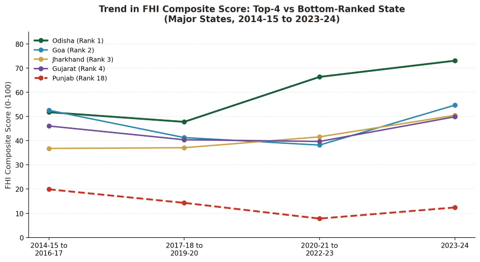
Note: Scores are 3-year period averages except FY 2023-24, which is a single-year score. Source: NITI Aayog FHI 2026, Table A2.
Challenges Highlighted in the Report
-
- Rising global public debt is up sharply over the past decade on pandemic-era stimulus, climate spending and geo-economic fragmentation.
- IMF projects it may near 100% of world GDP by decade-end, narrowing fiscal space everywhere.
- State debt now equals almost one-third of India’s general government debt, driven by rising subsidies, interest payments and committed expenditure.
- Persistent structural constraints in Aspirational States like Punjab, West Bengal, Kerala and Andhra Pradesh show weak fiscal prudence, narrow own-revenue capacity and widening debt.
- Geography-driven fiscal stress in NE/Himalayan States due to difficult terrain, sparse population and limited own-revenue capacity keep several States heavily dependent on Union transfers.
- Divergence, not convergence as fiscally disciplined States continue to pull ahead while structurally constrained States show little improvement, widening inter-state fiscal disparity.
Recommendations from the Report
i. Strengthen revenue mobilisation by broadening GST bases and enhancing own-tax capacity, especially in Aspirational-category States while curbing committed expenditure to restore fiscal flexibility.
ii. Rationalise subsidies by adopting standard expenditure heads and improve quality and composition of capital spending via medium-term fiscal plans.
iii. Undertake targeted fiscal consolidation in stressed States & tighter control of off-budget borrowings and stronger cash/debt management.
iv. Enhance Public Financial Management systems through transparency via CAG-verified data and peer benchmarking through tools like the FHI.
Conclusion:
The FHI 2026 shows State-level fiscal health is integral to India’s macroeconomic stability with States now holding nearly a third of general government debt. It signals deep structural rigidities that call for sustained fiscal governance reform and evidence-based benchmarking.
Spread the Word