TOPIC-1: India–Belgium Joint Statement
-
- GS Paper 2 (Bilateral Groupings and Agreements involving India; India–EU Strategic Partnership; UN Security Council Reforms; Maritime & Defence Security).
Context: Prime Minister of Belgium H.E. Mr. Bart De Wever paid an official visit to India (2–4 September 2026), marking his first visit to the country since taking office in February 202 Co-chairing talks with Prime Minister Narendra Modi. Both leaders agreed to target a doubling of bilateral trade within 5 years, launch a new Investment Fast-Track Mechanism and establish an India-Belgium Joint Working Group on Counter-Terrorism.
About India–Belgium Bilateral Strategic Partnership
-
- The bilateral visit builds upon the inaugural India-Belgium Strategic Dialogue launched in Brussels on 15 July 2026 and sets the stage for the 80th anniversary of diplomatic relations in 2027.
- The strategic relationship operates within the broader India–EU Free Trade Agreement (concluded during the January 2026 Summit) and the India-EU Trade and Technology Council (TTC)
- Belgium reaffirmed its support for India’s candidature for a permanent seat on a reformed UN Security Council (UNSC).
Key Highlights
-
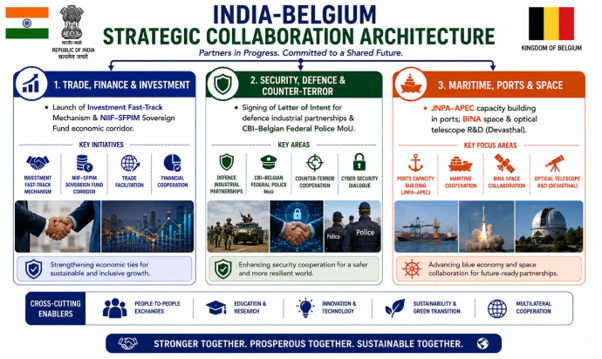
- Targeted Trade Doubling & Investment Corridors: Set a target to double bilateral trade over the next 5 years, backed by the launch of the India-Belgium Investment Fast-Track Mechanism and cooperation between Belgium’s sovereign fund (SFPIM) and India’s National Investment and Infrastructure Fund (NIIF).
-
- Counter-Terrorism & Police Cooperation: Agreed to establish a dedicated Joint Working Group on Counter-Terrorism and signed an MoU between India’s Central Bureau of Investigation (CBI) and the Federal Police of Belgium to combat transnational organized crime and cybercrime.
- Defence-Industrial Partnerships: Signed a Letter of Intent (LoI) between both Ministries of Defence for staff talks, military medicine, and defence-industrial co-production, alongside reciprocally stationing Defence Attachés in New Delhi and Brussels.
- Ports, Maritime & Renewable Energy: Focused on port infrastructure development linking Jawaharlal Nehru Port Authority (JNPA) with Antwerp/Flanders Port Training Centre (APEC), alongside renewing the MoU on Renewable Energy Cooperation (green hydrogen, offshore wind, and small hydropower).
- Semiconductor & Tech Partnerships: Agreed to link the ChipIn Centre, C-DAC, and Indian microelectronics hubs with Belgium’s imec for advanced semiconductor technology development.
UPSC Quick Reference Table
| Feature | Detailed Specification |
| Nodal Ministries | Ministry of External Affairs (India) & Federal Public Service Foreign Affairs (Belgium) |
| Key Dignitaries | Prime Minister Shri Narendra Modi & Prime Minister H.E. Mr. Bart De Wever |
| Trade Goal | Double bilateral trade within 5 years |
| Bilateral Mechanisms | Investment Fast-Track Mechanism & NIIF–SFPIM Economic Corridor |
| Law Enforcement Pact | CBI (India) – Federal Police (Belgium) MoU on cybercrime & organized crime |
| UNSC Support | Belgium reaffirmed support for India’s permanent seat on a reformed UNSC |
| Mutual UNSC Non-Perm Seats | India supported for 2028–29; Belgium supported for 2037–38 |
Conclusion:
The visit of Prime Minister Bart De Wever strengthens India–Belgium ties across trade, semiconductor R&D, counter-terrorism, and port logistics. Aligning bilateral mechanisms with the broader India–EU Free Trade Agreement advances economic integration, defense industry ties, and maritime security in the Indo-Pacific region.
TOPIC-2: SHG-Bank Linkages Review & Credit Roadmap for Women Entrepreneurs
-
- GS Paper 2 (Government Policies & Interventions for Development; Self-Help Groups [SHGs] and Financial Inclusion)
- GS Paper 3 (Inclusive Growth, Rural Credit Architecture, DAY-NRLM, and Women Entrepreneurship).
Introduction: Union Minister for Rural Development on Self-Help Group (SHG)-bank linkages under the Deendayal Antyodaya Yojana-National Rural Livelihoods Mission (DAY-NRLM). The meeting laid out a credit roadmap to expand the Lakhpati Didi target from 3 crore to 6 crore women, allocating ₹10 lakh crore to SHGs and ₹1 lakh crore for individual women entrepreneurs over the next 5 years.
About DAY-NRLM:
-
- DAY-NRLM is the flagship rural poverty alleviation program under the Ministry of Rural Development, organizing over 10 crore rural women into 92–93 lakh SHGs with cumulative bank credit disbursals surpassing ₹167 lakh crore.
- The new roadmap establishes the framework for Financial Inclusion aiming to eliminate regional credit disparities, streamline bank-level processing, mandate private bank participation in District Level Consultative Committees (DLCCs) and establish a dedicated helpline for SHG loan facilitation.
Key Highlights:
-
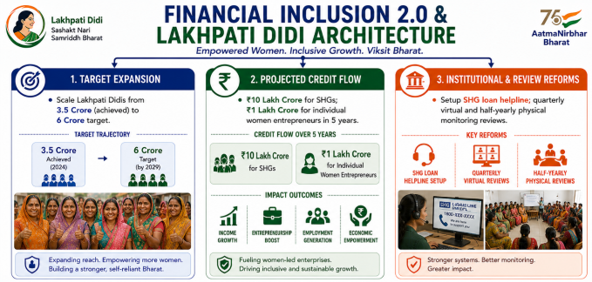
- Expansion of Lakhpati Didi Goal: Scaled the national target from 3 crore to 6 crore Lakhpati Didis, targeting rural women earning in the lower brackets (₹30,000–₹50,000 annually) for systematic income enhancement.
- Massive Credit Allocation Plan: Pledged ₹10 lakh crore in bank credit for SHG collective loans and ₹1 lakh crore in targeted loans for individual women entrepreneurs over the next 5 years.
- Time-Bound Review Governance: Institutionalized mandatory quarterly virtual reviews and half-yearly physical reviews with State Rural Livelihood Missions (SRLMs), RBI, NABARD, and commercial banks to track credit flows.
- Enforcing Private Bank Accountability: Directed private commercial banks to strictly participate in District Level Consultative Committee (DLCC) meetings and contribute to rural credit targets.
- Focus on Regional Equity: Mandated banks to prioritize underserved and high-poverty districts (“light the lamp where darkness exists”) to remove regional credit access imbalances.
UPSC Quick Reference Table
| Feature | Detailed Specification |
| Nodal Ministry | Ministry of Rural Development, Government of India |
| Parent Scheme | Deendayal Antyodaya Yojana-National Rural Livelihoods Mission (DAY-NRLM) |
| Revised Target | 6 Crore Lakhpati Didis (Up from initial 3 Crore; ~5 Crore achieved) |
| 5-Year Credit Outlay | ₹10 Lakh Crore (SHGs) & ₹1 Lakh Crore (Individual Women Entrepreneurs) |
| Cumulative SHG Metrics | 10 Crore+ Rural Women mobilized into 92–93 Lakh SHGs; ₹167 Lakh Crore disbursed |
| Institutional Governance | Quarterly Virtual / Half-Yearly Physical Reviews; SHG Credit Helpline |
Conclusion:
Expanding bank credit access and enforcing time-bound monitoring under DAY-NRLM strengthens the financial ecosystem for rural women. Scaling the Lakhpati Didi initiative to 6 crore women drives grassroots entrepreneurship, deepens financial inclusion, and supports inclusive economic growth across rural India.
TOPIC-3: NFRA Constitutes Advisory Committee on Audit Quality, Assurance and Technology
-
- GS Paper 2 (Statutory, Regulatory and Various Quasi-Judicial Bodies — NFRA)
- GS Paper 3 (Indian Economy — Corporate Governance, Auditing Standards, Financial Reporting, and Technology Integration).
Introduction: The National Financial Reporting Authority (NFRA) constituted an Advisory Committee on Audit Quality, Assurance and Technology on September 4, 2026 formed under Rules 15 and 16 of the NFRA Rules 2018. The panel will advise on strengthening audit quality, auditing standards, assurance practices, and technological integration across corporate financial reporting in India.
About NFRA: The National Financial Reporting Authority (NFRA) was constituted in October 2018 under Section 132(1) of the Companies Act, 2013, as an independent regulator for auditing and accounting standards.
Advisory Panel Framework: The newly constituted committee represents NFRA’s third major advisory body—following the Technical Advisory Committee (2020–2022) and Advisory Group on Auditor-Audit Committee Resources (July 2024). It brings together experts from across regulatory bodies, corporate audit committees, CFOs, independent directors, technology experts and accounting professionals.
Key Highlights
-
- Statutory Authorization: Invokes Rules 15 and 16 of the NFRA Rules 2018, which authorize NFRA to establish study groups, committees, and task forces to promote awareness of auditing standards.
-
- Multi-Stakeholder Advisory Composition: Connects regulators, industry representatives, chief financial officers (CFOs), independent directors, and technology specialists to address emerging corporate reporting challenges.
- Technology & Assurance Integration: Focuses on leveraging advanced audit technologies (such as automated data analytics, forensic tools, and AI) to enhance assurance quality and prevent financial reporting fraud.
- Evolution of NFRA Advisory Panels: Continues institutional capacity building following the Technical Advisory Committee (2020–2022) and the Advisory Group formed in July 2024 for auditor-audit committee outreach.
UPSC Quick Reference Table
| Feature | Detailed Specification |
| Nodal Regulator | National Financial Reporting Authority (NFRA), Ministry of Corporate Affairs |
| Parent Statute | Section 132 of Companies Act, 2013 & Rules 15–16 of NFRA Rules, 2018 |
| New Panel Name | Advisory Committee on Audit Quality, Assurance and Technology |
| Primary Objective | Provide expert inputs on audit quality, tech integration, and assurance standards |
| Stakeholder Groups | CFOs, Audit Committees, Independent Directors, Tech Experts, and Industry Leaders |
| Institutional Lineage | 3rd major panel (Post Technical Advisory Committee 2020 & Advisory Group 2024) |
Conclusion:
Constituting the Advisory Committee on Audit Quality, Assurance and Technology strengthens NFRA’s capacity to regulate financial reporting. Incorporating multi-stakeholder expertise and technology tools improves audit transparency, boosts investor confidence, and aligns Indian corporate governance with international standards.
TOPIC-4: ISRO Successfully Launches GSLV-F17 Carrying EOS-05 Earth Observation Satellite
-
- GS Paper 3 (Science and Technology — Developments and Applications, Achievements of Indians in Science & Technology; Space Technology [ISRO, Earth Observation Satellites, Commercialization & Private Sector Partnerships]).
Introduction: Prime Minister Shri Narendra Modi commended ISRO for the successful launch of the GSLV-F17 mission carrying Earth Observation Satellite-05 (EOS-05) on September 04, 2026. EOS-05 marks a major technological milestone as India’s first-ever high-resolution imaging satellite placed into Geosynchronous Orbit, expanding national remote sensing and real-time disaster monitoring capabilities.
About GSLV-F17 Mission:
The EOS-05 mission utilized ISRO’s Geosynchronous Satellite Launch Vehicle (GSLV) equipped with an indigenous Cryogenic Upper Stage (CUS).
EOS-05 Satellite: Unlike conventional Earth Observation Satellites positioned in Low Earth Orbit (LEO), placing EOS-05 into Geosynchronous Orbit (~35,786 km) allows continuous, real-time imaging and stationary observation over the Indian subcontinent. The mission also highlights expanding public-private partnerships under national space sector reforms, integrating private industry components across the supply chain.
Key Highlights
-
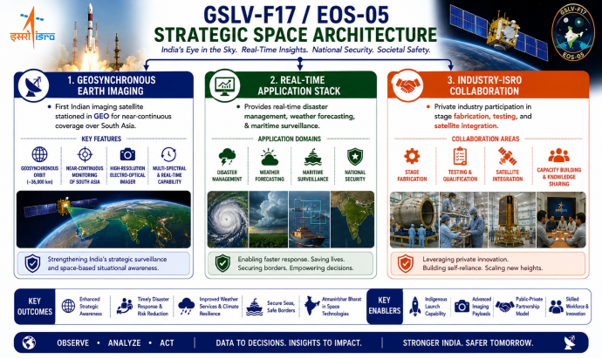
- First GEO Imaging Satellite: Positions EOS-05 in a geosynchronous orbit, enabling constant, high-cadence monitoring over the Indian landmass and maritime domain without orbital gap delays.
- Disaster Management & Agriculture: Delivers near-real-time observations for rapid response during cyclones, flash floods, landslides, agricultural monitoring, and oceanographic surveillance.
- GSLV Cryogenic Capability: Demonstrates the continued reliability of ISRO’s indigenous Cryogenic Upper Stage (CUS) on the three-stage GSLV rocket for heavy-payload orbital insertions.
- Public-Private Space Ecosystem: Built with manufacturing contributions from domestic private space industries, advancing commercial space ecosystem goals led by IN-SPACe and NSIL.
UPSC Quick Reference Table
| Feature | Detailed Specification |
| Nodal Agency | Indian Space Research Organisation (ISRO), Department of Space |
| Launch Vehicle | GSLV-F17 (Geosynchronous Satellite Launch Vehicle with Indigenous CUS) |
| Payload | EOS-05 (Earth Observation Satellite-05) |
| Orbit Type | Geosynchronous Orbit (GEO) (~35,786 km) |
| Primary Distinction | India’s first-ever imaging satellite stationed in Geosynchronous orbit |
| Key Applications | Near real-time disaster management, weather monitoring, agriculture & ocean studies |
Conclusion:
The successful launch of EOS-05 aboard GSLV-F17 expands India’s space technology capabilities, transitioning Earth observation from periodic LEO passes to continuous geosynchronous coverage. Integrating private defense and aerospace manufacturers strengthens the domestic space sector under Aatmanirbhar Bharat.
Spread the Word