TOPIC-1: 26th SCO Summit in Bishkek, Kyrgyz Republic
-
- GS Paper 2 (Bilateral, Regional, and Global Groupings involving India; Shanghai Cooperation Organization [SCO]; Regional Security, Counter-Terrorism, and Connectivity Architecture).
Context: Prime Minister Shri Narendra Modi participated in the 26th Meeting of the Council of Heads of State of the Shanghai Cooperation Organization (SCO) held in Bishkek, Kyrgyz Republic (August 31 – September 01, 2026). Summit focused on regional security, counter-terrorism, sovereignty-based connectivity and cultural cooperation under the theme “25 Years of the SCO: Together Towards Sustainable Peace, Development and Prosperity”.
About the 26th SCO Summit & India’s Engagement
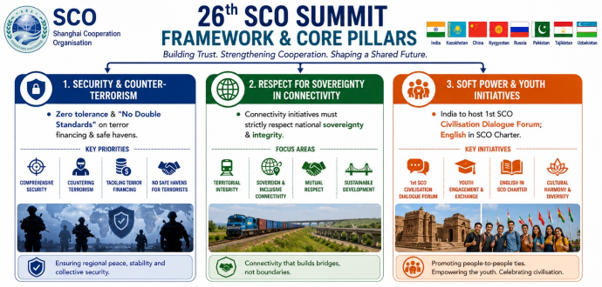
Chaired by Kyrgyz President H.E. Sadyr Zhaparov at Yrys Ordo in Bishkek summit brought together leaders of SCO member states to establish a strategic roadmap for the next 25 years. India reiterated its core SCO framework anchored on three pillars—Security, Connectivity, and Opportunity.
Key Highlights:
-
- Zero Tolerance for Terrorism: Called for committed collective action to dismantle terror financing, radicalization, and safe havens, stressing that there must be no double standards in combating terrorism.
- Dialogue over Conflict: Reaffirmed that regional and global conflicts cannot be resolved on the battlefield and that dialogue and diplomacy remain the only path forward.
- Sovereignty-Compliant Connectivity: Supported regional trade networks and market links while reiterating that all connectivity projects must strictly respect the sovereignty and territorial integrity of member states.
- Key Summit Outcomes & Adopted Documents:
- Adopted the landmark Bishkek Declaration, 4 MoUs, and over 20 decisions covering climate action, nuclear safety, energy conservation, and drug control.
- Adopted Indian-led initiatives, including introducing English as an Official Language in the SCO Charter, establishing the Civilisation Dialogue Forum, the Young Scientist Forum, and the Young Author’s Conclave.
- Hosting Flagship Forum: Announced that India will host the first edition of the SCO Civilisation Dialogue Forum later this year to deepen cultural and historical exchanges.
UPSC Quick Reference Table
| Feature | Detailed Specification |
| Nodal Event | 26th SCO Heads of State Summit (Bishkek, Kyrgyz Republic) |
| Chairperson / Host | H.E. Sadyr Zhaparov (President of the Kyrgyz Republic) |
| Milestone Celebrated | 25th Anniversary of the SCO (Founded in 2001) |
| India’s Core Framework | Security, Connectivity, Opportunity |
| Key Outcome Document | Bishkek Declaration (plus 4 MoUs and 20+ thematic decisions) |
| Indian Led Initiatives | English in SCO Charter, Civilisation Dialogue Forum, Young Scientist Forum |
Conclusion:
India’s active participation in the 26th SCO Summit reinforces its commitment to regional stability, counter-terrorism, and sovereignty-based economic connectivity. Driving initiatives like the Civilisation Dialogue Forum and advocating for English in the SCO Charter strengthens India’s soft power footprint across Eurasia.
TOPIC-2: 4th India–Denmark Joint Working Group Meeting on MSMEs & Intellectual Property
-
- GS Paper 2 (Bilateral Groupings & Agreements involving India; International Institutional Frameworks)
- GS Paper 3 (Indian Economy — Micro, Small, and Medium Enterprises [MSMEs], Intellectual Property Rights [IPR], Innovation Ecosystems, and Cluster-Based Development).
Context: The 4th Meeting of the India–Denmark Joint Working Group (JWG) was held in Copenhagen, Denmark (24–28 August 2026) to advance bilateral cooperation in MSME development, innovation and Intellectual Property (IP). The meeting brought together India’s Ministry of MSME and Danish Patent and Trademark Office (DKPTO) to build on the broader India–Denmark Green Strategic Partnership.
About India–Denmark JWG:
The JWG framework provides a bilateral platform to align India’s growing MSME sector with Denmark’s advanced innovation ecosystems, technology transfer models, and IP management systems.
Key Highlights
-
- Focus on IP & Technology Commercialization: Exchanged best practices on utilizing intellectual property (patents, trademarks, and design rights) as tools to enable MSMEs to commercialize academic R&D and scale technologies.
- Study of Danish Innovation Clusters: Visited Aarhus University’s Innovation “Kitchen” and the Agro Food Park cluster to gain technical insights on business incubators, industry-academia linkages, and mentoring networks.
- Nordic-India Startup Synergy: Participated in the Nordic–India Startup Summit 2026 (TechBBQ) to connect Indian entrepreneurs with Nordic venture networks, startup accelerators, and technological partners.
- Institutional Development: Engaged the Danish Ministry of Industry, Business and Financial Affairs to review policy frameworks for entrepreneurship and cluster-based MSME support.
UPSC Quick Reference Table
| Feature | Detailed Specification |
| Nodal Agencies | Ministry of MSME (India) & Danish Patent and Trademark Office (DKPTO, Denmark) |
| Event & Location | 4th Joint Working Group (JWG) Meeting, Copenhagen, Denmark (24–28 August 2026) |
| Delegation Leads | Dr. Rajneesh (Addl. Secy, MoMSME) & Maria Skou (Deputy DG, DKPTO) |
| Overarching Framework | India–Denmark Green Strategic Partnership |
| Key Innovation Sites | Aarhus University Innovation “Kitchen” & Agro Food Park |
| Nordic Event Attended | Nordic–India Startup Summit 2026 (TechBBQ) |
Conclusion:
The 4th JWG meeting advances India–Denmark economic cooperation by embedding intellectual property rights and cluster-based innovation into the MSME sector. Leveraging Danish incubators and startup networks strengthens technological adoption, competitiveness, and global integration for Indian small businesses.
TOPIC-3: India-Germany Cooperation for Sustainable Development & Energy Security
-
- GS Paper 2 (Bilateral Groupings & Agreements involving India; Global Strategic Partnerships)
- GS Paper 3 (Indian Economy — Energy Security, Decarbonization, Climate Action, and Carbon Markets).
Context: Union Minister for Power and Housing & Urban Affairs Shri Manohar Lal held a bilateral meeting with German Federal Minister for Environment, Climate Protection, and Nuclear Safety Mr. Carsten Schneider in New Delhi on September 2, 2026. The meeting focused on accelerating energy security, electrification, low-carbon development, and carbon market mechanisms.
About India-Germany Energy & Climate Partnership:
The bilateral engagement builds upon 75 years of diplomatic relations and 25 years of the India-Germany Strategic Partnership. The meeting reinforces ongoing initiatives under the Green and Sustainable Development Partnership (GSDP) focusing on the interlinked goals of clean energy transition, supply chain diversification, and climate resilience.
Key Highlights:
-
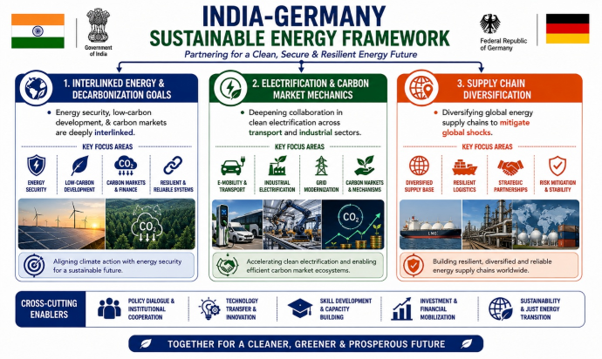
- Interlinked Climate-Energy Pillar: Both ministers agreed that energy security, low-carbon development, and carbon credit markets are deeply interlinked and mutually reinforcing.
- Carbon Markets & Electrification: Focused on developing reliable carbon market mechanisms and driving cross-sectoral electrification to achieve net-zero targets.
- Resilient Energy Supply Chains: Emphasized diversifying supply chains for critical clean technologies, renewable components, and energy storage systems.
- Synergy with 4th Indo-German Environment Forum: Follows the 4th Indo-German Environment Forum (“Together for More Resilience”), advancing circular economy models, low-carbon industries, and sustainable finance.
UPSC Quick Reference Table
| Feature | Detailed Specification |
| Nodal Ministries | Ministry of Power & MoHUA (India) & Federal Ministry for Environment (BMUKN, Germany) |
| Key Dignitaries | Shri Manohar Lal (Union Minister) & Mr. Carsten Schneider (German Federal Minister) |
| Diplomatic Context | 75 Years of Diplomatic Relations & 25 Years of Strategic Partnership |
| Primary Focus Areas | Energy Security, Electrification, Low-Carbon Development, and Carbon Markets |
| Overarching Framework | Green and Sustainable Development Partnership (GSDP) |
Conclusion:
The bilateral engagement between India and Germany strengthens clean energy cooperation, helping align energy security with low-carbon growth. Leveraging carbon markets, green technology exchanges, and resilient supply chains supports both nations in achieving sustainable development goals.
TOPIC-4: Legal Metrology (Indian Standard Time) Rules, 2026
-
- GS Paper 2 (Government Policies & Interventions for Governance & Infrastructure)
- GS Paper 3 (Science & Technology — Metrology, Digital Public Infrastructure, Cybersecurity, and Space Applications [NavIC]).
Context: The Department of Consumer Affairs notified the Legal Metrology (Indian Standard Time) Rules, 2026 to establish Indian Standard Time (IST) as the common, legally recognized and traceable time reference across India. Coming into force 180 days after publication in the Official Gazette rules advance government’s “One Nation, One Time” vision for digital and strategic infrastructure.
About the Legal Metrology (IST) Rules & Scientific Foundations:
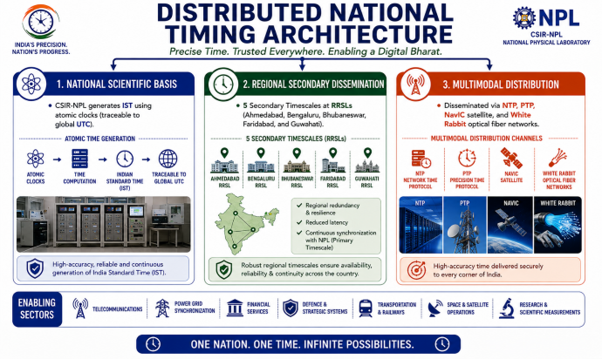
The rules provide an enforceable regulatory framework for the generation, maintenance, dissemination, and usage of IST across all administrative, commercial, and technical systems. While the Department of Legal Metrology serves as the regulatory and enforcement body, the CSIR-National Physical Laboratory (CSIR-NPL) acts as the scientific custodian of IST. CSIR-NPL maintains India’s primary atomic time scale (), ensuring continuous nanosecond-level traceability to Coordinated Universal Time (UTC) maintained by BIPM.
Key Highlights
-
- National Security & Cybersecurity Synchronization: Accurate timestamps support digital financial transactions, power grid coordination, telecom logs, and CERT-In compliance during cyber incident investigations.
- Distributed Regional Network: CSIR-NPL, ISRO, and Legal Metrology established secondary time scales across 5 Regional Reference Standard Laboratories (RRSLs) to eliminate reliance on a single central point of failure.
- Indigenous Satellite & Fiber Dissemination: Leverages ISRO’s NavIC satellite constellation for satellite-based time dissemination, alongside high-precision White Rabbit sub-nanosecond optical fiber technology for stock exchanges and critical infrastructure.
- 180-Day Transition Window: Provides digital platforms, financial institutions, power utilities, and government entities time to align internal systems with traceable IST sources.
UPSC Quick Reference Table
| Feature | Detailed Specification |
| Nodal Department | Department of Consumer Affairs, Ministry of Consumer Affairs, Food & Public Distribution |
| Scientific Custodian | CSIR-National Physical Laboratory (CSIR-NPL) |
| Implementation Vision | “One Nation, One Time” |
| Grace Period | 180 Days from Official Gazette publication |
| Secondary Time Hubs | 5 RRSLs (Ahmedabad, Bengaluru, Bhubaneswar, Faridabad, Guwahati) |
| Technology Stack | NavIC (ISRO Satellite), NTP/PTP, and White Rabbit (Fiber Network) |
Conclusion:
The Legal Metrology (IST) Rules, 2026 give formal legal standing to time measurement in India. Establishing a resilient, indigenous timing infrastructure across CSIR-NPL, ISRO’s NavIC and regional laboratories improves cybersecurity, aligns critical systems and strengthens digital sovereignty.
Spread the Word