TOPIC-1: 14th India–UAE High Level Joint Task Force Meeting on Investments
-
- UPSC Relevance: GS Paper 2 (Bilateral, Regional, and Global Groupings involving India; Bilateral Agreements — CEPA & BIT) & GS Paper 3 (Indian Economy — Foreign Direct Investment [FDI], Financial Sector Integration, Local Currency Settlement, and Infrastructure Investments).
Introduction: The 14th Meeting of the India–UAE High Level Joint Task Force on Investments (HLJTFI) was held in Mumbai on September 28, 2026 reviewed progress of the Comprehensive Economic Partnership Agreement (CEPA) and advanced major joint investment projects.
About the HLJTFI:
-
- The HLJTFI established in 2013, provides an institutional platform to promote two-way investment flows, address investor grievances through the UAE–India Fast Track Mechanism, and facilitate strategic economic partnerships.
- Bilateral trade reached US$101.25 billion in FY 2025–26 200 billion in two-way trade by 2032.
Key Highlights:
-
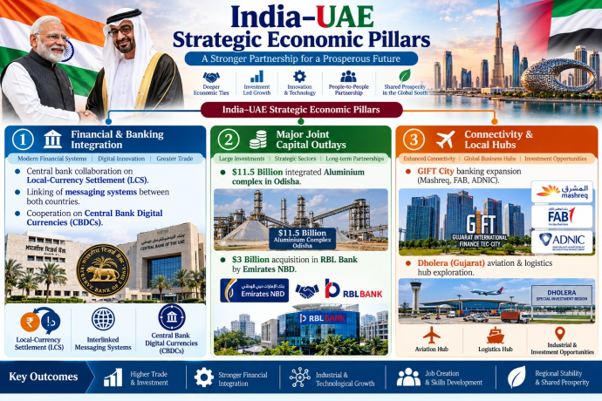
- Financial Sector Interoperability: Central banks of both nations advanced protocols for Local Currency Settlement (LCS), cross-border integration of payment and messaging systems (linking India’s SFMS with UAE equivalents), and Central Bank Digital Currencies (CBDC).
- High-Value Investment Milestones:
- Joint intent for a US$11.5 billion integrated Aluminium complex in Odisha.
- Emirates NBD acquired a majority stake (~US$3 billion) in India’s RBL Bank.
- International Holding Company (IHC) invested US$1 billion in Sammaan Capital.
- Institutional Expansion: Announced the operationalization of an Invest India office in the UAE before the end of 2026. Welcomed branch openings of Mashreq Bank, First Abu Dhabi Bank (FAB), and ADNIC in GIFT City, Gujarat.
- Infrastructure & Food Security: Reviewed progress on the Gujarat Food Park project, strategic crude energy storage cooperation, and potential investments in an aviation and logistics hub at Dholera, Gujarat.
UPSC Quick Reference Table
| Feature | Detailed Specification |
| Nodal Forum | 14th India–UAE High Level Joint Task Force on Investments (HLJTFI) |
| Co-Chairs | Shri Piyush Goyal (Union Commerce Minister) & H.H. Sheikh Hamed bin Zayed Al Nahyan (ADIA) |
| Bilateral Trade Status | US$101.25 Billion (FY 2025–26) | Target: US$200 Billion by 2032 |
| Key Economic Treaties | CEPA (Comprehensive Economic Partnership) & BIT (Bilateral Investment Treaty) |
| Major Industrial Project | US$11.5 Billion Integrated Aluminium Complex in Odisha |
| GIFT City Expansion | Branch operationalization of FAB, Mashreq Bank, and ADNIC |
| Dispute Resolution | UAE–India Fast Track Mechanism for investor grievance redressal |
Conclusion:
The 14th HLJTFI meeting underscores the deepening economic integration between India and the UAE. Aligning trade agreements (CEPA/BIT) with financial system integration, local currency settlements, GIFT City expansions, and mega-infrastructure investments supports energy security, supply chain resilience, and sustained capital inflows.
TOPIC-2: 2nd India–Ethiopia Joint Defence Cooperation (JDC) Meeting in Addis Ababa
-
- UPSC Relevance: GS Paper 2 (Bilateral, Regional and Global Groupings and Agreements involving India; India–Africa Relations & Strategic Partnerships) & GS Paper 3 (Defense Industry Cooperation, Peacekeeping Operations, & Joint Defense Production).
Introduction: The 2nd Joint Defence Cooperation (JDC) meeting between India and Ethiopia took place on September 28, 2026, in Addis Ababa focused on deepening military training, joint defense manufacturing, medical cooperation, and UN peacekeeping collaboration.
Institutional Context:
India–Ethiopia defense ties date back to 1958 with the establishment of the Harar Military Academy.
Institutional framework milestones include:
-
- February 2025: Bilateral Defence Cooperation MoU signed by the respective Defence Ministers.
- October 2025: Inaugural JDC meeting held in New Delhi.
- December 2025: Bilateral relationship elevated to a ‘Strategic Partnership’ during the visit of the Prime Minister of India to Ethiopia.

Key Highlights:
-
- Defense Production Joint Ventures: Discussions prioritized exploring defense industrial partnerships, leveraging Indian public and private defense manufacturers to supply equipment and establish joint manufacturing units.
- Training & Academic Exchange: Focuses on reciprocal officer exchanges across command and staff training institutions, building on historical capacity-building initiatives.
- UN Peacekeeping & Operational Sharing: Expanded cooperation in international peacekeeping, drawing on both nations’ extensive troop contributions to UN missions across Africa.
- Horn of Africa Maritime Context: Strengthens defense diplomacy in the strategic Horn of Africa and Indian Ocean Region (IOR) under India’s broader SAGAR (Security and Growth for All in the Region) and IAFTTF (India–Africa Defence Ministers’ Conclave) frameworks.
UPSC Quick Reference Table
| Feature | Detailed Specification |
| Nodal Body | Ministry of Defence, Government of India |
| Meeting Forum | 2nd India–Ethiopia Joint Defence Cooperation (JDC) (Addis Ababa) |
| Co-Chairs | Shri Sanjay Kumar (JS, MoD India) & Maj. Gen. Teshome Gemechu (Ethiopia) |
| Foundational Agreement | Defence Cooperation MoU (Signed February 2025) |
| Bilateral Status | Strategic Partnership (Elevated December 2025) |
| Key Domains Covered | Defense manufacturing joint ventures, military training exchanges, peacekeeping, & medical logistics |
Conclusion:
The 2nd JDC meeting in Addis Ababa highlights the expansion of the India–Ethiopia Strategic Partnership. Enhancing defense industrial collaboration, training exchanges, and peacekeeping alignment strengthens bilateral security ties and reinforces India’s broader defense diplomacy across Africa and the western Indian Ocean.
TOPIC-3: India Reaffirms Commitment to Cetacean Conservation at IWC-70 in Hobart, Australia
-
- UPSC Relevance: GS Paper 3 (Environment & Ecology — Biodiversity Conservation, Marine Ecosystems, Species Protection [Project Dolphin & Arabian Sea Humpback Whale], Wildlife Protection Act 1972, and International Environmental Conventions [IWC]).
Introduction: India underlined its commitment to the conservation of whales and other cetaceans at the 70th meeting of the International Whaling Commission (IWC-70), held in Hobart, Australia (September 28 – October 2, 2026). India emphasized science-based conservation priorities, international range-country cooperation, and evidence-backed management strategies to mitigate threats facing global and regional cetacean populations.
About the International Whaling Commission (IWC):
-
- The International Whaling Commission (IWC) is the global body established under the International Convention for the Regulation of Whaling (ICRW), signed in Washington, D.C., on December 2, 1946.
- IWC-70 brings together 89 member governments. India joined the IWC in 1981 and has consistently advocated for a complete moratorium on commercial whaling, emphasizing non-lethal research, habitat protection, and threat mitigation.
Key Highlights:
-
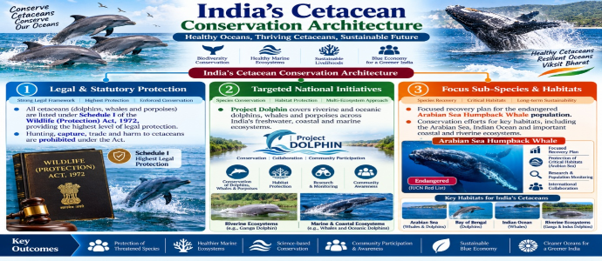
- Highest Legal Safeguards: All cetacean species (whales, dolphins, and porpoises) occurring in Indian territorial waters are placed under Schedule I of the Wildlife (Protection) Act, 1972, granting them the highest level of legal protection against hunting, trade, or exploitation.
-
- Project Dolphin: Implements an ecosystem-based conservation strategy targeting both freshwater (Gangetic and Indus river dolphins) and marine cetaceans, focusing on habitat restoration, anti-poaching, and community-led eco-tourism.
- Arabian Sea Humpback Whale Focus: Highlighted focused species recovery efforts for the Arabian Sea Humpback Whale—a genetically isolated, non-migratory sub-population listed among the 25 priority species under MoEF&CC’s Development of Wildlife Habitats scheme.
- Marine Protected Areas (MPAs): Leverages a network of MPAs and Marine Bio-reserves (such as the Gulf of Mannar, Andaman & Nicobar Islands, and Malvan Marine Sanctuary) to safeguard critical breeding, calving, and foraging grounds.
- Mitigating Anthropogenic Threats: Emphasized practical measures to reduce ship strikes, noise pollution from offshore seismic surveys, marine plastic debris, and accidental entanglement in commercial fishing gear (bycatch).
UPSC Quick Reference Table
| Feature | Detailed Specification |
| Global Forum | 70th Meeting of the International Whaling Commission (IWC-70) |
| Host & Dates | Hobart, Australia (28 September – 02 October 2026) |
| Foundational Treaty | International Convention for the Regulation of Whaling (ICRW, 1946) |
| India’s Membership | Member state since 1981 (MoEF&CC is the nodal ministry) |
| Domestic Protection | Listed under Schedule I of the Wildlife (Protection) Act, 1972 |
| Flagship Initiatives | Project Dolphin & Arabian Sea Humpback Whale Recovery Plan |
Conclusion:
India’s intervention at IWC-70 reaffirms its role in global marine conservation. Combining strict statutory protections under the Wildlife Protection Act, flagship programs like Project Dolphin, and international scientific cooperation at forums like the IWC supports the long-term ecological balance of marine ecosystems.
TOPIC-4: 2nd India–Italy Joint Working Group (JWG) on Tourism
-
- UPSC Relevance: GS Paper 2 (Bilateral Groupings & Agreements involving India; India–Italy Strategic Partnership) & GS Paper 3 (Economics of Tourism, Cine-Tourism, Service Sector Growth, & Hospitality Capacity Building).
Introduction: The 2nd India–Italy Joint Working Group (JWG) on Tourism convened virtually on September 29, 2026 focused on expanding bilateral tourism, introducing cine-tourism initiatives, twinning heritage destinations, and laying the groundwork for the upcoming India–Italy Year of Culture and Tourism 2027.
Bilateral Framework:
-
- The meeting advances commitments made under the India–Italy Joint Strategic Action Plan (2025–2029), which elevated bilateral ties to a Special Strategic Partnership.
- With both nations home to ancient civilizational heritage sites, the institutional JWG mechanism serves as a catalyst for service sector expansion, economic ties, and cultural exchanges ahead of the jointly celebrated Year of Culture and Tourism in 2027.
Key Highlights:
-
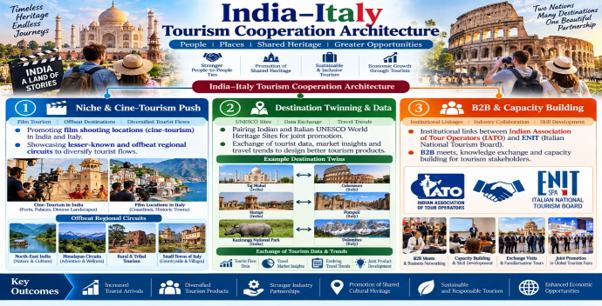
- Cine-Tourism & Offbeat Destinations: Focuses on leveraging film production incentives to showcase travel destinations across both nations, while promoting offbeat regional circuits beyond traditional high-density tourist hubs.
- Destination Twinning & UNESCO Heritage Synergy: Explores technical collaborations for “destination twinning”—pairing culturally similar Indian and Italian heritage cities/UNESCO sites to drive mutual tourism flows.
- Specialized Technical Groups: Agreed to designate dedicated points of contact and form focused technical working groups to resolve operational hurdles and facilitate continuous inter-ministerial engagement.
- Roadmap to ‘Year of Culture and Tourism 2027’: Serves as an operational foundation for setting up joint cultural festivals, roadshows, and hospitality exchanges planned for 2027.
- Institutional & Industry Stakeholders: Included representatives from the Ministry of Culture, Ministry of External Affairs (MEA), Indian Association of Tour Operators (IATO), and ENIT (Italian National Tourism Board).
UPSC Quick Reference Table
| Feature | Detailed Specification |
| Nodal Body | Ministry of Tourism, Government of India |
| Bilateral Mechanism | 2nd India–Italy Joint Working Group (JWG) on Tourism (Sept 29, 2026) |
| Co-Chairs | Shri Bhuvnesh Kumar (Secretary, Tourism, India) & Ms. Emanuela Tripi (Italy) |
| Industry Partners | IATO (Indian Association of Tour Operators) & ENIT (Italian National Tourism Board) |
| Major Milestone | Preparatory roadmap for India–Italy Year of Culture and Tourism 2027 |
| Focus Themes | Cine-tourism, destination twinning, offbeat circuits, B2B links, & technical groups |
Conclusion:
The outcome of the 2nd India–Italy JWG on Tourism deepens bilateral service sector ties. Structural agreements covering cine-tourism, destination pairing, and technical collaboration support tourism growth, enhance soft-power diplomacy, and build institutional momentum leading into the 2027 Year of Culture and Tourism.
TOPIC-5: CCEA Approves Intelligent Traffic Management System (ITMS) for Delhi
-
- UPSC Relevance: GS Paper 2 (Government Policies & Interventions for Urban Governance; Administrative Agencies — Delhi Police/MHA) & GS Paper 3 (Infrastructure — Urban Mobility, Smart Cities, Artificial Intelligence [AI] Applications in Traffic Enforcement, Road Safety, and Digital Public Infrastructure).
Introduction: The Cabinet Committee on Economic Affairs (CCEA), chaired by Prime Minister Narendra Modi, approved the Intelligent Traffic Management System (ITMS) Project for Delhi on September 30, 2026. The project covers 42 identified traffic corridors across the National Capital Region.
Project Rationale:
-
- Delhi’s active registered vehicle population has expanded to approximately 71 lakh, severely straining existing road infrastructure. Traditional traffic management relies heavily on static, fixed-time signals and manual policing.
- The ITMS project introduces real-time, AI-driven traffic management to optimize existing road capacity.
Implementation Timeline & Structure:
-
- Implementation Period: Phased execution over 24 months across 3 evaluation-linked stages, followed by 5 years of Operation & Maintenance (O&M).
- Executing Agency: Delhi Police via a Master System Integrator (MSI) selected through competitive bidding.
- Project Management Consultant: Centre for Development of Advanced Computing (C-DAC) will provide technical scrutiny, system validation, and acceptance benchmarking.
Key Highlights:
-
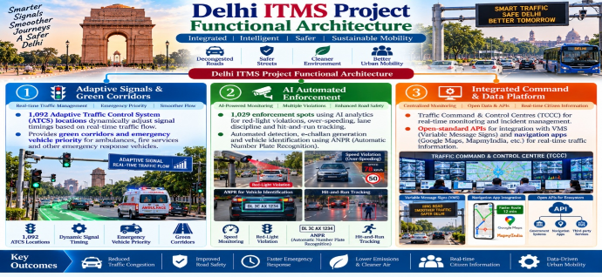
- Adaptive Traffic Control System (ATCS): Deploys dynamic, real-time signal adjustments across 1,092 ATCS locations to smooth vehicular flow and reduce idle delays along major corridors.
- Emergency Green Corridors: Automates priority passage for ambulances and emergency response units through traffic-dense stretches.
- AI-Enabled Automated Enforcement: Equips 1,029 enforcement locations with AI cameras to detect red-light breaches, stop-line errors, wrong-way driving, speeding, non-helmet/seatbelt usage, mobile phone distractions, and illegal parking.
- Security & Stolen Vehicle Analytics: Integrates license-plate recognition (ANPR) and video analytics to identify stolen, hot-listed, blacklisted, or hit-and-run vehicles.
- Command, Control & Data Infrastructure: Establishes centralized Traffic Command and Control Centres backed by a secure Data Centre and Disaster Recovery setup. Uses open standards and APIs to facilitate future urban mobility integrations and stream real-time congestion updates via Variable Message Signs (VMS) and navigation apps.
UPSC Quick Reference Table
| Feature | Detailed Specification |
| Approving Body | Cabinet Committee on Economic Affairs (CCEA) |
| Executing Body | Delhi Police (Ministry of Home Affairs) |
| Technical Consultant | C-DAC (Centre for Development of Advanced Computing) |
| Total Project Outlay | ₹1,789.52 Crore (24-month rollout + 5 years O&M) |
| Physical Scope | 42 Corridors | 1,092 ATCS Locations | 1,029 Enforcement Spots |
| Core Technologies | Adaptive Signals (ATCS), AI Video Analytics, ANPR, VMS, and Open APIs |
Conclusion:
The CCEA’s approval of the ₹1,789.52 crore ITMS project represents a move toward technology-first urban traffic management. Replacing static signals with real-time AI analytics, automated enforcement and green corridors for emergency services enhances road safety.
Spread the Word