TOPIC-1: 5th Kautilya Economic Conclave (KEC 2026)
-
- UPSC Relevance: GS Paper 2 (Important International Institutions, Foreign Policy & Strategic Autonomy, Digital Public Infrastructure, and Centre-State Fiscal Relations) & GS Paper 3 (Indian Economy — Macroeconomic Stability, Monetary Policy, Industrial Policy, AI & Technology Governance, Climate Resilience, and Trade Supply Chains).
Introduction: The 5th Kautilya Economic Conclave (KEC 2026) was held in New Delhi from October 3 to 5, 2026, under the theme “Resilience in an Age of Flux.” Organized by the Institute of Economic Growth (IEG) in partnership with the Ministry of Finance.
Institutional Context: Founded in 1952 by Prof. V.K.R.V. Rao, the Institute of Economic Growth (IEG) established the Kautilya Economic Conclave in 2022 to provide an international policy dialogue forum.
Previous editions tracked shifting global economics:
-
- 2022: “Redefining the Future”
- 2023: “Navigating a World on Fire”
- 2024: “The Indian Era”
- 2025: “Seeking Prosperity in Turbulent Times”
- 2026: “Resilience in an Age of Flux”
Key Highlights:
-
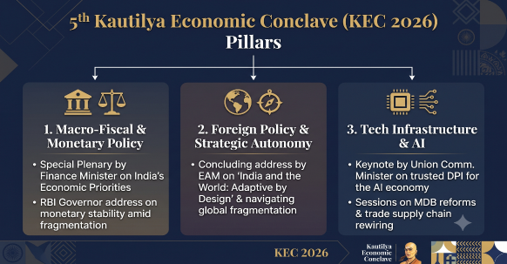
- Macroeconomic Priorities & Fiscal Resilience: Union Finance Minister Smt. Nirmala Sitharaman delivered a special plenary address on maintaining growth, controlling inflation, and attracting long-term risk capital despite global supply chain shocks and economic fragmentation.
- Foreign Policy & Strategic Autonomy: External Affairs Minister Dr. S. Jaishankar delivered the concluding address titled “India and the World: Adaptive by Design,” outlining how India preserves strategic autonomy, diversifies partnerships, and navigates contested global supply lines.
- Digital Infrastructure for the AI Economy: Union Minister Shri Jyotiraditya M. Scindia highlighted how trusted Digital Public Infrastructure (DPI), high-speed telecom networks, and artificial intelligence can drive productivity while safeguarding data privacy and market competition.
- Central Banking & Monetary Strategy: RBI Governor Shri Sanjay Malhotra and global central bank leaders addressed inflationary pressures, financial fragility, capital flow volatility, and monetary policy credibility in an age of geopolitical flux.
- Cultural Capital & Trade Rewiring: Culture Minister Shri Gajendra Singh Shekhawat delivered a keynote on “Culture as Capital,” while parallel sessions explored Asia-Africa growth corridors, MDB (Multilateral Development Bank) reforms, climate resilience, and agricultural food security.
UPSC Quick Reference Table
| Feature | Detaile Specification |
|---|---|
| Organizing Nodal Bodies | Institute of Economic Growth (IEG) & Ministry of Finance |
| Event & Theme | 5th Kautilya Economic Conclave 2026 — “Resilience in an Age of Flux” |
| Dates & Venue | October 3–5, 2026 (New Delhi) |
| Inaugural Address | Shri C. P. Radhakrishnan (Vice President of India) |
| Key Plenary Speakers | Smt. Nirmala Sitharaman (Finance), Dr. S. Jaishankar (External Affairs), Shri Jyotiraditya Scindia (Communications), Shri Sanjay Malhotra (RBI Governor) |
| Core Discussion Domains | Macroeconomic stability, Strategic Autonomy, DPI & AI regulations, MDB reforms, & Asia-Africa trade corridors |
Conclusion:
The 5th Kautilya Economic Conclave highlights India’s growing role in global economic discourse. Synthesizing insights on central banking, digital public infrastructure, trade realignment, and strategic autonomy offers actionable frameworks for policymakers to build economic resilience in an era of global uncertainty.
TOPIC-2: Sādhana Śhrinkhla — 1st Regional Workshop on Mission Karmayogi (Vijayawada)
-
- UPSC Relevance: GS Paper 2 (Government Policies & Interventions for Good Governance; Civil Services Reforms — Mission Karmayogi, Capacity Building Commission [CBC], iGOT Karmayogi, & Administrative Training Institutes [ATIs]).
Introduction: The Capacity Building Commission (CBC) concluded the inaugural two-day regional workshop under the Sādhana Śhrinkhla initiative in Vijayawada, Andhra Pradesh (September 29–30, 2026). Themed “From Training Institutions to Capacity Building Institutions” powered by the UNNATI digital platform.
About Sādhana Śhrinkhla:
-
- Sādhana (Strengthening Adaptive Development and Humane Aptitude for National Advancement) Śhrinkhla is a nationwide consultative initiative under Mission Karmayogi (National Programme for Civil Services Capacity Building).
- The platform connects over 900 Training Institutions (TIs) and Administrative Training Institutes (ATIs) to align physical classroom instruction with the online iGOT Karmayogi ecosystem
Key Highlights:
-
- UNNATI (Unified New-Age National Training Initiative): Serves as the core digital enabler connecting over 900 Training Institutions. It integrates Capacity Building Plans (CBPs) with State HR systems, tracks online/offline learning, and evaluates real-time performance using the UNNATI Capability Index.
- Karmayogi Quality Framework (KQF): Establishes quality standards across the learning lifecycle via the National Curriculum Design Framework (NCDF) and an AI-driven Quality Evaluator for curriculum review.
- Karmayogi Kartavya Karyakram (KKK): Focuses on behavioral training to build Seva Bhav (citizen-centric service mindset) among public servants, particularly at the grassroots level.
- State Performance Recognition: Recognized Andhra Pradesh as the top-performing State in civil service capacity building, followed by Karnataka (2nd) and Odisha (3rd).
- Participating States/UTs: Gathered delegations from Andhra Pradesh, Karnataka, Telangana, Odisha, Puducherry, Kerala, and Tamil Nadu.
UPSC Quick Reference Table
| Feature | Detailed Specification |
| Organizing Nodal Body | Capacity Building Commission (CBC) under Mission Karmayogi |
| Event & Venue | 1st Regional Workshop on Sādhana Śhrinkhla (Vijayawada, Andhra Pradesh) |
| Core Theme | “From Training Institutions to Capacity Building Institutions” |
| Flagship Digital Engine | UNNATI (Unified New-Age National Training Initiative) |
| Quality Framework | Karmayogi Quality Framework (KQF) & National Curriculum Design Framework |
| Behavioral Module | Karmayogi Kartavya Karyakram (KKK) (Focus on Seva Bhav & citizen-first delivery) |
| Top Performing State | Andhra Pradesh (1st in capacity building metrics) |
Conclusion:
Connecting physical training institutes with digital public infrastructure like UNNATI and iGOT Karmayogi helps build a competent and citizen-centric bureaucracy to drive public delivery.
TOPIC-3: India–Netherlands Strategic Engagement in Agriculture & Horticulture
-
- UPSC Relevance: GS Paper 2 (Bilateral Groupings & Agreements involving India; India–Netherlands Institutional Relations) & GS Paper 3 (Major Crops & Cropping Patterns, Supply Chain Management, Horticulture, Seed Sector R&D, Agricultural Technology, and Climate-Smart Farming).
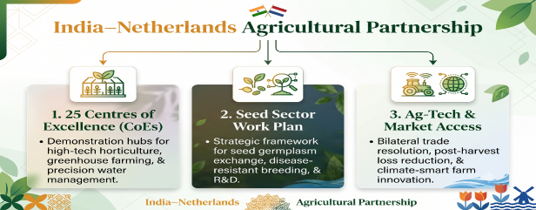
Introduction: India held bilateral talks with the high-level meeting with Netherlands which focused on accelerating agricultural productivity. It emphasis on establishing 25 Centres of Excellence (CoEs) in agriculture and horticulture, formulating a joint work plan for the seed sector and expanding bilateral market access.
About India–Netherlands Agricultural Collaboration:
-
- The Netherlands is a global leader in high-tech, precision agriculture, greenhouse technology, and post-harvest supply chain management.
- Institutional cooperation between India and the Netherlands in agriculture operates primarily through Joint Working Group (JWG) on Agriculture and Action Plan on Agriculture. Thereby, leveraging Dutch expertise in protected cultivation, seed breeding and cold-chain infrastructure to support India’s agricultural modernization.
Focus Areas:
-
- Expansion of Centres of Excellence (CoEs): Reviewed progress on 25 CoEs established across various states to transfer Dutch technology in protected cultivation, drip irrigation, hydroponics, and crop-specific management directly to Indian farmers.
- Structured Seed Sector Work Plan: Agreed to create a dedicated work plan establishing a clear framework for joint seed breeding, quality seed multiplication, disease-resistant crop varieties, and regulatory alignment.
- Agricultural Technology & R&D: Joint initiatives between the Indian Council of Agricultural Research (ICAR/DARE) and Dutch agricultural universities (such as Wageningen University) focusing on climate-resilient farming, soil health management, and AI in precision agriculture.
- Trade Facilitation & Market Access: Addressed phytosanitary standards, trade barriers, and market access issues to boost two-way agricultural and horticultural exports.
UPSC Quick Reference Table
| Feature | Detailed Specification |
|---|---|
| Nodal Ministries | Ministry of Agriculture & Farmers Welfare (India) & Ministry of Agriculture, Fisheries, Food Security and Nature (Netherlands) |
| Key Flagship Initiative | 25 Centres of Excellence (CoEs) in Agriculture & Horticulture |
| Core Agreement Domain | Joint Work Plan for Seed Sector Cooperation & Germplasm Exchange |
| Key Indian Institutions | DARE (Department of Agricultural Research and Education) & ICAR |
| Dutch Expertise Area | Protected cultivation (greenhouses), seed technology, & cold-chain logistics |
Conclusion:
It plays a key role in modernizing India’s horticultural and seed sectors. Scaling up Centres of Excellence, facilitating technology transfers and streamlining market access support sustainable yield improvements for Indian farmers.
TOPIC-4: Historic First Mineral Block Auctions in Jammu & Kashmir (UT)
-
- UPSC Relevance: GS Paper 3 (Indian Economy & Resource Allocation — Mineral Sector Development, Mining Reforms, Infrastructure Inputs [Cement/Limestone], Regional Economic Integration of J&K, & Employment Generation).
Introduction: In a historic first, two major limestone mineral blocks in the Union Territory of Jammu & Kashmir were successfully auctioned through the Ministry of Mines, Government of India. This auction marks the initiation of competitive commercial mineral extraction in the region for regional infrastructure and industrial growth.
Strategic Rationale:
-
- Prior to these auctions, mineral exploitation in the region remained largely unorganized or limited in scale. Under the Mines and Minerals (Development and Regulation) [MMDR] Amendment Act framework, Ministry of Mines executed a transparent e-auction process.
- Limestone is the foundational raw material for the cement and construction industries.
- Commercial extraction directly supports local infrastructure, roads, housing projects, and industrial development across Jammu & Kashmir.
Geological Specifications:
-
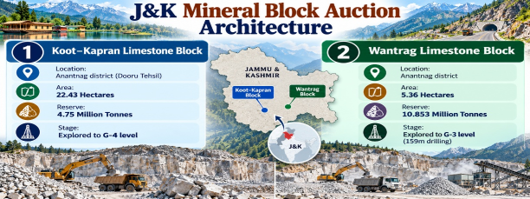
- Targeted Resources: Both blocks—Koot–Kapran and Wantrag—are situated in Anantnag district, South Kashmir, offering combined estimated reserves exceeding 15.6 million tonnes of high-grade limestone.
- Geological Exploration Stages:
- G-4 Stage (Reconnaissance): Conducted for Koot–Kapran, establishing initial resource mapping for further detailed prospecting.
- G-3 Stage (Prospecting): Completed for Wantrag, including 159 meters of core drilling to provide confirmed geological modeling.
- Socio-Economic Impacts: Generates direct local employment, opens service-sector opportunities (transport, equipment supply, processing units), and creates state revenue via mining royalties and payments to the District Mineral Foundation (DMF).
- Supports ‘Viksit Jammu & Kashmir’: Aligns mineral sector expansion with broader infrastructure investments, supporting economic integration and industrialization in post-Article 370 J&K.
UPSC Quick Reference Table
| Feature | Detailed Specification |
| Nodal Ministry | Ministry of Mines, Government of India (in coordination with J&K UT Govt) |
| Primary Mineral | Limestone (Essential raw material for cement & industrial infrastructure) |
| Blocks Auctioned | Koot–Kapran Block (22.43 ha / 4.75 MT) & Wantrag Block (5.36 ha / 10.85 MT) |
| District Location | Anantnag District, Jammu & Kashmir (UT) |
| Exploration Levels | G-4 Stage (Koot–Kapran) & G-3 Stage (Wantrag) |
| Auction Framework | Competitive e-auction under the MMDR Act transparent allocation mechanism |
Conclusion:
The successful auction of the Koot–Kapran and Wantrag limestone blocks establishing a transparent, competitive mineral allocation framework unlocks industrial capital, creates local jobs and strengthens raw material supply chains for infrastructure development across the Union Territory.
TOPIC-5: Mumbai’s Jawahar Dweep Declared India’s First Plastic-Free Oil Terminal
-
- UPSC Relevance: GS Paper 3 (Environment & Pollution Mitigation — Marine Plastic Pollution, Swachh Bharat Abhiyan, Maritime Sustainability, Oil Spill Response Capabilities, & Coastal Protection).
Introduction: Union Minister of Ports, Shipping and Waterways Shri Sarbananda Sonowal declared Mumbai Port Authority’s Jawahar Dweep Marine Oil Terminal as India’s first plastic-free oil terminal during Swachhata Abhiyan 2026 on October 2, 2026.
About Jawahar Dweep:
-
- Jawahar Dweep (formerly Butcher Island) is an island located off the coast of Mumbai that serves as a major marine oil terminal operated by the Mumbai Port Authority (MbPA). It handles crude oil and liquid petroleum imports and offloading for major oil refineries in Mumbai.
- Under the Swachh Bharat Mission (Urban) and MoPSW’s maritime green guidelines, the terminal phased out single-use plastics across operational docks, residential quarters, and coastal zones.
Environmental Initiatives:
-
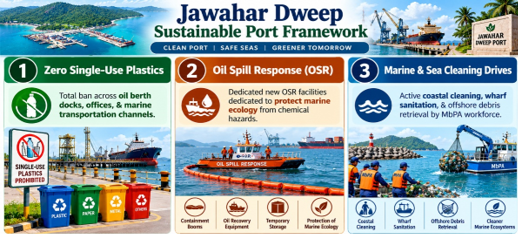
- Elimination of Single-Use Plastics: Jawahar Dweep achieved complete elimination of single-use plastics across fuel-handling berths, administrative units, and staff quarters.
- Dedication of Oil Spill Response (OSR) Facilities: Dedicated advanced Oil Spill Response (OSR) equipment to the nation to safeguard marine biodiversity in the Arabian Sea against hydrocarbon leaks and chemical hazards.
- Recognition of Safai Karmis: Honored sanitation workers (Safai Karmis) as the backbone of maritime sanitation during the Gandhi Jayanti Swachhata Abhiyan drive.
- Targeted Cleanliness Drives: Conducted offshore sea-cleaning activities along the BPX North Area wharf and Indira Dock to clear marine litter and microplastics.
UPSC Quick Reference Table
| Feature | Detailed Specification |
| Nodal Body | Mumbai Port Authority (MbPA) under Ministry of Ports, Shipping and Waterways |
| Milestone Achieved | First Plastic-Free Oil Terminal in India |
| Location | Jawahar Dweep (Butcher Island), Mumbai Harbor, Maharashtra |
| Key Dedicated Asset | Oil Spill Response (OSR) Facilities for coastal marine protection |
| Event Alignment | Swachhata Abhiyan 2026 (Gandhi Jayanti, October 2, 2026) |
| Broader Mission | Swachh Bharat Mission & Green Port Guidelines for Blue Economy |
Conclusion:
Therefore, by combining single-use plastic elimination with upgraded Oil Spill Response (OSR) facilities supports marine ecology protection and advances India’s broader green port initiatives under the Blue Economy framework.
Spread the Word