Context: The Ministry of Education released the All India Survey on Higher Education (AISHE) reports for 2022–23 and 2023–24. The data shows India’s higher education system has expanded steadily over the last decade in institutions, enrolment, gender parity and social inclusion. This is a good moment to assess how far India has moved towards the NEP 2020 target of a 50% Gross Enrolment Ratio by 2035, and what still holds the system back.
Why Higher Education Matters
-
- Higher education is more than a policy sector as it decides whether India can convert its demographic dividend into a productive, innovative workforce. The National Education Policy (NEP) 2020 treats higher education as a core pillar of India’s transition to a knowledge economy in line with Sustainable Development Goal 4 (SDG-4).
- AISHE conducted annually by the Ministry of Education since 2010–11 is the primary evidence base for this sector. It tracks institutions, enrolment, faculty and infrastructure and is used to monitor NEP 2020’s implementation and guide policy correction.
Key Highlights of AISHE 2023-24
1. India’s higher education network has widened considerably since 2014–15:
-
- Universities: 760 → 1,289 (up 69.6%)
- Colleges: 38,498 → 48,246 (up 25.3%)
- Standalone institutions: 12,276 → 15,221 (up about 24%)
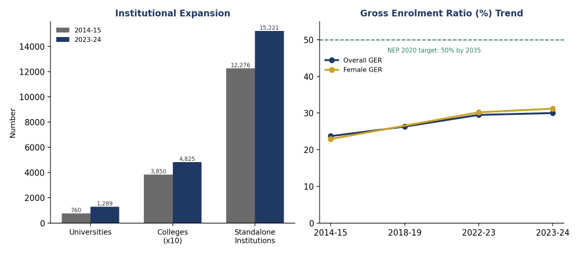
Fig 1: Institutional expansion and GER trend, 2014-15 to 2023-24
Source: AISHE 2023-24, Ministry of Education; PIB (30 Aug 2026).
2. Enrolment and Gross Enrolment Ratio (GER)
-
- Total enrolment: 42 crore (2014-15) → 4.50 crore (2023-24), up 31.5%
- GER: 7% (2014-15) → 30.0% (2023-24) — against the NEP target of 50% by 2035
- ph.D enrolment: 1.17 lakh → 3.43 lakh (up 192.9%) — the sharpest rise among all levels
3. Female participation has grown faster than the system average and female GER have overtaken male GER:
-
- Female enrolment: 57 crore → 2.24 crore (up 42.2%)
- Female GER: 9% → 31.2%, ahead of male GER at 28.9%
- Gender Parity Index (GPI): 92 → 1.08 overall; SC-GPI 0.91 → 1.11; ST-GPI 0.81 → 1.08
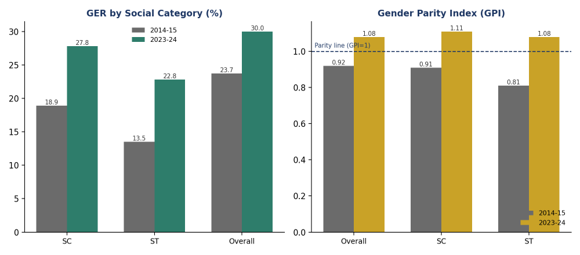
Fig 2: GER by social category and Gender Parity Index, 2014-15 vs 2023-24
Source: AISHE 2023-24, Ministry of Education.
4. STEM enrolment rose from 5 lakh to 1.02 crore, crossing one crore for the first time & female share in STEM up from 38.4% to 44%
Significance of These finding
-
- More institutions and more seats have let in students who were earlier locked out i.e. women, SC/ST/OBC groups, and persons with disabilities.
- Rising GPI values mark a genuine shift because girls are not just enrolling but they are staying in the system at higher rates than boys in most categories.
- The growth is in Ph.D and integrated programmes and in STEM are central to building a research-oriented, multidisciplinary higher education system emphasised by NEP 2020.
- Growing foreign enrolment and India’s expanding footprint in global rankings (52 Indian universities featured in QS World University Rankings 2027, up from just 11 in 2015) suggest the sector is becoming more internationally visible.
Challenges
1. GER growth pace insufficient for the 50% by 2035 target as highlighted by PRS legislative.
2. A Parliamentary Standing Committee on Education report (tabled March 2025) found that 28.56% of sanctioned teaching posts across IITs, NITs, IIMs, IISERs and central universities are vacant and at the professor level is a staggering 56.18%. In reserved category posts over 40% of sanctioned SC/ST/OBC faculty posts in central universities remain unfilled.
3. A separate 2026 Committee report flagged similarly high vacancies in the UGC and AICTE themselves, which weakens the regulator’s own capacity to monitor the sector. Student-faculty ratios at many top institutions run at 20:1 or higher, against a global benchmark closer to 10:1.
4. India’s spending on research and innovation stands at about 0.69% of GDP as compared with 2.8% in the USA, 4.2% in South Korea and 4.3% in Israel.
5. Enrolment growth has not translated evenly into skilled, job-ready graduates. Research highlighted by the Observer Research Foundation (ORF) points to a completion gap as many students enrol but do not finish or finish without the skills employers need.
Major Higher Education Models
| Country | Key strength |
|---|---|
| USA | Strong university-industry linkages, research ecosystem and global talent attraction. |
| UK | Strong internationalisation and high completion rates. 23% of tertiary students were international in 2023. |
| Germany | Strong industry-linked vocational and applied learning. 4,23,000 international students in 2023. |
| China | Large-scale expansion combined with strong state support for research and globally competitive universities. |
The UK hosted nearly 749,000 international students in 2023, while Germany hosted around 423,000. The US hosted nearly 1.18 million international students in 2024–25.
Way Forward
1. The Anusandhan National Research Foundation (ANRF/NRF) needs full operational and financial backing to become the funding backbone NEP 2020 envisaged. Linking research grants to interdisciplinary and industry-relevant work in areas such as AI, semiconductors, clean energy and quantum technology.
2. The Parliamentary Standing Committee has recommended time-bound recruitment and stricter compliance with reservation norms in faculty hiring.
3. ORF’s suggests India should shift incentives from enrolment numbers to completion and graduation outcomes.
4. NEP 2020’s should be paired with a curriculum review cycle that keeps pace with industry needs particularly in emerging sectors.
5. Carefully facilitating foreign university campuses in India as internationalisation adds depth rather than becoming a parallel, disconnected track from India’s own public higher education system.
6. Filling vacancies within the UGC and AICTE themselves is a precondition for effective oversight of a system this large.
Conclusion
India has made substantial progress in democratising access to higher education, particularly for women and disadvantaged groups. However, next phase must convert this quantitative expansion into quality human capital through better learning, research, skills and institutional autonomy.
Spread the Word