TOPIC-1: Exercise INDRA-2026 (Naval Edition) & Port Call at Vladivostok
-
- UPSC Relevance: GS Paper 2 (Bilateral, Regional, & Global Groupings involving India; India–Russia Strategic Partnership) & GS Paper 3 (Security Challenges & Defence Capabilities — Naval Exercises, Maritime Domain Awareness [MDA], Project 17 Stealth Frigates, & Strategic Vision MAHASAGAR).
Introduction: Indian Naval Ship INS Sahyadri (F49) arrived at Vladivostok, Russia, on October 10, 2026, to participate in the bilateral maritime exercise Exercise INDRA-2026. Conducted from October 13 to 18, 2026, between Indian Navy andRussian Federation Navy (RuFN). The exercise focuses on interoperability, anti-submarine tactics, and seamanship evolutions in the Pacific theater.
Vision Framework:
-
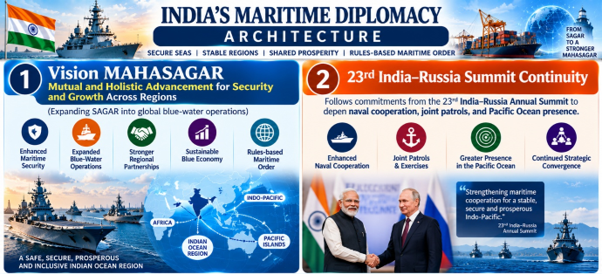
- Exercise INDRA is a biennial multi-service bilateral exercise between India and Russia that originated in 2003. The 2026 naval edition aligns with India’s overarching strategic ocean framework:
Key Highlights:
-
- Participating Vessel — INS Sahyadri (F49): An indigenously designed and built Shivalik-class (Project 17) stealth multi-role guided-missile frigate. Built at Mazagon Dock Limited (MDL), Mumbai, it features structural, thermal, and acoustic radar-stealth characteristics along with long-range land-attack capabilities.
- Exercise Phases:
- Harbour Phase (Oct 13–15): Includes cross-deck visits, subject-matter expert exchanges (SMEE), operational planning briefings, and cultural interactions to foster personnel camaraderie.
- Sea Phase (Oct 16–18): Focuses on surface firing drills, tactical anti-submarine warfare (ASW) exercises, air defense maneuvers, and complex replenishment-at-sea (RAS) evolutions.
- Geopolitical Significance: Operating in Vladivostok highlights the Indian Navy’s blue-water operational reach across the Far East and Northwest Pacific, reinforcing strategic balance and freedom of navigation.
UPSC Quick Reference Table
| Feature | Detailed Specification |
| Nodal Agencies | Indian Navy & Russian Federation Navy (RuFN) |
| Exercise & Year | Exercise INDRA-2026 (Bilateral Naval Edition) |
| Location & Dates | Vladivostok, Russia | October 13–18, 2026 |
| Indian Navy Asset | INS Sahyadri (F49) (Shivalik-Class / Project 17 Guided-Missile Stealth Frigate) |
| Strategic Vision | MAHASAGAR (Mutual and Holistic Advancement for Security and Growth Across Regions) |
| Core Capabilities | Anti-submarine warfare (ASW), air defense, joint tactical maneuvers, & cross-deck landing |
Conclusion:
The deployment of INS Sahyadri to Vladivostok for Exercise INDRA-2026 reflects India–Russia strategic and defence partnership in the Northwest Pacific which demonstrates Indian Navy’s blue-water capabilities & advances Vision MAHASAGAR.
TOPIC-2: 16th India–UK Joint Economic and Trade Committee (JETCO) & CETA Implementation
-
- UPSC Relevance: GS Paper 2 (Bilateral Groupings & Agreements involving India; India–UK Economic Diplomacy, CETA Implementation, & Regional Mayoral Missions) & GS Paper 3 (Indian Economy — Free Trade Agreements [FTAs], Zero-Duty Access, Clean Energy, Financial Integration [GIFT City–City of London], & Supply Chain Resilience).
Introduction: 16th Session of the India–UK Joint Economic and Trade Committee (JETCO focused on translating the opportunities created under the landmark India–UK Comprehensive Economic and Trade Agreement (CETA) into trade expansion, investments and jobs with an operational target to double bilateral trade by 2030.
Strategic Context:
-
- The India–UK CETA (which entered into force in July 2026) marks a major milestone in India’s trade relations with developed economies.
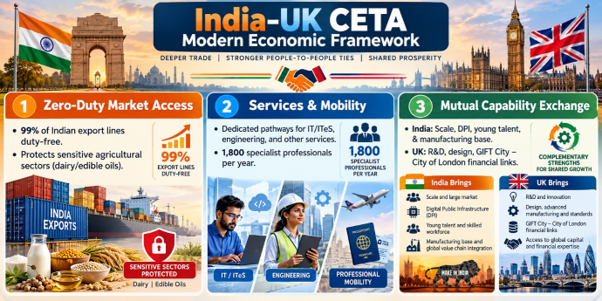
- The agreement grants zero-duty access for 99% of Indian exports to the UK market while opening up opportunities for UK exporters in automotive, technology and life sciences.
- The meeting also highlighted the Social Security Double Contribution Convention, designed to protect temporary service professionals from dual social security levies, lowering service delivery costs.
Five Priority Cooperation Pillars
1. Infrastructure & Clean Energy: Joint project development, renewable transmission, and green utility financing.
2. Advanced Manufacturing & Resilient Supply Chains: Electric vehicles (EVs), battery storage technologies, semiconductors, and precision engineering.
3. Technology & Deep-Tech Innovation: Collaboration under the Technology Security Initiative (TSI) in AI, quantum computing, and 6G telecom R&D.
4. Financial Services Integration: Strategic linkage between GIFT City (Gandhinagar) and the City of London across fintech, insurance, transition finance, and cross-border trade settlements.
5. Healthcare, Life Sciences & Consumer Goods: Pairing India’s scale in affordable generic pharmaceuticals and diagnostics with the UK’s discovery research and branded drug ecosystem.
Grassroots Trade Access & Multilingual Guidance: Stressed providing CETA documentation, rules of origin, and tariff schedules in regional Indian languages (e.g., Tamil for manufacturing clusters like Tirupur) to assist MSMEs and first-time exporters.
Great North Mayoral Delegation: Hosted a high-level UK mayoral delegation supported by the UK India Business Council (UKIBC) representing five Combined Authorities across the North of England, securing £1 billion in new cross-border business deals.
UPSC Quick Reference Table
| Feature | Detailed Specification |
| Nodal Body (India) | Ministry of Commerce and Industry |
| Nodal Body (UK) | Department for Business and Trade |
| Summit Framework | 16th Session of India–UK JETCO (Joint Economic and Trade Committee) |
| Primary Economic Treaty | India–UK Comprehensive Economic and Trade Agreement (CETA) |
| Bilateral Trade Goal | Double bilateral trade by 2030 (Under the India-UK Vision 2035) |
| Financial Corridor | GIFT City (Gandhinagar) City of London Integration |
| Key Regional Anchor | Great North Mayoral Mission (UKIBC partner delegation) |
Conclusion:
The 16th JETCO meeting and CETA implementation signal a shift in India–UK economic relations. Connecting trade liberalisation with advanced manufacturing, deep-tech research and financial corridor integration between GIFT City and London.
TOPIC-3: Union Environment Minister Interacts with IFS Mid-Career Training (MCT) Participants
-
- UPSC Relevance: GS Paper 2 (Role of Civil Services in a Democracy, Governance Reforms, Administrative Training Institutions [IGNFA]) & GS Paper 3 (Environment & Conservation — Forest Governance, Human-Wildlife Conflict, Modern Technology in Forestry [GIS/AI], Forest Conservation Act [FCA] Amendments, & Climate Finance).
Context: Union Minister for Environment, Forest and Climate Change (MoEFCC), Shri Bhupender Yadav, interacted with the participants of the Mid-Career Training (MCT) Phase-III (19) programme of the Indian Forest Service (IFS) in New Delhi.
Policy Directives for IFS Officers:
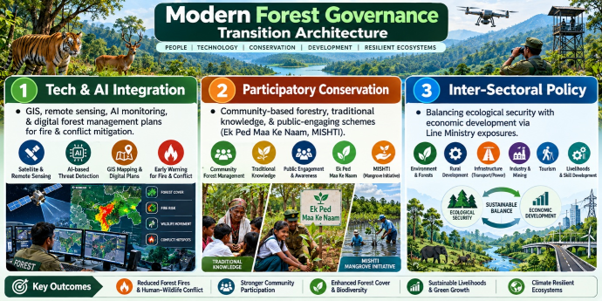
The interaction emphasized shifting forest governance from traditional enforcement toward modern, technology-enabled, and community-driven resource management:
1. Transition from Regulatory to Facilitative Leadership: Encouraged officers to balance ecological security with economic growth, transitioning from passive custodians to active managers of bio-resources.
2. Emerging Conservation Challenges Identified: Highlighted key operational bottlenecks:
a) Human-Wildlife Conflict mitigation using real-time surveillance.
b) Forest Fire Management and climate-resilient forestry practices.
c) Balancing Development and Conservation under amended statutory frameworks.
3. Key Flagship Initiatives Highlighted: Praised citizen-driven initiatives like Ek Ped Maa Ke Naam, MISHTI (mangrove restoration), Aravalli Green Wall Project, and Nagar Van Yojana for expanding tree and forest cover.
Strategic Modules of the MCT Phase-III (19) Programme
The 4-week training programme for officers with 7–9 years of service integrates field experience with policy formulation:
1. Line visits to Uttarakhand and Uttar Pradesh to observe best practices in ecotourism, wildlife habitat management, and community-based conservation models.
UPSC Quick Reference Table
| Feature | Detailed Specification |
| Nodal Body | Indira Gandhi National Forest Academy (IGNFA), Dehradun |
| Target Audience | IFS Officers with 7–9 years of service (MCT Phase-III, 19th batch) |
| Key Flagship Schemes | MISHTI, Aravalli Green Wall, Nagar Van Yojana, & Ek Ped Maa Ke Naam |
| Key Tech Drivers | Artificial Intelligence (AI), GIS, Remote Sensing, & Digital Forest Plans |
| Core Legal Focus | Forest Conservation Act (FCA) Amendments & Forest Rights Act (FRA) |
| Field Exposure | Best practice studies across Uttarakhand & Uttar Pradesh |
Conclusion:
MCT Phase-III participants reflects the broader shift in Indian civil service capacity building. Equipping IFS officers with AI technology, inter-ministerial exposure and participatory management tools helps align forest governance with sustainable development.
Spread the Word