TOPIC-1: Agriculture and Rural Development Ecosystem Commitments for ‘Shakti Ki Saptadhara’
-
- GS Paper 2 (Government Policies and Interventions for Development in Rural Sectors; Welfare Schemes for Vulnerable Sections)
- GS Paper 3 (Agricultural Produce and Export Marketing; Supply Chain & Food Processing; Technology Indigenization & FPOs).
Context: Union Minister Shri Shivraj Singh Chouhan led a national commitment program to translate the Prime Minister’s Independence Day vision of ‘Shakti Ki Saptadhara’ into ground-level agricultural and rural development outcomes. It sets actionable targets for expanding rural women’s incomes, boosting food processing, and linking local produce to global markets.
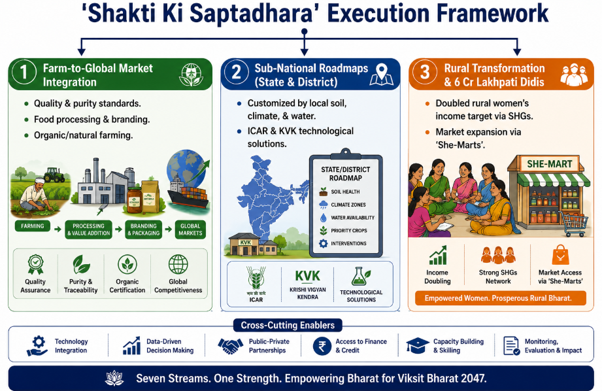
Implementation Architecture
Strategic Pillars
-
- Farm-to-Global Market Integration:
- Aligns agricultural products with international quality, safety, and purity standards.
- Enhances processing, packaging, and branding for high-value exports like spices, fruits, and flowers.
- Promotes chemical-free, organic, and natural farming backed by technical guidance and market intelligence.
- Sub-National Agricultural Roadmaps:
- Replaces uniform planning with tailored agricultural roadmaps for every state and district.
- Designs crop strategies based on local soil conditions, water availability, and agro-climatic zones.
- Integrates modern technologies, AI, high-yielding seeds, and mechanization through ICAR and Krishi Vigyan Kendras.
- Expanded Rural Economic Targets:
- Officially doubles the rural women empowerment target from 3 crore to 6 crore Lakhpati Didis.
- Establishes ‘She-Marts’ and structured branding to market rural handicrafts, food products, and traditional goods globally.
- Increases household savings and financial self-reliance through Self-Help Group (SHG) networks.
- Field Governance & Operational Mantras:
- Mandates direct field visits by officials to verify ground-level scheme execution and beneficiary impacts.
- Adopts four administrative success principles: Paanv mein chakkar (field mobility), Munh mein shakkar (courteous teamwork), Seene mein aag (target-driven passion), and Maathe par barf (composure under stress).
- Farm-to-Global Market Integration:
UPSC Quick Reference Table
| Feature | Detailed Specification |
| Nodal Ministries | Ministry of Agriculture & Farmers Welfare; Ministry of Rural Development |
| Event Location | C. Subramaniam Auditorium, Pusa, New Delhi |
| Overarching Vision | ‘Shakti Ki Saptadhara’ (Roadmap for Viksit Bharat 2047) |
| Lakhpati Didi Target | 6 Crore Women (Expanded from the completed 3 Crore target) |
| Planning Mechanism | Dedicated State-level and District-level Agricultural Roadmaps |
| Key Market Initiative | ‘She-Marts’ for SHG products and global export linkages |
| Secretarial Representation | DARE/ICAR, Dept. of Agriculture & Farmers Welfare, Dept. of Rural Development, Dept. of Land Resources |
Conclusion:
Aligning the Agriculture and Rural Development sectors under the ‘Shakti Ki Saptadhara’ framework connects farm-level production directly with global export markets. Combining district-level agro-climatic planning, natural farming, and expanded initiatives like creating 6 crore Lakhpati Didis creates a clear path toward sustainable rural growth and agricultural self-reliance.
TOPIC-2: NCC All India Girls High Altitude Trek ‘Aparajita – Parang La 2026’
-
- GS Paper 1 (Geography of the Himalayas, Physical Geography)
- GS Paper 3 (Nari Shakti, Border Area Development, Youth Empowerment & Leadership).
Context: Raksha Mantri Shri Rajnath Singh flagged off ‘Aparajita – Parang La 2026’. It is a flagship high-altitude expedition organized by the National Cadet Corps (NCC) in New Delhi. The expedition features 28 girl cadets led by women officers from the Indian Army, Navy, and Air Force. Traversing the high-altitude Parang La Pass, the 30-day journey is designed to foster leadership, mental resilience, self-confidence, and national integration among youth.
Strategic Highlights
-
- Tri-Service Leadership & Nari Shakti:
-
-
- Led by three women officers representing the Army, Navy, and Air Force.
- Features 28 selected girl cadets with an average age of 19 years (youngest participant: 16.5 years).
- Selected through a merit-based preparatory and acclimatization phase in the Bhaba-Pin Valley sector.
- Challenging Himalayan Terrain:
- Covers a 250-km, 30-day route traversing glaciers, snowfields, river valleys, and high-altitude deserts.
- Crosses the Parang La Pass at an elevation of 5,578 meters (18,300 feet), connecting Himachal Pradesh’s Spiti Valley to Ladakh’s Changthang region.
- Waypoints include Kibber, Dumla, Thaltak, Bongrojen, Parang La, Dak Karzong, Norbu Sumdo, Kiangdom, and Korzok.
- Environmental & Community Directives:
- Enforces a zero-waste policy to safeguard the fragile Himalayan ecosystem.
- Prioritizes respectful engagement with local mountain communities to understand regional traditions and experiences.
- National Integration (‘Ek Bharat, Shreshtha Bharat’):
- Unites cadets from diverse linguistic, cultural, and regional NCC Directorates across India under a single mission.
- Promotes teamwork, physical endurance, and environmental stewardship among young citizens.
-
UPSC Quick Reference Table
| Feature | Detailed Specification |
| Nodal Organization | National Cadet Corps (NCC), Ministry of Defence |
| Expedition Title | ‘Aparajita – Parang La 2026’ |
| Flagging-Off Authority | Raksha Mantri Shri Rajnath Singh |
| Key Pass & Elevation | Parang La Pass (5,578 metres / 18,300 feet) |
| Regions Connected | Spiti Valley (Himachal Pradesh) to Changthang (Ladakh). |
| Team Composition | 28 Girl Cadets led by 3 Tri-Service Women Officers. |
| Total Distance & Time | ~250 km over 30 days. |
| Cultural Ethos | Nari Shakti & Ek Bharat, Shreshtha Bharat |
Conclusion:
The ‘Aparajita – Parang La 2026’ expedition demonstrates the role of adventure training in developing leadership and resilience among young women. Crossing one of the country’s high-altitude passes supports environmental awareness, border area familiarization, and national integration through youth participation.
Topic-3: UDISE+ 2025–26 Report on India’s School Education Progress
Introduction: The UDISE+ 2025–26 Report provides a comprehensive picture of India’s school education system, covering 14.67 lakh schools, 1.03 crore teachers and 24.72 crore students. It shows significant gains in access, teacher availability, inclusion and infrastructure, while highlighting continuing challenges in secondary retention and universal accessibility.
Positive Findings
-
- Improved teacher availability: Overall Pupil–Teacher Ratio (PTR) is 24:1, below the NEP 2020 benchmark of 30:1. Stage-wise PTR is 10:1 at Foundational, 12:1 Preparatory, 17:1 Middle and 21:1 Secondary.
- Better access to secondary education: Secondary-stage GER rose to 71.7%, while Middle-stage GER stands at 89.6%.
- Declining dropout: Dropout rates fell to 1.8% at Preparatory, 3.6% at Middle and 7.0% at Secondary.
- Strong transition: Transition rates are 99.2% from Foundational to Preparatory, 93.8% to Middle and 88.3% to Secondary.
- Gender equity: Girls constitute 48.4% of enrolment, while women account for 54.9% of teachers.
- Social inclusion: SC and ST students together constitute 27.7% of enrolment, while OBC students account for 44.9%.
- Improved digital infrastructure: 69.9% of schools have computers and 67.4% have internet connectivity.
- Strong basic infrastructure: 99.5% schools have drinking water, 95% electricity, 98.5% girls’ toilets and 90.5% libraries.
- School rationalisation: Single-teacher schools declined by around 3% to 1,00,843, while zero-enrolment schools declined 29% to 5,663.
Continuing Concerns
-
- Secondary retention remains weak: Despite improvements in dropout, retention at the Secondary stage is only 51.9%, indicating substantial attrition at higher grades.
- Secondary GER still has a gap: At 71.7%, secondary GER remains significantly below the near-universal participation seen at earlier stages.
- Digital divide persists: Around 30.1% of schools lack computers and 32.6% lack internet connectivity, limiting universal access to digital learning.
- Accessibility remains incomplete: Only 58.2% of schools have ramps with handrails, indicating significant gaps in infrastructure for children with disabilities.
- Climate-resilient infrastructure is limited: Only 29.9% of schools have rainwater-harvesting facilities, showing scope for greater environmental resilience.
- Learning outcomes not directly captured: Improvements in enrolment, PTR and infrastructure do not automatically translate into better learning outcomes, which remain the ultimate measure of educational quality.
Conclusion:
The next priority should be to convert gains in enrolment, teachers and infrastructure into better learning outcomes, higher secondary retention, universal accessibility and meaningful digital inclusion in line with NEP 2020.
Spread the Word