
TOPIC-1: Directorate of Revenue Intelligence (DRI) Crackdown on SAFTA Misuse in Areca Nut Imports
-
- GS Paper 2 (Bilateral, regional, and global groupings involving India — SAFTA; Role of regulatory and enforcement agencies)
- GS Paper 3 (Indian Economy — Trade Agreements, Duty Evasion, Smuggling, Customs & Tax Frauds, Hawala & Financial Crimes, Impact on Domestic Agriculture).
Context: The Directorate of Revenue Intelligence (DRI) apex anti-smuggling agency under the Central Board of Indirect Taxes and Customs (CBIC) dismantled a major multi-state smuggling network. The syndicate illegally imported South-East Asian areca nuts into India by fraudulently claiming zero-duty benefits under the South Asian Free Trade Area (SAFTA) agreement.
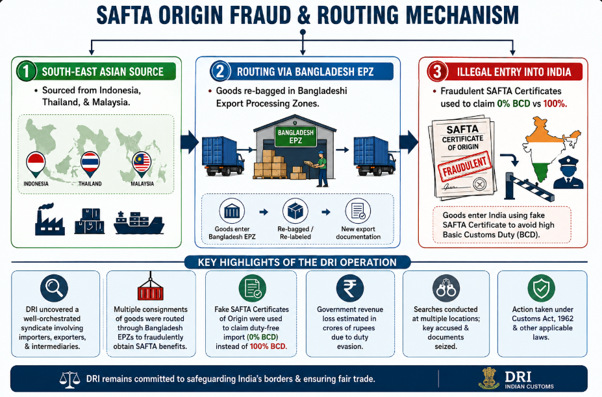
Key Highlights of the DRI Operation
-
- Scale of Duty Evasion: Initial investigations reveal an estimated customs duty fraud exceeding ₹2,500 Crore.
- Enforcement Actions & Seizures:
- Arrests: 9 individuals (including masterminds and facilitators) arrested.
- Seizures: ₹75 Lakh in cash (believed to be illicit sale proceeds) and a live consignment of 160 Metric Tonnes (MT) of areca nuts.
- Inter-State Raids: Simultaneous searches conducted across Kolkata and Visakhapatnam covering importers, Customs Brokers, and Import Export Code (IEC) holders.
- Regulatory Action: License of the key Customs Broker firm responsible for clearing the majority of fraudulent consignments was suspended.
Modus Operandi of the Syndicate
1. Tax Arbitrage Exploitation: India levies a 100% Basic Customs Duty (BCD) on areca nut imports to protect domestic farmers. However, imports originating from SAFTA member countries like Bangladesh are 100% exempt if they satisfy the prescribed Rules of Origin (RoO) criteria.
2. Origin Fraud: Areca nuts sourced from non-SAFTA nations (Indonesia, Thailand, Malaysia) were shipped to Export Processing Zones (EPZs) in Bangladesh. The goods were merely re-bagged/transshipped to disguise their origin, obtaining fraudulent SAFTA Certificates of Origin.
3. Hawala & Money Laundering: Indian importers paid masterminds through cash collections, layered via hawala channels and dummy corporate entities.
Economic Impacts
-
- Domestic Farmers: Depresses domestic market prices, undercutting genuine areca nut growers in major producing states (Karnataka, Kerala, Assam).
- Revenue Loss: Directly defrauds the public exchequer by bypassing tariff protection measures.
- Trade Integrity: Compromises the integrity of bilateral trade concessions under SAFTA and weakens border security regulations.
UPSC Quick Reference Table
| Component | Detailed Specification |
| Investigating Agency | Directorate of Revenue Intelligence (DRI), Ministry of Finance |
| Commodity Involved | Areca Nuts (Betel Nuts) |
| Tariff Arbitrage | 100% Basic Customs Duty vs. 0% Concessional SAFTA Rate |
| Misdeclared Origin | Claimed as Bangladesh (Actual origin: Indonesia, Thailand, Malaysia) |
| Revenue Loss Estimate | Exceeds ₹2,500 Crore |
| Money Laundering Mode | Hawala channels and dummy entities. |
Conclusion:
Dismantling the illegal areca nut import network highlights the role of strict enforcement of Rules of Origin (RoO) under regional free trade agreements like SAFTA. Preventing origin fraud helps protect domestic farmers, prevents revenue loss, and maintains fair trade practices.
TOPIC-2: India Launches Guide to Grasslands & Open Natural Ecosystems (ONEs) at UNCCD COP17
-
- GS Paper 3 (Environment and Ecology — Biodiversity conservation, land degradation neutrality, climate resilience, and sustainable land management).
Context: India launched its first-ever “Guide to Grasslands and Other Open Natural Ecosystems (ONEs) of India” at an official side event during the 17th Session of the Conference of the Parties (COP17) to the United Nations Convention to Combat Desertification (UNCCD) held in Ulaanbaatar, Mongolia. The release aligns with the broader global goal of achieving Land Degradation Neutrality (LDN) and coincides with the UN-declared International Year of Rangelands and Pastoralists (IYRP 2026).
Core Objectives
-
- Reclassifying Open Natural Ecosystems (ONEs)
- Replaces the colonial bias that judged ONEs as “waste” due to lack of trees.
- Promotes scientific management of non-forest ecosystems alongside forests.
- Recognizes ONEs as vital carbon sinks, water regime anchors & biodiversity hubs.
Paradigm Shift in Conservation
1. Shift Away from the “Wasteland” Label: Historically, scrublands, ravines, and grazing lands were classified as “wastelands” due to a forestry-centric bias that defined land productivity solely by tree cover. The guide re-frames these regions as ecologically vital biomes.
2. Community Governance Systems: Highlights traditional conservation models—such as the Oran (sacred groves/grazing reserves) and Gauchar (village commons) in Rajasthan—that demonstrate sustainable land stewardship by pastoral communities.
3. Biodiversity & Ecological Security: ONEs harbor unique, endemic wildlife adapted to arid and open conditions (e.g., Great Indian Bustard, Lesser Florican, Chinkara, Blackbuck) while supporting soil water filtration and microbial processes.
Key Ecosystems
-
- Himalayan & Terai
- Thar & Banni
- Deccan Savannas Rangelands
- Coastal & Riverine & Plateaus
- Grasslands Scrub/Ravines
Thematic Scope Covered in the Guide
-
- Thematic Modules: Incorporates scientific studies on pastoralism, fire ecology (understanding natural fire regimes versus invasive burn threats), and below-ground carbon sequestration.
- Carbon Dynamics: Highlights that while open biomes lack dense canopy cover, they hold significant soil organic carbon (SOC) pools that offer stable carbon storage less vulnerable to surface forest fires
UPSC Quick Reference Table
| Component | Detailed Specification |
| Document Name | Guide to Grasslands and Other Open Natural Ecosystems (ONEs) of India |
| Launch Platform | Side event at UNCCD COP17, Ulaanbaatar, Mongolia |
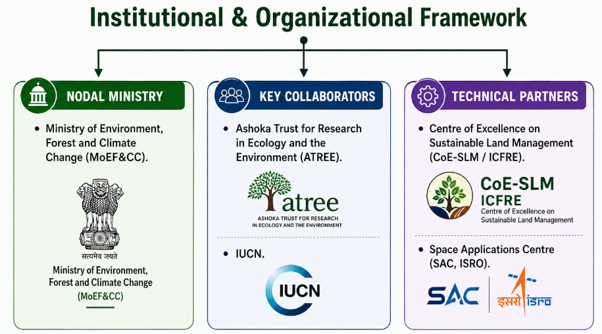
| Lead Organization | ATREE, under the guidance of MoEF&CC |
| Partner Institutions | IUCN, ICFRE (CoE-SLM), and Space Applications Centre (SAC-ISRO) |
| Traditional Systems | Orans and Gauchars (Community-managed pastoral lands) |
| Global Alignment | International Year of Rangelands and Pastoralists (IYRP 2026) & LDN Targets |
Conclusion:
The release of the Guide to Grasslands and Other Open Natural Ecosystems introduces a framework for recognizing non-forest biomes in climate resilience and land restoration. Integrating indigenous pastoral knowledge with ISRO spatial mapping and scientific inputs supports India’s Land Degradation Neutrality (LDN) goals and protects biodiversity across open landscapes.
Spread the Word