Introduction:
The Micro, Small and Medium Enterprises Development (Amendment) Bill, 2026, passed by both Houses in August 2026, seeks to modernise this framework with particular emphasis on timely payments, easier registration, digital dispute resolution and stronger enforcement.
MSMEs-Why the Sector Matters
According to the Economic Survey 2025–26:
-
- MSMEs contribute 31.1% of GDP.
- They account for 35.4% of manufacturing output.
- They contribute 48.58% of exports.
- As per the Government’s August 2026 data, 9.16 crore MSMEs are registered on Udyam, employing more than 40 crore people.
Thus, improving the business environment for MSMEs has direct implications for employment generation, exports, manufacturing competitiveness and inclusive growth.
Why was the MSMED Act 2006 amended
-
- Under the existing framework, MSE buyers are required to make payment within the prescribed period, subject to a maximum of 45 days. Yet delayed payments remain a major concern for the viability and growth of MSEs.
-
- 2,56,892 cases were filed on the MSME Samadhaan Portal up to December 2025. These involved claims of ₹55,244.26 crore. ₹22,096.62 crore remained outstanding.
- Although MSE Facilitation Councils (MSEFCs) exist, delays in mediation, arbitration and enforcement can lock up scarce working capital.
- The MSME ecosystem has increasingly moved towards digital registration and formal supply chains. Which require a simpler and more flexible registration framework.
- Modern enterprises increasingly combine manufacturing and services and grow beyond traditional investment-only classifications. The Bill moves towards a dual investment + turnover framework.
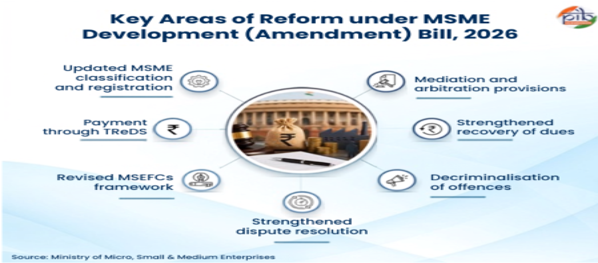
Comparison
| MSMED Act, 2006 | 2026 Amendment Bill |
|---|---|
| • Based on investment in plant & machinery/equipment. | • Based on investment + annual turnover. |
| • Memorandum mandatory for medium manufacturing enterprises & voluntary for others. | • Free and voluntary registration for all MSMEs through national/state digital platforms. |
| • No statutory requirement for CPSEs to settle MSME invoices through TReDS(Trade Receivables Discounting System) | • CPSEs required to settle MSME invoices through TReDS. States may extend this to their PSEs/entities. |
| • States may establish one or more Facilitation Councils. | • States can establish multiple MSEFCs(Micro and Small Enterprises Facilitation Councils) with adequate infrastructure, digital systems and trained manpower. |
| • Mediation available for delayed-payment disputes, but no specific 90-day timeline. | • Mediation to be completed within 90 days from first appearance. |
| • No comparable statutory timeline for making the award. | • If mediation fails, referral within 30 days; arbitral award within 90 days from completion of pleadings. |
| • Buyer challenging an award/order must deposit 75% of awarded amount. | • Provision extended to mediated settlements; if proceedings remain pending beyond 6 months, court must direct payment of at least 50% of awarded amount to the MSME supplier. |
| • No specific mechanism under the Act for recovering mediated settlements/arbitral awards as land revenue. | • Settlements/awards can be recovered as arrears of land revenue through the District Collector/Deputy Commissioner or notified authority. |
Significance of the 2026 Amendment
i. Delayed payments can convert a profitable order into a working-capital crisis.
ii. TReDS-based invoice settlement and stronger recovery mechanisms can help MSMEs convert receivables into usable liquidity.
iii. Statutory timelines for mediation and arbitration seek to reduce uncertainty and prevent MSMEs from remaining locked in disputes for prolonged periods.
iv. Free voluntary registration and decriminalisation of certain violations represent a shift from a punitive regulatory approach towards trust-based compliance and Ease of Doing Business.
v. Integration of Udyam, Udyam Assist, TReDS and digital dispute resolution can bring more enterprises into formal financial and institutional networks.
vi. NITI Aayog stresses that MSME competitiveness depends not only on credit availability but also on technology adoption, efficient resource allocation, risk management and an enabling business environment.
Challenges
-
- Infrastructure, trained personnel, digital capacity and monitoring will determine whether the statutory timelines translate into actual disposal.
- The Bill strengthens recovery, but delayed-payment problems ultimately depend on effective enforcement against buyers and timely compliance with awards.
- NITI Aayog identifies persistent barriers such as lack of collateral, information asymmetry, complex processes and high perceived risk. Therefore, payment reforms alone cannot solve the broader MSME financing gap.
- NITI Aayog’s Enhancing Competitiveness of MSMEs in India highlights that competitiveness requires more than finance, including technology upgradation, better resource utilisation and stronger institutional support.
- Registration will have limited value if formal enterprises do not receive easier access to credit, markets, technology, skills and government procurement. Formalisation must therefore be linked to tangible economic benefits.
Way Forward
-
- Move towards stronger payment-performance disclosure and payment-code mechanisms.
- NITI Aayog emphasises improving the entire credit-utilisation process.
- Strengthen book-keeping, financial literacy, digital records, credit assessment and risk-management capabilities of MSMEs rather than focusing only on loan availability.
- NITI Aayog identifies scheme convergence as important components of MSME competitiveness.
Conclusion:
The MSME Development (Amendment) Bill, 2026 real success, however, will depend on converting statutory reforms into faster payments, stronger institutional capacity and higher productivity. Thus, enabling India’s MSMEs to become engines of employment, exports and globally competitive growth.
Spread the Word