TOPIC-1: Scientific Mine Closure & Repurposing Initiatives by SECL
-
- GS Paper 3 (Environmental conservation, environmental impact assessment; Energy sector – Renewable energy integration; Inclusive growth, sustainable livelihoods, and mineral sector governance).
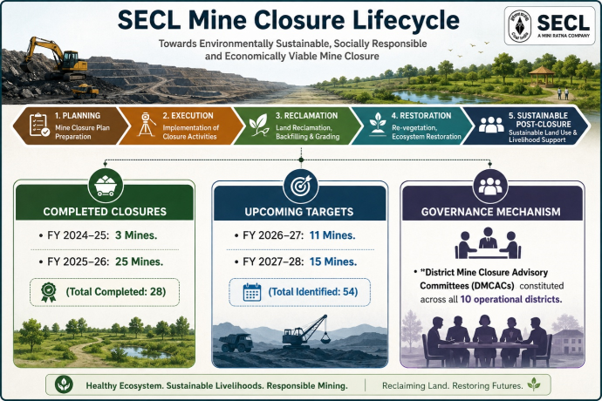
Operational Overview: South Eastern Coalfields Limited (SECL), a major subsidiary of Coal India Limited (CIL), has taken a lead role in scientific mine closure across its operational areas in Chhattisgarh and Madhya Pradesh. By treating mine closure as an integral phase of the mining lifecycle rather than an afterthought, SECL has completed the scientific closure of 28 abandoned mines out of 54 identified sites, accounting for 67% of all scientifically closed abandoned coal mines in India.
In FY 2025–26 alone, SECL closed 25 mines—the highest single-year achievement by any mining enterprise in the country. The company aims to complete the scientific closure of all remaining 26 identified abandoned mines by FY 2027–28.
Phased Implementation Roadmap
1. Renewable Energy Integration
SECL is transforming closed mine lands into clean energy generation hubs to support net-zero targets:
-
- Completed Plants: Commissioned 20 MW solar power plants at Bhatgaon and Bishrampur.
- Under Implementation:
- 5 MW solar project integrated with an Eco Park at Vivek Nagar UG.
- 40 MW solar project at Pinoura UG.
- Planned Projects: 55 MW solar power project across Jamuna UG and Govinda UG.
2. Civic & Community Infrastructure Creation
Reclaimed land and redundant mine service buildings have been repurposed to serve public needs:
-
- Educational & Health Infrastructure: Integrated reclaimed land into Bal Vihar Higher Secondary School (Korba 3&4 UG); established a health center and weekly market (Banki 7&8 UG); created a community center (Banki 5&6 UG).
- Water & Civil Services: Installed municipal water filter plants at North Jhagrakhand UG and Subhash Incline; established a CISF Post (South Jhagrakhand 5&6 UG) and public parks (South Jhagrakhand 10&11 UG).
3. Ecological Restoration & Forestry
-
- Mass Afforestation: Planted ~35,000 saplings at Chachai UG following underground opening sealing and demolition of redundant structures.
- Dense Plantations & Regeneration: Developed dense forest patches at Ramnagar UG, Korea UG, and Malga UG, while preserving naturally regenerated flora at Rajgamar 8&9 UG and Pure Chirimiri UG.
4. Sustainable Livelihood Generation & Bio-Economy
-
- Pisciculture in Mine Voids: Utilizing water bodies created by closed open-cast/underground mines for commercial fish farming—projected to yield 25 tonnes of annual fish production, create 206 direct livelihoods, and generate an average annual income of ₹3 lakh per participating family.
- Skill Development: Organizing community training in computer literacy, tailoring, handicrafts, mushroom cultivation, pickle making, and agro-processing.
- Future Livelihood Pipelines:
- Jamuna OC: Eco-tourism, poultry farming, and masala processing.
- Baiga OC: Honey processing, turmeric cultivation, and cage-culture fisheries.
- Banki UG: Compressed Bio-Gas (CBG) plant, training center, and fruit orchards.
UPSC Quick Reference Table
| Metric / Parameter | Detailed Specification |
| Nodal Body | South Eastern Coalfields Limited (SECL) / Ministry of Coal |
| Geographical Operations | Chhattisgarh and Madhya Pradesh (10 Operational Districts) |
| National Share | Accounts for 67% of all scientifically closed abandoned mines in India |
| FY 2025–26 Achievement | 25 Mines scientifically closed in a single financial year |
| Local Governance Body | District Mine Closure Advisory Committees (DMCACs) |
| Solar Energy Capacity | Over 120 MW commissioned, under implementation, or planned |
| Fisheries Potential | 25 Tonnes/year fish production; ₹3 Lakh annual income/family |
Conclusion:
SECL’s mine closure framework moves beyond passive site sealing by converting abandoned coal mines into assets for renewable energy, local infrastructure, afforestation, and rural livelihoods. Deploying District Mine Closure Advisory Committees (DMCACs) and integrating solar power, compressed bio-gas, and pisciculture provides a model for sustainable post-mining land restoration in India.
TOPIC-2: Progress on Legislative Reforms
-
- GS Paper 2 (Government Policies & Interventions; Judicial Reforms, Dispute Redressal Mechanisms, Statutory Bodies & Centrally Sponsored Schemes)
- GS Paper 3 (Ease of Doing Business, Economic Growth, Investment Climate).
Executive Summary:
The initiatives focus on four primary pillars:
1. Trust-Based Governance: Decriminalization of minor technical offenses via the Jan Vishwas legislative framework.
2. Institutionalizing ADR: Strengthening statutory frameworks for Arbitration, Pre-Institution Mediation, and Institutional Mediation.
3. Legal Aid & Lok Adalats: Expanding pre-litigation and court-annexed mediation settlement figures through Legal Services Authorities.
4. Court Infrastructure: Evaluating the impact of the Centrally Sponsored Scheme (CSS) for District and Subordinate Court Infrastructure on reducing case pendency.
Key Pillars of Legislative & Judicial Reforms
1. Trust-Based Governance & Decriminalization
-
- Jan Vishwas (Amendment of Provisions) Act, 2026: Published in the Official Gazette on 8 April 2026, this legislation rationalizes provisions across 79 Central Acts administered by 23 Ministries and Departments.
- Objective: Replaces minor criminal penalties and imprisonment risks for technical/procedural defaults with proportional civil penalties, administrative mechanisms, and self-certification models to improve the Ease of Doing Business (EoDB).
2. Alternative Dispute Resolution (ADR) Framework
To create a less adversarial, time-bound, and neutral dispute resolution landscape, key legislative interventions include:
-
- Arbitration & Conciliation Act, 1996: Progressively amended (2015, 2019, 2020) to promote institutional arbitration, ensure neutrality of arbitrators, minimize judicial intervention, and enforce arbitral awards within statutory timelines.
- Commercial Courts Act, 2015 (Amended 2018): Mandates Pre-Institution Mediation and Settlement (PIMS) for commercial disputes of specified value where no urgent interim relief is contemplated.
- India International Arbitration Centre (IIAC) Act, 2019: Established the IIAC as an autonomous body of national importance to facilitate independent institutional arbitration.
- Mediation Act, 2023: Acts as a standalone statutory framework regulating domestic, institutional, and online mediation.
Performance of Legal Services Authorities (NALSA / SALSA / DLSA): Through court-annexed and pre-institution mediation:
-
- 2024–25: 98,406 cases settled
- 2025–26: 2,25,647 cases settled (more than 129% year-on-year growth)
3. Judicial Infrastructure & Impact on Pendency
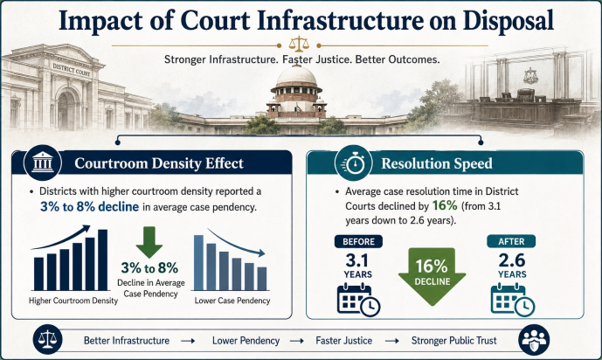
Under the Centrally Sponsored Scheme (CSS) for Development of Infrastructure Facilities for District and Subordinate Courts, a third-party evaluation conducted under the aegis of NITI Aayog highlighted measurable judicial outcomes:
UPSC Quick Reference Table
| Component | Detailed Specification |
| Nodal Ministry | Ministry of Law and Justice |
| Latest Decriminalization Law | Jan Vishwas Act, 2026 (Amends 79 Central Acts across 23 Ministries) |
| Standalone Mediation Law | Mediation Act, 2023 |
| Institutional Arbitration Body | India International Arbitration Centre (IIAC) (Established under 2019 Act) |
| Mediation Cases Settled (2025–26) | 2,25,647 cases (via Legal Services Authorities) |
| Impact of Court CSS Infrastructure | Court resolution time dropped from 3.1 years to 2.6 years (16% reduction) |
Conclusion:
Rationalizing criminal penalties through the Jan Vishwas Act 2026, establishing statutory mediation under the Mediation Act 2023, and strengthening district court infrastructure through the Centrally Sponsored Scheme help modernize India’s legal architecture. Reducing case resolution times and resolving over 2.25 lakh disputes through mediation in 2025–26 support institutional efficiency and ease of doing business.
TOPIC-3: Supreme Court Guidelines for Gender-Sensitive
-
- GS Paper 2 (Structure, Organization, and Functioning of the Judiciary; Judicial Precedents & Reforms; Protection of Vulnerable Sections) &
- GS Paper 4 (Ethics and Human Interface — Compassion, Empathy, and Sensitivity in Governance & Adjudication).
Overview: In a written reply in the Rajya Sabha, Union Minister of State (Independent Charge) for Law and Justice, Shri Arjun Ram Meghwal, highlighted the Supreme Court’s judgment in Suo Motu Writ Petition (Criminal) No. 1 of 2025 (and related directives in Miscellaneous Application No. 1998 of 2026). The landmark ruling formally adopted a comprehensive report prepared by a Committee of Experts under the aegis of the National Judicial Academy (NJA). The initiative mandates a gender-sensitive, victim-centric, and trauma-informed framework across all stages of criminal investigation, cross-examination, and judicial drafting, particularly in cases involving sexual and gender-based violence.
Core Pillars of the Supreme Court Guidelines
1. Prevention of Secondary Victimization
-
- Strict Limits on Sexual History: Expressly prohibits reliance on or inquiry into a survivor’s past sexual history, character, or prior relationships during cross-examination, enforcing statutory bars under the Indian Evidence Act / Bharatiya Sakshya Adhiniyam.
- Control of Intrusive Interrogation: Directs trial judges to actively intervene and disallow harassing, humiliating, or irrelevant questions aimed at character assassination during cross-examination.
2. Gender-Sensitive Language & Judgments
-
- Publication of ‘Judgments and Gender’: Accompanying the judgment, the Supreme Court released the guidance module “JUDGMENTS AND GENDER (Sensitivity and compassion in writing judgments)”.
- Elimination of Judicial Stereotypes: Mandates that judicial orders avoid patriarchal stereotypes, patronizing tropes, or moralistic observations regarding a victim’s behavior, attire, or conduct.
3. Victim-Centric & Trauma-Informed Courtroom Practices
-
- Preserving Autonomy and Privacy: Reaffirms constitutional guarantees of dignity, bodily integrity, privacy, and personal autonomy under Article 21.
- Dignified Courtroom Environment: Encourages the use of vulnerable witness courtrooms, protective screening/video links, in-camera trials, and frequent breaks during testimony to prevent re-traumatization.
Institutional Role & Stakeholder Training
-
- National Judicial Academy (NJA) & State Academies: The guidelines serve as a core curriculum for ongoing capacity building and training of trial judges, prosecutors, and law enforcement officers.
- Systemic Awareness: Aims to eliminate institutional biases during police investigations, medical evaluations, and trial proceedings to ensure fair and responsive justice.
UPSC Quick Reference Table
| Component | Detailed Specification |
| Nodal Ministry | Ministry of Law and Justice |
| Key Judicial Precedent | Suo Motu Writ Petition (Crl.) No. 1 of 2025 |
| Formulating Agency | National Judicial Academy (NJA) Expert Committee |
| Primary Directive | Prohibition of secondary victimization & sexual history inquiries |
| Official Benchbook | Judgments and Gender: Sensitivity and Compassion in Writing Judgments |
| Core Values | Gender sensitivity, trauma-informed adjudication, victim dignity |
Conclusion:
By curbing secondary victimization during trials, regulating cross-examination practices, and eliminating gender stereotypes from judicial orders, the framework aligns trial procedures with constitutional guarantees of human dignity, privacy, and equality.
Spread the Word