Introduction:
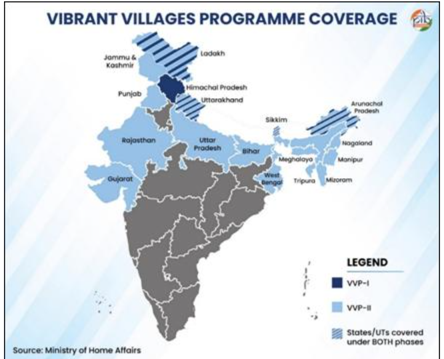
Vibrant Villages Programme (VVP) is a flagship initiative recasting India’s border villages from “last villages” of the map into “first villages” of national development and security. It is implemented in two phases, VVP-I (2023, northern border) and VVP-II (2026, all remaining land borders).
Why Do Border Villages Matter?
-
- India has over 15,000 km of international land borders with seven neighbouring countries. Border Area Development Programme (BADP) launched in 1986-87, covered 111 districts in 16 States/2 UTs and sanctioned over 39,000 works since 2004-05, but is now in its sunset phase.
- Multiple assessments including a 2004 Parliamentary Standing Committee report, Planning Commission Task Force Report, 2018 Parliamentary Standing Committee highlighted inadequate fund allocation and village-list-based targeting as reasons for its limited transformational impact.
- VVP responds to this by concentrating resources on strategically selected “priority” villages to convert border residents which are long recognised as the “eyes and ears” of security forces since 1999 Kargil intrusion. (It was first reported by local shepherds)
- VVP carries a combined outlay of Rs 11,639 crore and targets over 2,616 villages spread across 17 States and Union Territories along India’s 15,000-km international land frontier.
Strategic Rationale: The China Dimension
-
- VVP is widely read alongside China’s ‘Xiaokang’ (moderately prosperous) border-village programme. Under which Beijing has reportedly built around 628 settlements along the Line of Actual Control backed by over 1,20,000 km of roads and 30 border airports.
- Observer Research Foundation (ORF) notes a key structural difference i.e. Xiaokang villages are populated through state compulsion whereas VVP seeks voluntary return migration through genuine livelihood incentives. Thus having a potential soft-power advantage for India if implementation keeps pace.
Evolution of VVP:
| VVP-I | VVP-II |
|---|---|
| • 10 April 2023, Kibithoo (Arunachal Pradesh) | • 20 Feb 2026, Nathanpur (Assam) |
| • Centrally Sponsored (Centre + States) | • Central Sector (100% Centre-funded) |
| • 662 villages, 46 blocks, 5 States/UT (northern border) | • 1,954 villages, 334 blocks, 17 States/UTs (remaining land borders) |
| • Rs 4,800 cr (FY23-FY27) | • Rs 6,839 cr (till FY29) |
| • Road connectivity (Rs 2,500 cr) | • Trans-border crime control, value chains via SHGs/cooperatives |
What Makes VVP Different?
1. VVP’s operating logic rests on Village Action Plans prepared jointly by district administrations and Gram Panchayats, aiming for saturation of existing Central and State schemes rather than creating a parallel delivery system.
2. VVP strengthens border villages through all-weather roads, bridges, electricity, healthcare, education & infrastructure.
3. Improved connectivity enhances market access, emergency response, public service delivery and strategic mobility. Thereby strengthening both development and border management.
4. The programme promotes sustainable livelihoods through tourism, cooperatives, SHGs, FPOs, agriculture, etc.
5. VVP-I has approved 327 tourism projects worth ₹145 crore, including eco-tourism, adventure tourism, eco-resorts etc.
6. VVP supports integrated village development through Village Action Plans and convergence of Central, State and local schemes.
7. The programme promotes security, demographic resilience & local economic growth by linking development, population stability, community participation and stronger border management.
Achievement So Far:
| Indicator | Achievement |
|---|---|
| Projects sanctioned by MHA | 1,248 projects worth Rs 3,020.32 crore |
| Projects via Central convergence | 1,655 additional projects |
| Funds released to States/UTs | Rs 953.47 crore |
| Projects completed | 283 |
| Road projects / new villages connected | 111 projects (Rs 2,481.93 cr) connecting 134 villages; 35 long-span bridges |
| Tourism projects approved | 327 projects worth Rs 145 crore |
| Outreach activities held | 8,800+ (health camps, skilling, awareness drives) |
CHALLENGES:
i. Legacy of social backwardness as highlighted by the 2018 Parliamentary Standing Committee on Home Affairs and only partially bridged since physical infrastructure has outpaced social infrastructure in remote border blocks.
ii. Analyses of the sunset BADP (Planning Commission Task Force, 2007; PSC reports) attribute its limited impact to inadequate and thinly-spread fund allocation. A structural risk VVP must actively avoid despite covering nearly four times as many villages.
iii. ORF flags that ineffective monitoring and weak accountability in far-flung terrain can lead to fund diversion and slow execution with some India-Tibet border villages still requiring multi-day travel on foot or pony even in 2024.
iv. A 2024 survey by Uttarakhand’s Rural Development and Migration Prevention Commission found 11 villages already abandoned in Chamoli, Pithoragarh and Uttarkashi. Thus, showing that out-migration can outrun scheme rollout in real time.
v. India’s border build-up remains “much slower” than China’s simultaneous Xiaokang expansion, given India’s terrain, weather-dependent construction windows and multi-agency coordination needs versus China’s centralised, compulsion-driven model.
vi. Convergence across PMGSY, RDSS, tourism, health and skilling ministries increases coordination costs. The reliance on a High-Powered Committee to grant case-by-case guideline relaxations reflects a workaround rather than a structurally simplified framework for border-specific implementation.
WAY FORWARD:
i. Operationalise proposed ‘Vibrant Gram Sabha’ mechanism as a standing, community-led review body so that Village Action Plan implementation is tracked in near real time by residents themselves, not only by district administration.
ii. Use PM Gati Shakti and similar geo-tagged dashboards for physical and financial progress tracking of every sanctioned project.
iii. Deepen demonstrated model of assured local procurement such as ITBP sourcing milk, vegetables and grains directly from border villages and extend FPO/SHG/cooperative-linked value chains across all newly-added VVP-II blocks.
iv. Mandate carrying-capacity and disaster-vulnerability assessments before large infrastructure sanctions in ecologically sensitive Himalayan and north-eastern stretches, ensuring VVP’s growth does not undermine the very terrain it seeks to secure.
v. Prioritise SMART classrooms, healthcare posts and skilling infrastructure with the same urgency as roads and electrification as emphasised by 2018 Parliamentary Standing Committee.
CONCLUSION:
Ultimately, VVP’s success will be measured less by outlay and more by whether border residents choose to stay, return and build their futures in these villages as the programme moves from its foundational to its consolidation phase. Thus, Vibrant Villages Programme must bring fundamental change from securing borders around villages to strengthening security through villages.
Spread the Word