
Topic-1: India’s Leadership in Global Food Standards at CAC49
GS Paper 2: Important International institutions, agencies, and fora- their structure, mandate (Codex Alimentarius Commission).
GS Paper 3: Food processing and related industries in India (supply chain management, quality control); Agricultural exports and economics.
Context: India achieved significant milestones at the 49th Session of the Codex Alimentarius Commission (CAC49) held in Geneva, Switzerland, from July 6 to 10, 2026. The Indian delegation, led by the CEO of the Food Safety and Standards Authority of India (FSSAI), successfully secured the adoption of seven India-led food standards and gained approval to develop a new global standard for cashew kernels.
Key Codex Standards Adopted at CAC49
The Commission adopted seven critical science-based texts developed under India’s direct leadership or co-chairmanship. These standards harmonize global quality requirements, ultimately reducing technical barriers to trade for Indian agricultural exports:
-
- Standards Chaired by India: Adopted new global quality benchmarks for Dried Coriander Seeds (one of the world’s most traded spices) and Fresh Curry Leaves (a regionally vital culinary herb).
- Standards Co-Chaired by India: Established internationally harmonized requirements for Vanilla and Large Cardamom.
- Food Safety and Water Management: Adopted guidelines for the Safe Use and Reuse of Water in Food Production and Processing to promote sustainable agricultural water management.
- Poultry Hygiene: Implemented global guidelines for the control of Campylobacter and Salmonella in chicken meat to reduce foodborne illnesses.
- Packaging Transparency: Formalized provisions for Joint Presentation and Multipack Formats under the General Standard for the Labelling of Prepackaged Foods.
Future Initiatives & Global Governance Roles
Beyond adopting existing texts, India secured major regulatory roles to shape the future of global food trade:
-
- Cashew Kernel Standardization: The Commission overwhelmingly approved India’s proposal to develop a new Codex Standard for Cashew Kernels under the Codex Committee on Processed Fruits and Vegetables (CCPFV). This will enhance the global competitiveness and market access of Indian cashew exports.
- New Food Sources (NFPS): India was elected as the Co-Chair of the Electronic Working Group on New Food Sources and Production Systems (NFPS). This group is tasked with reviewing regulatory frameworks and identifying risk analysis gaps for emerging and alternative food technologies.
UPSC Prelims Fodder: Fact-Check
| Feature | Details |
| Global Summit | 49th Session of the Codex Alimentarius Commission (CAC49) in Geneva. |
| Indian Nodal Agency | FSSAI (Food Safety and Standards Authority of India) & Spices Board. |
| India-Chaired Standards | Dried Coriander Seeds and Fresh Curry Leaves. |
| Co-Chaired Standards | Vanilla and Large Cardamom. |
| New Approval Pipeline | India won the bid to draft global standards for Cashew Kernels. |
| Future Governance Role | India elected Co-Chair for the Working Group on New Food Sources (NFPS). |
Conclusion:
India’s success at CAC49 highlights its growing influence in shaping international, science-based food safety regulations by leading the standardization of key commodities like coriander, cardamom, and cashews, India is actively dismantling global non-tariff trade barriers.
Topic-2: Mobile Phone Manufacturing Scheme (MPMS)
GS Paper 2: Government policies and interventions for development in various sectors and issues arising out of their design and implementation.
GS Paper 3: Indian Economy and issues relating to planning, mobilization of resources, growth, development, and employment; Effects of liberalization on the economy, changes in industrial policy and their effects on industrial growth.
Context: The Union Cabinet chaired by the Prime Minister approved the Mobile Phone Manufacturing Scheme (MPMS) with a massive budgetary allocation of ₹62,500 crore. The new scheme succeeds the Production Linked Incentive Scheme for Large Scale Electronics Manufacturing (PLI-LSEM), which concluded its tenure on March 31, 2026.
Core Objectives
While the previous PLI framework established India as the world’s second-largest mobile phone manufacturer by volume (achieving 99.2% domestic sourcing for local consumption), MPMS signals a major policy shift:
-
- Value Addition Depths: Moving past basic completely knocked-down (CKD) assembly to catalyze local fabrication of complex components.
- Technological Sovereignty: Actively supporting domestic Indian original equipment manufacturers (OEMs) to generate localized intellectual property, designs, and patents rather than relying solely on foreign contract manufacturers.
The Fiscal Incentive Architecture (2026–2031)
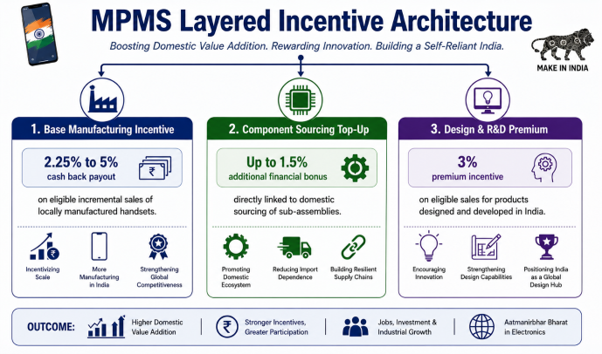
The scheme spans a 5-year tenure from FY 2026-27 to FY 2030-31. The ₹62,500 crore corpus is built on a layered, performance-linked structure:
Macroeconomic Impact Projections
The operational execution of the scheme expects major shifts in India’s export and labor profiles over the next five years:
-
- Production Volumetrics: Cumulative mobile phone production is projected to reach approximately ₹39,00,000 crore during the scheme’s lifespan, with smartphones reinforcing their position as India’s single largest exported product category (surpassing traditional leaders like diesel fuel and cut diamonds).
- Labor Capitalization: Expected to generate 60,000 direct, high-value technical jobs, heavily benefiting the formal electronics manufacturing workforce.
UPSC Prelims Fodder: Fact-Check
| Feature | Details |
| Scheme Nomenclature | Mobile Phone Manufacturing Scheme (MPMS). |
| Financial Allocation | ₹62,500 Crore over a 5-year award baseline. |
| Tenure Horizon | FY 2026-27 to FY 2030-31. |
| Predecessor Core | Replaces PLI-LSEM (which concluded on March 31, 2026). |
| Incentive Caps | Base: 2.25% – 5% | Sourcing: +1.5% | Design & R&D: +3%. |
| Industrial Baseline | Electronics manufacturing grew 7x and exports 11x since FY 2014-15. |
| Employment Goal | Target creation of 60,000 direct employment opportunities. |
Conclusion:
The introduction of the ₹62,500 crore Mobile Phone Manufacturing Scheme (MPMS) marks the evolution of India’s electronics industrial policy. By layering standard manufacturing incentives with top-ups for component sourcing and local product design, the government is moving up the global value chain.
Topic-3: National Investment Policy for Urea-2026 (NIPU-2026)
GS Paper 2: Government policies and interventions for development in various sectors and issues arising out of their design and implementation.
GS Paper 3: Issues related to direct and indirect farm subsidies; Technology missions; Infrastructure; Inclusivity in agricultural economics (Atmanirbhar Bharat).
Context: The Cabinet Committee on Economic Affairs (CCEA), chaired by the Prime Minister, approved the Department of Fertilizers’ proposal for the National Investment Policy for Urea-2026 for Atmanirbhar Bharat (NIPU-2026). The framework establishes a modern, investor-friendly ecosystem to build 8 to 9 new gas-based urea manufacturing plants, targeting an additional domestic production capacity of 10 million metric tonnes (100 LMT) to eliminate India’s reliance on foreign imports.
The Macro Nutrient Deficit & Policy Necessity
Urea remains the most widely consumed nitrogenous fertilizer in Indian agriculture. The policy addresses a persistent structural gap in India’s agricultural supply chain:
-
- The Current Footprint: India operates 33 manufacturing units with a combined reassessed domestic capacity of 269.42 Lakh Metric Tonnes (LMT).
- The Supply-Demand Gap: Total domestic production hovers around 30 million tonnes against a rising annual national demand of nearly 40 million tonnes. The resulting 10 million tonne shortfall has historically been met via costly imports that drain foreign exchange reserves.
- The Chronology: The predecessor framework, New Investment Policy (NIP)-2012, successfully added 6 new units (4 via Public Sector Joint Ventures and 2 via private firms) before its investment window closed in October 2019. NIPU-2026 updates this architecture to address fresh capacity expansion proposals.
Structural Shifts: NIPU-2026 vs. NIP-2012
NIPU-2026 introduces major changes to the previous pricing model. These adjustments protect public finances while offering predictable, stable terms for public, private, and cooperative sector projects alike
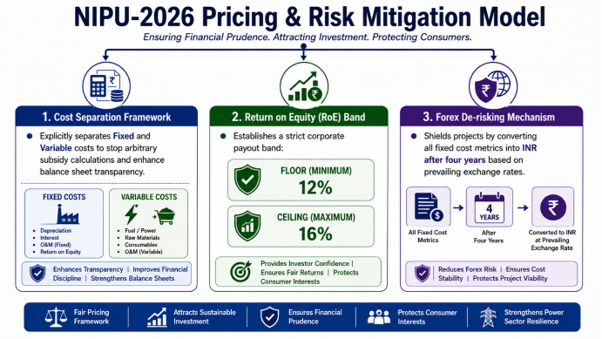
Macroeconomic Payback: Due to these structural risk mitigations and optimized subsidy formulas, the government will achieve net fiscal savings of over ₹250 crore for each plant established under NIPU-2026 compared to the NIP-2012 framework.
UPSC Prelims Fodder: Fact-Check
| Feature | Details |
| Policy Nomenclature | National Investment Policy for Urea-2026 (NIPU-2026). |
| Nodal Department | Department of Fertilizers (Ministry of Chemicals and Fertilizers). |
| Primary Technology | Gas-based Urea Manufacturing Units (highly energy efficient). |
| Target Scale Output | Create 8–9 new plants to add 10 Million Tonnes of capacity. |
| Subsidy Safety Caps | Regulated via a strict 12% to 16% Return on Equity (RoE) band. |
| Forex Risk Anchor | Fixed costs converted entirely to INR after 4 operational years. |
| Current Baseline | 33 active units yielding a base capacity of 269.42 LMT. |
Conclusion:
NIPU-2026 provides a transparent financial blueprint to transition India toward complete self-sufficiency in its most critical agricultural input by introducing a clear 12%–16% RoE band and removing foreign exchange risks after four years, the framework attracts private and public capital into cleaner, gas-based manufacturing.
Topic-4: India-UK Comprehensive Economic and Trade Agreement (CETA)
GS Paper 2: Bilateral, regional and global groupings and agreements involving India and/or affecting India’s interests; Effect of policies and politics of developed countries on India’s interests.
GS Paper 3: Indian Economy (International Trade, Free Trade Agreements, Rules of Origin, and Service Sector Dynamics); Mobilization of resources and employment generation.
Context: The landmark India-United Kingdom Comprehensive Economic and Trade Agreement (CETA) and the accompanying Agreement on Social Security (Double Contribution Convention – DCC) officially entered into force on July 15, 2026. The historic date was finalized during the G7 Summit in France, concluding several years of negotiations spanning 14 formal rounds and over 800 technical sessions.
Key Pillars of the Goods and Services Framework
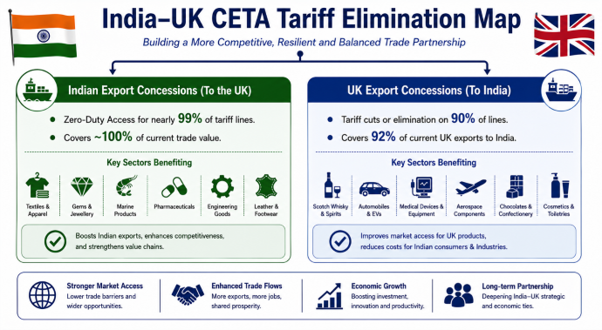
The agreement leverages the complementary nature of both economies, removing major tariff walls and opening extensive market access:
1. Goods Sector Boost
-
- Target Segments: The immediate zero-tariff regime heavily benefits India’s labor-intensive sectors, including textiles, apparel, leather goods, gems & jewelry, engineering components, marine products, chemicals, and pharmaceuticals.
- Immediate Trade Flow: On Day One of implementation, over 50 export consignments valued at more than USD 140 million were flagged off from 20+ ports, airports, and Special Economic Zones (SEZs) across India (including Mundra, Nhava Sheva, and Chennai).
2. Services & Talent Mobility Catalyst
-
- Macroeconomic Alignment: Services account for more than 50% of India’s GDP and over 70% of the UK’s GDP. CETA introduces legally binding predictability for cross-border investments in IT, financial services, telecommunications, professional services (legal/accounting), and higher education.
- Workforce Competitive Edge: The agreement significantly expands mobility options for Indian skilled professionals and tech talent moving into the British market.
The Double Contribution Convention (DCC) Explained
The Agreement on Social Security acts as a crucial financial relief mechanism for Indian corporations operating abroad:
-
- The Double Taxation Problem: Previously, Indian professionals sent to the UK on short-term assignments were forced to pay social security contributions in both India and the UK, which increased the costs of running a business.
- The Five-Year Exemption Rule: Under the newly enforced DCC, Indian professionals on temporary assignments in the United Kingdom are completely exempted from double social security contributions for up to five years. This directly enhances the price competitiveness of Indian IT and consulting services globally.
Trade Facilitation: The eCoO 2.0 Platform
To reduce procedural compliance costs and wait times, especially for MSMEs, the deal modernizes customs workflows:
-
- Self-Certification: The very first Certificates of Origin (CoO) under CETA were digitally generated on Day One through India’s updated eCoO 2.0 platform.
- The Shift: Exporters can now self-certify that their products meet the required Rules of Origin criteria online, bypassing the need to wait for physical government verification.
Long-Term Macro Projections
According to joint economic impact assessments released by the Department of Commerce and the British High Commission:
-
- Bilateral Trade Expansion: Expected to increase bilateral trade by over £25 billion annually over the long term (climbing from the 2025 baseline of £48 billion).
- GDP Contribution: Projected to inject nearly £5 billion annually into both the UK and Indian GDPs, supporting over 700,000 baseline jobs.
UPSC Prelims Fodder: Fact-Check
| Feature | Details |
| Agreement Nomenclature | India–UK Comprehensive Economic and Trade Agreement (CETA). |
| Enforcement Date | July 15, 2026 (Announced at the G7 Summit in France). |
| Social Security Pact | Double Contribution Convention (DCC) (5-year social security waiver). |
| India Tariff Advantage | 99% of tariff lines shifted to Zero-Duty status immediately. |
| UK Tariff Advantage | Tariff cuts/eliminations implemented across 90% of its tariff lines. |
| Digital Customs Tool | eCoO 2.0 Platform operationalized for instant self-certification. |
| Day One Baseline Trade | >USD 140 Million worth of goods cleared customs on the first day. |
Conclusion:
The enforcement of the India-UK CETA and the Double Contribution Convention marks a turning point in India’s modern trade policy by pairing extensive zero-duty market access for goods with a 5-year social security exemption for professionals, the agreement sets a new standard for balanced trade.
Topic-5: Electronics Industrial Policy, Export Composition & Industrial Gender Dynamics
GS Paper 2: Government policies and interventions for development in various sectors and issues arising out of their design and implementation.
GS Paper 3: Indian Economy and issues relating to planning, mobilization of resources, growth, development, and employment; Changes in industrial policy and their effects on industrial growth.
Context: Data released by the Ministry of Electronics & IT (MeitY) tracks India’s transformation over the last decade into a global electronics hub. Driven by the Make in India and Atmanirbhar Bharat frameworks, mobile phones have shifted from a minor export item to become India’s single largest export product, acting as the main anchor for domestic electronics production.
Macro Growth Volumetrics (2014-15 vs. 2025-26)
The implementation of target industrial schemes has scaled up India’s electronics manufacturing, shifting the country from an import-dependent consumer market to the world’s second-largest mobile phone manufacturer by volume:
-
- Electronics Production Scale: Increased from ₹1.90 lakh crore (2014-15) to an estimated ₹13.11 lakh crore, representing a 7-fold increase.
- Electronics Export Multiplier: Rocketed from ₹38,263 crore to ₹4.24 lakh crore, registering an 11-fold rise. Electronics now rank as India’s third-largest export category globally ($47.96 billion).
- Mobile Sector Super-Growth:
- Production: Surged 33-fold, climbing from ₹18,900 crore to ₹6.27 lakh crore.
- Exports: Surged 165-fold, skyrocketing from ₹1,566 crore to ₹2.60 lakh crore.
- Export Hierarchy Shift: Mobile phones rose from the 153rd ranked export item in FY 2014-15 to become India’s largest individual export product, overtaking traditional leading items like diesel fuel and cut diamonds.
- Domestic Localisation Depth: Supported by more than 40 global component manufacturers setting up local shops, domestic value addition grew from 15% to 23%, signaling a shift toward real component localization beyond basic assembly.
The Labor Ecosystem:
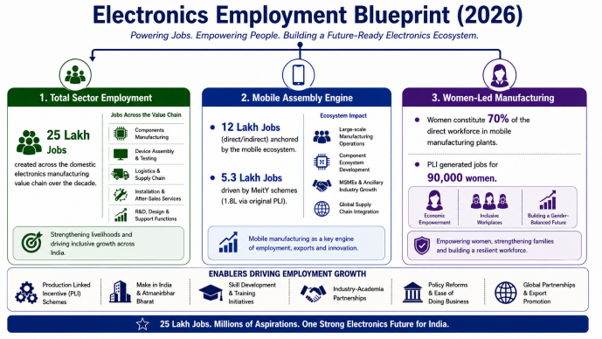
The electronics sector has emerged as a major driver of formal industrial employment, featuring high rates of workforce participation among women:
Geographic Manufacturing Hotspots: The electronics manufacturing clusters located in Hosur & Sriperumbudur (Tamil Nadu) and Bengaluru (Karnataka) have become primary hubs, together providing high-quality technical employment to more than 1 lakh people.
Policy Evolution: Shifting from PLI-LSEM to MPMS
To maintain this momentum following the conclusion of the Production Linked Incentive Scheme for Large Scale Electronics Manufacturing (PLI-LSEM) on March 31, 2026, the government updated its industrial policy framework:
-
- The Transition: The Cabinet approved the Mobile Phone Manufacturing Scheme (MPMS) with an outlay of ₹62,500 crore spanning from FY 2026-27 to FY 2030-31.
- The Strategic Shift: While the original PLI focused heavily on building assembly volume, MPMS prioritizes structural depth. It offers base incentives (2.25%–5%), adding top-ups (up to 1.5%) for domestic sourcing of components and a premium (3%) for indigenous design, R&D, and brand creation.
UPSC Prelims Fodder: Fact-Check
| Feature | Details |
| Global Ranking | India is the world’s 2nd-largest mobile manufacturer by volume. |
| Market Share Node | 99.2% of mobile phones used in India are manufactured domestically. |
| Export Hierarchy | Mobile phones are India’s largest individual export item. |
| Gender Footprint | Women account for nearly 70% of the direct workforce in mobile production. |
| Regional Clusters | Hosur (TN), Sriperumbudur (TN), and Bengaluru (KA) exceed 1 Lakh jobs. |
| New Policy Core | Mobile Phone Manufacturing Scheme (MPMS) (Outlay: ₹62,500 Cr). |
| Value Addition | Domestic value addition scaled up from 15% to 23%. |
Conclusion:
India’s electronics manufacturing sector highlights the success of target industrial scripting under the Make in India vision by scaling production 7-fold and establishing smartphones as the nation’s premier export commodity, the sector has created millions of jobs—particularly for women in formal industrial roles.
Spread the Word