Topic-1: All India Media Conference 2026
GS Paper 2: Appointment to various Constitutional posts, powers, functions, and responsibilities of various Constitutional Bodies (Election Commission of India); Salient features of the Representation of the People Act.
GS Paper 3: Role of media in internal security challenges; Technology deployment in administrative and democratic systems.
Context: The Election Commission of India (ECI) hosted its inaugural All India Media Conference 2026 at the India International Institute of Democracy and Election Management (IIIDEM), New Delhi. Organized under the central theme “Connecting stakeholders, strengthening democracy: Role of media in elections,” the summit brought together over 380 media professionals from all States and Union Territories.
The ECI Digital and Statutory Architecture
During the keynote address, Chief Election Commissioner (CEC) Shri Gyanesh Kumar highlighted the scale of India’s democratic infrastructure and the technological safety nets that protect it:
-
- The Electoral Roll Lifecycle: India’s voter directory spans nearly 95 crore electors. The list is classified as a dynamic “living document” that is continuously verified through the ongoing Special Intensive Revision (SIR) framework.
- The ECINET Infrastructure: The ECI highlighted its newly deployed integrated digital portal, ECINET (launched in January 2026). Designed to maximize transparency, the application serves as a unified digital public engine for accessing authentic data, checking rules, and tracking structural reports.
- Statutory Compliance Mandates: The conference focused on structural provisions built directly into the Constitution of India and the Representation of the People Acts (RPA) of 1950 and 1951, which govern media regulations, code enforcement, and transparent vote tallies.
The “Concurrent Audit” Framework Explained
A key takeaway from the 2026 summit was the conceptualization of the polling cycle as a multi-stage “concurrent audit” managed by external stakeholders rather than an insulated internal process.
UPSC Prelims Fodder: Fact-Check
| Feature | Details |
| Bilateral Summit Node | 1st All India Media Conference 2026. |
| Nodal Organizer | Election Commission of India (ECI). |
| Thematic Focus Core | “Connecting stakeholders, strengthening democracy: Role of media in elections.” |
| Chief Election Chair | Shri Gyanesh Kumar (CEC). |
| Electoral Scale Base | ~95 Crore registered voters monitored nationwide. |
| Primary Digital Node | ECINET Platform (Integrated public digital portal). |
| Human Resource Links | Over 12 Lakh BLOs and 15 Lakh political BLAs active on the ground. |
Conclusion:
The first All India Media Conference highlights the Election Commission’s proactive approach to countering misinformation and building public trust. By opening up its core processes to the press—ranging from ECINET’s digital framework to the roles of Booth Level and Polling Agents—the ECI has clearly mapped out its concurrent auditing system. This structural transparency ensures that India’s massive electoral exercises remain verifiably secure, collaborative, and deeply democratic.
Topic-2: Investment Friendliness Index (IFI)
GS Paper 2: Statutory, regulatory, and various quasi-judicial bodies (NITI Aayog); Government policies and interventions for development in various sectors; Issues arising out of their design and implementation.
GS Paper 3: Indian Economy and issues relating to planning, mobilization of resources, growth, development, and employment; Effects of liberalization on the economy; Changes in industrial policy and their effects on industrial growth.
Context: NITI Aayog released the first-ever Investment Friendliness Index (IFI). The data-driven report establishes a unified framework to benchmark the investment readiness, regulatory ease, and infrastructure health of all 28 States and 8 Union Territories across India.
Core Framework and Weights Matrix
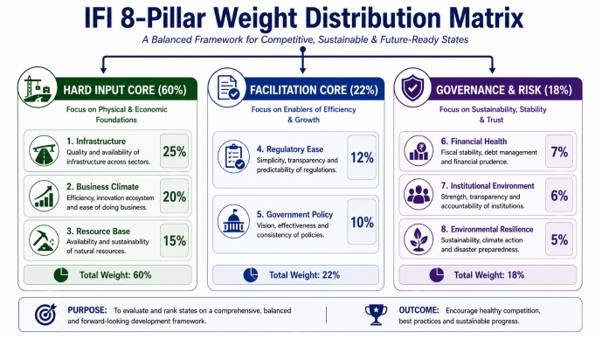
The index moves away from self-reported state data by balancing hard public metrics with perception data from a primary survey of active businesses. It evaluates sub-national competitiveness using 84 distinct indicators distributed across 8 central pillars:
Categorization and Performance Clusters
States are assigned scores out of a maximum of 100 points and grouped into four distinct performance categories:
1. Top Performers (Score ): Gujarat (Top Rank: 56.6), Maharashtra (53.7), Tamil Nadu (53.3), Goa, and Odisha.
2. Frontrunners (Score ): Includes 15 states (e.g., Delhi, Uttar Pradesh, and Andhra Pradesh) demonstrating rapid institutional progress.
3. Emerging Performers (Score ): 8 States/UTs showing moderate reform progress.
4. Aspiring States (Score ): 8 States/UTs facing structural bottlenecks (e.g., Bihar, Jharkhand, and West Bengal at the bottom of the Large States group).
Peer-Group Performance Analysis
To ensure fair comparisons across India’s diverse geography and economic scales, NITI Aayog split the final rankings into three peer groups:
| Peer Group Classification | Rank 1 | Rank 2 | Rank 3 | Key Driving Strengths Indicated by Index |
|---|---|---|---|---|
| Large Major States | Gujarat | Maharashtra | Tamil Nadu | Gujarat's port logistics, single-window NOC ease, and low power tariffs (-29% vs national average). |
| Hilly & North-Eastern States | Uttarakhand | Assam | Himachal Pradesh | Targeted ease of doing business in tourism and agro-processing setups. |
| Union Territories & City States | Goa | Delhi | Chandigarh | High per-capita growth infrastructure, stable services grids, and simplified local tax rules. |
Strategic and Policy Significance
-
- Promoting Competitive & Cooperative Federalism: The tool encourages a healthy “race to the top” among states by highlighting successful local policies—such as Gujarat’s iNDEXTb single-window portal or Maharashtra’s private equity attraction—as models for other states to adopt.
- Bridging the Macro-Micro Gap: While national-level reforms improve India’s broad macroeconomic indicators, the IFI recognizes that businesses ultimately interact with state-level logistics, land allocation, and local inspections.
- Targeted Capital Deployment: The index serves as a roadmap for retail and institutional investors to direct resources toward high-performing, transparent state ecosystems.
UPSC Prelims Fodder: Fact-Check
| Feature | Details |
| Index Nomenclature | Investment Friendliness Index (IFI). |
| Publishing Authority | NITI Aayog (First Edition released July 2026). |
| Statutory Catalyst | Tasked during the 9th Governing Council Meeting; formally backed in Budget 2025–26. |
| Top Rank (Overall & Large States) | Gujarat (Score: 56.6). |
| Lowest-Ranked Performer | Lakshadweep. |
| Highest Weight Pillar | Infrastructure (25%). |
| Evaluation Framework Scale | Evaluates all 28 States and 8 UTs using 8 Pillars and 84 Indicators. |
Conclusion:
The NITI Aayog Investment Friendliness Index shifts sub-national development away from simple political messaging toward objective, data-backed metrics. By highlighting the specific strengths and infrastructure gaps of individual states, the index helps local governments modernize their regulatory frameworks.
Topic-3: Mission Aagaman
GS Paper 2: Government policies and interventions for development in various sectors and issues arising out of their design and implementation; Statutory, regulatory, and various quasi-judicial bodies (IN-SPACe, ISRO).
GS Paper 3: Science and Technology- developments and their applications and effects in everyday life; Achievements of Indians in science & technology; Indigenization of technology and developing new technology; Space economy.
Context: India marked a historic milestone in its space journey with the successful launch of “Mission Aagaman.” The mission successfully deployed Vikram-1, the nation’s first privately developed orbital launch vehicle, into its designated Low Earth Orbit (LEO) from the Satish Dhawan Space Centre in Sriharikota.
Technical Innovations & Launch Vehicle Architecture
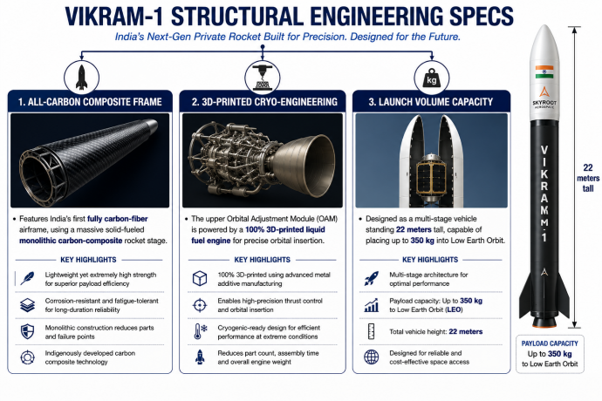
Developed by the Hyderabad-based space-tech startup Skyroot Aerospace, Vikram-1 showcases major indigenous engineering breakthroughs, shifting away from traditional metallic rocket architectures:
-
- Mission Execution Profile: Unlike typical maiden rocket test flights that carry inert dummy weights to simulate mass, Mission Aagaman launched active experimental and commercial payloads from both domestic and international partners. The flight successfully validated Skyroot’s custom ultra-low-shock pneumatic separation systems, alongside its core guidance, telemetry, and flight control software.
The Space Economy & Policy Framework
The structural success of Vikram-1 highlights the impact of the 2020 Space Sector Reforms and the Indian Space Policy 2023, which dismantled the state monopoly on rocket launches:
-
- The Triumvirate Framework: The launch demonstrates the success of India’s three-tier space management model:
1. ISRO: Providing tracking infrastructure and launchpad access.
2. IN-SPACe: Acting as the single-window autonomous clearinghouse for private entities.
3. Private Startups: Driving agile, cost-effective commercial product development.
-
- Macro Economy Scaling: India’s space ecosystem has grown to include over 400 space startups and its first sector unicorn. The national space economy has reached nearly USD 9 billion, with an official policy roadmap aiming to scale this to USD 44 billion by 2035.
UPSC Prelims Fodder: Fact-Check
| Feature | Details |
| Launch Mission Name | Mission Aagaman (Executed July 18, 2026). |
| Rocket Nomenclature | Vikram-1 (Named after Dr. Vikram Sarabhai). |
| Developer Corporate | Skyroot Aerospace (Hyderabad-based private startup). |
| Vehicle Capability | LEO insertion capacity of up to 350 Kilograms (kg). |
| Propulsion Highlights | Monolithic carbon-composite solid stage + 100% 3D-printed liquid OAM engine. |
| Regulating Catalyst | IN-SPACe (Indian National Space Promotion and Authorization Centre). |
| Launch Base Venue | Satish Dhawan Space Centre (SDSC-SHAR), Sriharikota, Andhra Pradesh. |
Conclusion:
The orbital success of Vikram-1 marks a major evolution in India’s space program, shifting the country from relying solely on state-run launches to building a vibrant, commercial public-private space ecosystem. By proving the reliability of advanced manufacturing methods like 3D-printed liquid engines and carbon-fiber airframes, India has cemented its position as a cost-effective, dependable provider of small-satellite launch services in the highly competitive global space economy.
Topic-4: India-Europe Strategic Economic Architecture & EU-FTA Integration
GS Paper 2: Bilateral, regional and global groupings and agreements involving India and/or affecting India’s interests; Effect of policies and politics of developed/developing countries on India’s interests.
GS Paper 3: Indian Economy (International Trade, Free Trade Agreements, Regulatory Frameworks like CBAM); Science and Technology (6G, Quantum Computing, Fintech integration).
Context: Union Minister of Commerce and Industry, Shri Piyush Goyal, concluded a comprehensive five-day diplomatic tour covering Spain, Belgium, Finland, and Estonia (July 13–18, 2026). Accompanied by a high-level corporate delegation, the tour focused on advancing the implementation roadmap for the newly negotiated India–EU Free Trade Agreement (FTA) and deepening technical cooperation with key European nodes.
Country-Specific Strategic Interventions
The multi-nation tour established targeted cooperation models tailored to the industrial strengths of each European partner:
1. Spain: The “10×10×10” Matrix and Financial Integration
-
- The Scale Blueprint: Shri Goyal unveiled the ambitious “10×10×10” Vision, which aims to expand bilateral trade, investment capital, and tourism flows tenfold over the next decade.
- Fintech Interoperability: Technical teams agreed to fast-track digital cross-border integration by linking India’s Unified Payments Interface (UPI) with Spain’s Bizum network.
- Global Access Duopoly: Discussions focused on joint investment channels targeting Latin America, utilizing Spain’s position as a gateway to both the EU and LatAm markets.
2. Belgium (Brussels): The EU-TTC and Regulatory Negotiations
-
- TTC Action Plan: Co-chaired the 3rd India–EU Trade and Technology Council (TTC) Ministerial Meeting, formally adopting the 2026–27 TTC Action Plan.
- SPS Trade Relaxations: Secured the formal listing of 21 additional Indian fishery establishments by EU regulatory bodies, raising the total approved exporting facilities to 625.
- Regulatory Adjustments: India advanced negotiations on the Investment Protection Agreement, Geographical Indications Agreement, and raised specific market access concerns regarding the EU’s Carbon Border Adjustment Mechanism (CBAM), steel scrap access, and duty derogations for Basmati rice.
- Defense & Industry Clusters: Proposed dedicated plug-and-play industrial clusters for Belgian firms and initiated defense collaboration with Thales on counter-drone technologies and electronic warfare.
3. Finland: High-Tech Co-Development Grids
-
- Deep Tech Alliances: Capitalizing on Nordic engineering, agreements focused on the co-development and co-manufacturing of Artificial Intelligence, 6G telecom architecture, quantum computing infrastructure, and circular economy tools.
- Corporate Scale-Ups: Held strategic talks with the global executive leadership of KONE and Nokia, urging them to expand their manufacturing footprints, R&D centers, and data center investments in India.
4. Estonia: Sovereign Digital Governance Partnerships
-
- The Tech Architecture: Marking the first formal Indian ministerial visit to Tallinn since the resident embassy opened in 2021, the dialogue centered on cybersecurity, blockchain infrastructure, e-residency systems, and green hydrogen.
- Regional Hubbing: Estonia positioned itself as India’s primary gateway to the Baltic and Nordic markets.
UPSC Prelims Fodder: Fact-Check
| Feature | Details |
| Bilateral Tour Node | Union Minister’s 4-Nation European Tour (July 13–18, 2026). |
| Visiting Horizon | Spain, Belgium (EU Headquarters), Finland, and Estonia. |
| Spanish Vision Model | 10×10×10 Vision (10-fold increase in trade, investment, and tourism in 10 years). |
| Fintech Linkage | UPI (India) and Bizum (Spain) platform integration. |
| Apex Forum Node | 3rd India–EU Trade and Technology Council (TTC) Ministerial Meeting. |
| Export Clearance Scale | 625 Indian fishery establishments now officially approved for EU export. |
| Defense Partner Node | Strategic tech ties initiated with Thales (Counter-drone & electronic warfare). |
Conclusion:
Shri Piyush Goyal’s multi-nation European tour successfully moves the India-EU economic relationship from high-level trade negotiations to practical, ground-level implementation. By linking UPI with Bizum, securing market access for Indian fisheries at the TTC, and setting up advanced deep-tech partnerships in 6G and quantum computing with Finland and Estonia, India is building a resilient, technology-driven trade framework.
Spread the Word