TOPIC-1: OPU-IVF Calf Born in Badri Cattle: Genetic Improvement & Conservation Breakthrough
-
- UPSC Relevance: GS Paper 3 (Science and Technology — Biotechnology, Assisted Reproductive Technologies [ART], Indigenous Genetic Resources, Biodiversity Conservation, and Sustainable Livestock Farming).
Introduction: In a major milestone for indigenous cattle conservation, a healthy female Badri calf was born on September 11, 2026 through Ovum Pick-Up and In Vitro Fertilization (OPU-IVF) technology.
About Badri Cattle:
-
- Badri cattle (Bos indicus) are a small, climate-resilient, disease-resistant indigenous cattle breed adapted to the hilly terrain of the Himalayas and recognized as the State Animal of Uttarakhand.
- The breakthrough was achieved by transferring an embryo produced from high-quality Badri germplasm into a surrogate Sahiwal recipient cow at G. B. Pant University of Agriculture and Technology, Pantnagar.
OPU-IVF Technology:
-
- Ovum Pick-Up (OPU) and In Vitro Fertilization (IVF) is an advanced reproductive biotechnology. Unlike natural breeding or artificial insemination, OPU extracts unfertilized eggs (oocytes) directly from living donor cows using ultrasound guidance.
- These oocytes are matured and fertilized in a laboratory setting using elite bull semen, and the resulting embryos are implanted into surrogate recipient cows (such as Sahiwal or crossbreds), accelerating elite female multiplication.
Key Highlights:
-
- First OPU-IVF Birth in Badri Breed: Proves the viability of assisted reproductive technologies (ART) for hilly indigenous livestock, bypassing traditional slow breeding cycles.
- Surrogate Interspecies Embryo Transfer: Successfully used a surrogate Sahiwal cow to carry and deliver a purebred Badri embryo, maximizing output without stressing high-yield Badri donor cows.
- Conservation & Rapid Multiplication: Enables the extraction of multiple oocytes from a single high-yielding female per year, increasing elite germplasm propagation exponentially over traditional natural calvings.
- Pioneering Somatic Cell Cloning Research: The ICAR-NDRI and GBPUAT collaborative pipeline is advancing toward generating cloned Badri embryos to preserve high-producing traits and genetic diversity.
UPSC Quick Reference Table
| Feature | Detailed Specification |
| Nodal Agencies | ICAR-National Dairy Research Institute (NDRI), Karnal & GBPUAT, Pantnagar |
| Funding Agency | Uttarakhand Biotechnology Council, Haldi |
| Breed Monitored | Badri Cattle (Bos indicus) — State Animal of Uttarakhand |
| Biotechnology Used | Ovum Pick-Up (OPU) + In Vitro Fertilization (IVF) + Embryo Transfer (ET) |
| Surrogate Mother | Sahiwal Recipient Cow |
| Strategic Goal | Conservation of indigenous livestock germplasm, genetic improvement, and cloning |
Conclusion:
The successful birth of the OPU-IVF Badri calf demonstrates how advanced biotechnology can protect and scale indigenous genetic resources. Leveraging embryo transfer and cloning techniques strengthens livestock climate resilience, preserves native biodiversity, and supports sustainable dairy livelihoods across the Himalayan region.
TOPIC-2: Dryland Congress 2026 & Adoption of the Delhi Declaration on Drylands (3D)
-
- UPSC Relevance: GS Paper 2 (Bilateral, Regional & Global Groupings — South–South Cooperation, UN Mechanisms) & GS Paper 3 (Agriculture — Dryland Farming, Climate Resilient Agriculture, International Agricultural R&D, and Innovation Partnerships).
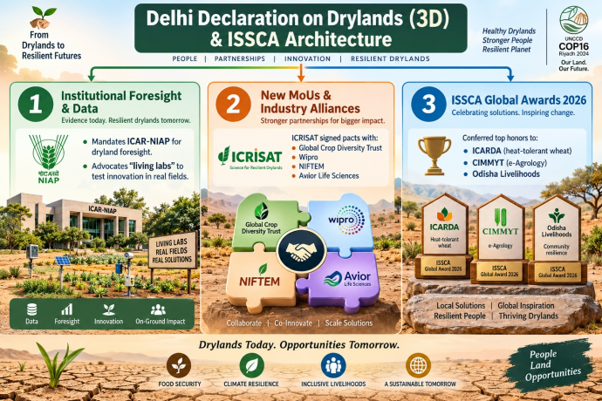
Introduction: The three-day Dryland Congress 2026 concluded in New Delhi with the formal adoption of the Delhi Declaration on Drylands (3D) coinciding with the United Nations Day for South–South Cooperation. The declaration establishes a collaborative roadmap to transform dryland agri-food systems across the Global South through science, data systems, living laboratories, and South–South cooperation.
About Dryland Congress 2026:
-
- Organized jointly by the Indian Council of Agricultural Research (ICAR) and the International Crops Research Institute for the Semi-Arid Tropics (ICRISAT), the congress focused on the theme “Transforming Dryland Agriculture with South–South Cooperation.”
Delhi Declaration (3D):
-
- The Delhi Declaration on Drylands (3D) prioritizes institutionalizing agricultural foresight—with ICAR-NIAP leading foresight studies—creating “living laboratories” to link field research with policy, expanding digital agricultural tools, and accelerating cross-border technology transfers across arid and semi-arid regions.
Key Highlights:
-
- Institutionalizing Foresight & Living Labs: Dr. M. L. Jat (Secretary DARE & DG ICAR) mandated the ICAR-National Institute of Agricultural Economics and Policy Research (ICAR-NIAP) to lead dryland agricultural foresight, emphasizing robust data systems and real-world “living laboratories.”
- Expansion of South–South Partnerships: ICRISAT and ICAR launched the International Solidarity for South-South Cooperation in Agriculture (ISSCA) framework, creating institutional pipelines with CGIAR, FARA, APAARI, NABARD, and RIS.
- New Strategic MoUs: ICRISAT exchanged pacts with the Global Crop Diversity Trust, Avior Life Sciences, NIFTEM, Wipro Limited, and the District Administrations of Angul and Rayagada (Odisha) to scale tech deployment.
- ISSCA Global Awards 2026 Conferred: Evaluated 170 nominations across 34 countries. Highlights include:
- Transformative Excellence (Mega Award): ICARDA (heat-tolerant TAAT wheat), CIMMYT (e-Agrology 360), and Odisha Livelihoods Mission (women-led sustainable farming).
- Climate Resilience & NRM: Recognized Karnataka’s Krishi Bhagya, NECTAR’s banana pseudo-stem processing, and Bihar’s Aahar–Pyne landscape rejuvenation.
- Digital Agriculture: Awarded Andhra Pradesh’s APMIP Digital Ecosystem and Gujarat’s Krushi Pragati.
UPSC Quick Reference Table
| Feature | Detailed Specification |
| Nodal Hosts | ICAR (Ministry of Agriculture) & ICRISAT (Hyderabad) |
| Theme | “Transforming Dryland Agriculture with South–South Cooperation” |
| Key Outcome | Delhi Declaration on Drylands (3D) |
| Lead Foresight Agency | ICAR-National Institute of Agricultural Economics and Policy Research (ICAR-NIAP) |
| Flagship Initiative | International Solidarity for South-South Cooperation in Agriculture (ISSCA) |
| Key Awardees | ICARDA (Lebanon), CIMMYT (Mexico), Odisha Livelihoods Mission (India) |
Conclusion:
The adoption of the Delhi Declaration on Drylands (3D) advances global efforts toward climate-resilient agriculture. Linking agricultural foresight, data-driven living labs, and South–South technology exchanges provide a practical framework to safeguard food security across vulnerable dryland regions.
TOPIC-3: NHRC & MEA Organise ITEC Executive Capacity Building Programme on Human Rights for NHRIs of Global South
-
- UPSC Relevance: GS Paper 2 (Statutory, Regulatory & Quasi-Judicial Bodies — NHRC; India’s Foreign Policy & South–South Cooperation — ITEC Framework, Global South Engagement, and International Human Rights Architecture).
Introduction: The National Human Rights Commission (NHRC), India, in partnership with the Ministry of External Affairs (MEA), is hosting a 6-day ITEC Executive Capacity Building Programme on Human Rights in New Delhi from September 14 to 19, 2026. The program brings together 41 senior-level functionaries from 15 National Human Rights Institutions (NHRIs) across the Global South.
About ITEC:
-
- The Indian Technical and Economic Cooperation (ITEC) program is the primary bilateral assistance platform of Ministry of External Affairs.
- It was established in 1964 to promote technical cooperation, skill-building and knowledge-sharing among developing nations.
- It acts as a specialized platform for NHRIs across Asia, Africa, and Latin America to strengthen complaint mechanisms, legal advocacy, and human rights enforcement.
Key Highlights:
-
- Focus on Global South Solidarity: Fosters mutual learning and institutional capacity-building among NHRIs to address shared governance, socio-economic, and human rights challenges across developing nations.
-
- Contemporary Human Rights Agenda: Covers emerging domains including Human Rights and Business, Impact of New Technology on Human Rights, sustainable development goals (SDGs), and international human rights law frameworks.
- Practical Operational Insights: Shares NHRC India’s institutional methodologies, including digital complaint management, on-ground investigative procedures, and spot enquiry frameworks.
- Interactive & Field Immersion: Combines expert-led technical sessions with site visits, cultural exchange, and direct interaction with leading legal and human rights practitioners.
UPSC Quick Reference Table
| Feature | Detailed Specification |
| Organising Bodies | National Human Rights Commission (NHRC, India) & Ministry of External Affairs (MEA) |
| Flagship Scheme | Indian Technical and Economic Cooperation (ITEC) Program |
| Duration & Venue | September 14–19, 2026 (6 Days, New Delhi) |
| Chief Guest | Justice V. Ramasubramanian (Chairperson, NHRC, India) |
| Target Participants | 41 senior functionaries from 15 Global South NHRIs |
| Core Themes | Tech & Human Rights, Business & Human Rights, Complaint Management Systems |
Conclusion:
The NHRC-MEA ITEC Capacity Building Programme reinforces India’s leadership in South–South cooperation. Sharing three decades of institutional expertise strengthens national human rights frameworks across the Global South, aiding international rights protection and technical capacity-building.
Spread the Word