
Introduction
India’s agricultural sector has transitioned from standard welfare assistance to a technology-driven value chain. The state has deployed an integrated strategy combining direct income security, precision resource management, institutional cooperative tracking, and advanced processing networks. This framework enhances the on-ground resilience of the Annadatas while ensuring comprehensive nutritional and food security across the country.
Key Points:
-
- Macroeconomic Footprint: Agriculture and allied sectors comprise approximately 18% of national Gross Value Added (GVA). The sector’s GVA expanded significantly from ₹20.9 lakh crore in 2014-15 to ₹48.7 lakh crore.
- Fiscal Outlay Scaling: Budgetary allocations for the Department of Agriculture and Farmers Welfare jumped to ₹1,40,528.78 crore for 2026-27.
- Direct Credit Transmission: Operational Kisan Credit Card (KCC) accounts reached 7.81 crore, managing an institutional credit volume of ₹10.20 lakh crore.
- The DBT Anchor: The Pradhan Mantri Kisan Samman Nidhi (PM-KISAN) has disbursed over ₹4.28 lakh crore across 22 installments to more than 9.44 crore families.
- Structural Production Milestones: Total national foodgrain output scaled to a historic high of 357.73 million tonnes in 2024-25.
A Roadmap for Reforms
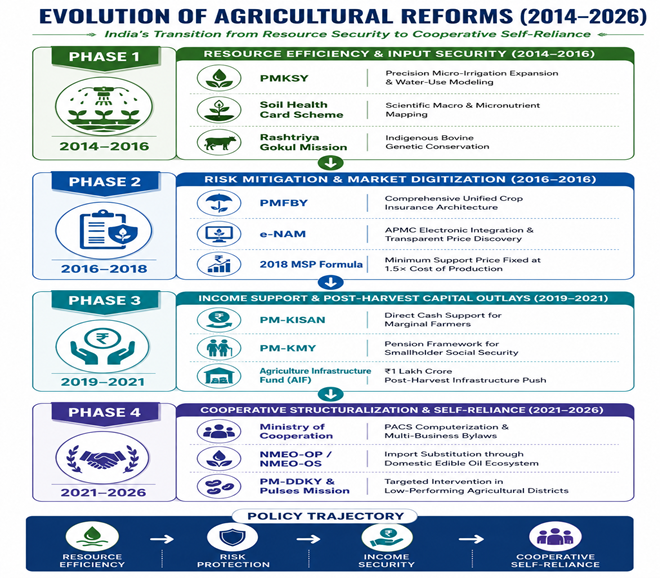
Production Trajectories
Sustained public investment has generated significant volume increases across core crop and high-value horticulture matrixes:
-
- Foodgrain Architecture: Driven by the National Food Security and Nutrition Mission (NFSNM), output rose from 265.05 million tonnes in 2013-14 to 357.73 million tonnes in 2024-25.
- Rice: Recorded an output of 150.18 MT, marking a 42.38% increase over 2014-15 levels and securing India’s position as the world’s largest producer.
- Wheat & Maize: Wheat reached a record 117.94 MT (up 36%), while maize production expanded by 79% to reach 43.40 MT.
- The Oilseeds Rebound: Total output touched 42.99 MT, helping lower external edible oil import dependency from 63.2% in 2015-16 down to 56.25%.
- Horticulture Diversification: Production expanded to 369.05 million tonnes, contributing nearly 37% of the total Gross Value Output within the crop segment.
- Foodgrain Architecture: Driven by the National Food Security and Nutrition Mission (NFSNM), output rose from 265.05 million tonnes in 2013-14 to 357.73 million tonnes in 2024-25.
Policy Dimensions
The government operates a multi-layered policy framework to stabilize rural household balance sheets and lower risk:
1. Direct Financial Cushioning via PM-KISAN
Functions as a massive direct benefit transfer (DBT) safety net, providing an annual financial transfer of ₹6,000 in three equal tranches. The program has distributed ₹4.28 lakh crore, with more than 25% of benefits directly reaching women farmers. Retirement security is supplemented by the Pradhan Mantri Kisan Maandhan Yojana (PM-KMY), which provides a monthly pension of ₹3,000 after age 60 to 24.95 lakh enrolled smallholders.
2. Comprehensive Insurance Coverage under PMFBY
Operating on the principle of “One Nation, One Crop, One Premium”, PMFBY covers the entire cultivation cycle against natural risks. Since inception, 92.46 crore farmer applications have been processed, and claims worth ₹1.96 lakh crore have been settled digitally. Last-mile grievance redressal is handled via the Krishi Rakshak Portal and Helpline (KRPH).
3. Expanded MSP Framework and Market Security
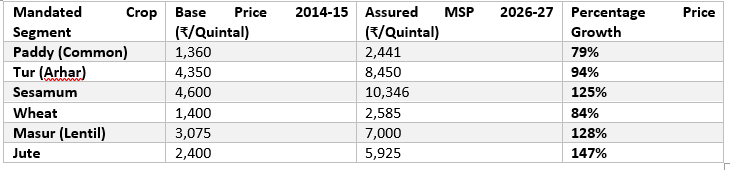
The 2018-19 reform mandated fixing Minimum Support Prices (MSPs) at a minimum of 50% above the comprehensive cost of production. Total public procurement expanded by 76% to 1,229.2 million tonnes over the last decade, channeling an aggregate MSP value of ₹26.32 lakh crore directly into the rural economy. Notable marketing season targets for 2026-27 indicate clear price support trajectories:
Sustainable Resource Management
-
- Precision Hydrology (PMKSY): Expanded irrigation access from 49.3% to 55% of total gross cropped area, optimizing water-use efficiency through micro-irrigation systems.
- Soil Diagnostics (SHC Scheme): Issued 26 crore diagnostic Soil Health Cards supported by an institutional infrastructure of 8,313 soil-testing laboratories and 70,000 trained Krishi Sakhis.
- Chemical-Free Agriculture: Deployed cluster-based transitions under the Paramparagat Krishi Vikas Yojana (PKVY) covering 18.84 lakh hectares, alongside the National Mission on Natural Farming (NMNF) which has registered 19 lakh farmers.
- Clean Energy Integration (PM KUSUM): Deployed over 10 lakh standalone solar agricultural pumps and solarised 13 lakh grid-connected pumps to open decentralized alternative income streams.
Institutional Modernization
-
- Cooperative Digitization: The Ministry of Cooperation (established 2021) has fast-tracked the Primary Agricultural Credit Societies (PACS) computerization project, onboarding 61,866 PACS onto localized ERP software and allowing diversification into 25 multi-business lines.
- Aggregation Infrastructure: Formed 10,000 Farmer-Producer Organizations (FPOs) to maximize bulk bargaining power.
- The Agriculture Infrastructure Fund (AIF): Sanctioned ₹84,202 crore in credit for 1.68 lakh post-harvest farm-gate logistics and cold-storage projects.
- Digital Trading Corridors (e-NAM): Unified 1,656 APMC mandis into a single electronic screen trading window, onboarding 1.80 crore farmers for transparent price discovery.
Food Processing and Allied Sectors
-
- Value Addition Matrices: Food processing sector GVA expanded to ₹2.24 lakh crore, supported by a strategic budget increase to ₹4,064 crore for 2026-27.
- The PLI Stimulus (PLISFPI): Disbursed incentives worth ₹2,162.55 crore across 274 project nodes to maximize industrial scale. This is supported by the PMFME scheme, which extended seed capital to women-led Self-Help Groups.
- Allied Sector Performance:
- The Dairy Grid: Milk production rose by 69.4% to reach 247.87 million tonnes, placing per capita availability at 485 grams per day.
- Fisheries Dynamism: Blue economy outputs doubled to 19.78 MT, driven by inland aquaculture and supported by 2,195 specialized Farmers’ Fisheries Producer Organizations (FFPOs).
The Digital Agriculture Mission
-
- Digital Public Infrastructure (DPI): Formally created 7.63 crore unique Farmer IDs and digitized 23.5 crore crop plots to ensure precise benefit targeting and eliminate systemic leakages.
- Automated Early Warning Systems: Launched the National Pest Surveillance System utilizing machine learning tools to screen 66 crops and monitor 432 pest variants in real-time.
- AI-Backed Extension Rails: Deployed the multi-lingual Kisan e-Mitra conversational tool to handle over 95 lakh queries across 11 regional languages. This works alongside 731 frontline Krishi Vigyan Kendras (KVKs) and the Agricultural Technology Management Agency (ATMA).
Challenges
-
- Input-Subsidy Imbalances and Ground Water Crises: While the PM KUSUM scheme clean-powers farming, high electricity and crop subsidies in intensive agricultural zones continue to distort optimal crop choices. This encourages water-heavy paddy cultivation in arid belts, causing severe groundwater depletion.
-
- Indian Express (The FPO Scale and e-NAM Liquidity Friction): Analytical briefs in the Indian Express emphasize that while 10,000 FPOs are registered, the vast majority remain small, specialized bodies lacking the working capital required to aggregate commodities effectively. Furthermore, actual interstate electronic trading on e-NAM remains minimal due to friction in cross-border quality assaying standardizations and localized dispute resolution defaults.
- ORF (The Tariff, Quality, and Phytosanitary Disconnect): Policy papers from the Observer Research Foundation (ORF) highlight that while value-added processed food exports scaled up to 20.4%, India’s agricultural export complex faces structural blocks in Western markets. The high volume of localized chemical broadcasting causes shipments to frequently trip non-tariff and rigid phytosanitary barrier (MRL – Maximum Residue Limit) protocols, exposing a gap between frontline extension advice (KVKs) and international market entry standards.
-
- First-Mile Integration Friction for Fragmented Smallholders: The portal infrastructure for e-NAM and AIF logistics is highly advanced. However, smallholders with an average landholding of around 1.08 hectares often face challenges accessing these systems independently without aggregate FPO mediation.
- Phytosanitary Barriers in Processed Food Export Chains: While processed food exports expanded to 20.4% of the agricultural basket, shipments frequently encounter strict non-tariff and phytosanitary barriers in developed markets, emphasizing the need to align local processing with global standards.
Way Forward
-
- Connecting AgriStack to Automated Credit Rails: Linking unique Farmer IDs directly with the Unified Lending Interface (ULI) to allow automatic, interest-subsidized short-term credit lines without paper intervention.
- Cluster-Based Value-Chain Allocations via PACS: Leveraging computerized PACS nodes to build solar-powered micro-cold storage units at the village level, minimizing post-harvest perishable losses.
- Climate-Adaptive Germplasm Scaling: Expanding the field deployment of the 2,996 newly released climate-resilient seed varieties through targeted Seed Village networks to withstand extreme heat and drought stress.
- Targeted Logistics Upgrades (SARTHAK PDS): Executing the newly funded ₹25,530 crore automated logistics program to optimize storage and distribution efficiency.
Conclusion
India’s agricultural framework has successfully shifted from traditional production volume support to high-efficiency, data-driven value-chain integration. By combining direct income safety nets like PM-KISAN with precision resource management and digital public infrastructure under the Digital Agriculture Mission, the state has strengthened the core capabilities of the farm sector.
Spread the Word