Topic-1: India-Europe Deep-Tech Corridors
GS Paper 2: Bilateral, regional, and global groupings and agreements involving India and/or affecting India’s interests; Government policies and interventions for development in various sectors and issues arising out of their design and implementation.
GS Paper 3: Science and Technology- developments and their applications and effects in everyday life; Indigenization of technology and developing new technology; Achievements of Indians in science & technology.
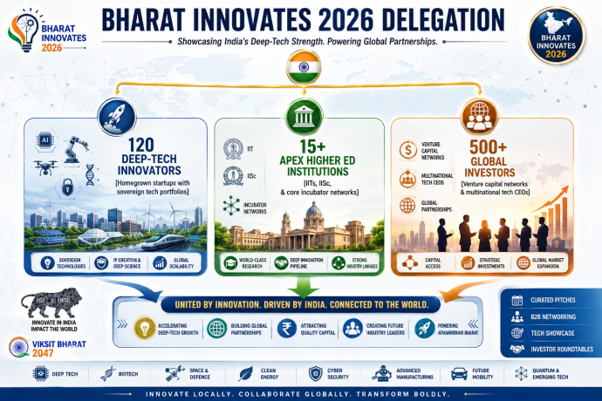
Context: Jointly inaugurated by Prime Minister Shri Narendra Modi and French President Emmanuel Macron, the maiden edition of Bharat Innovates 2026 commenced at the Palais des Expositions de Nice, France.
Implemented by the Ministry of Education, Government of India, this flagship summit marks a step forward in cementing deep-tech, academic, and venture capital corridors between India and the broader European continent.
Summit Footprint
The event serves as an international launchpad for sovereign, high-value engineering, gathering over 500 global stakeholders, venture capital funds, and Fortune 500 CEOs. The Indian delegation showcased domestic capabilities across 13 strategic tech sectors, with heavy focus on advanced computing, semiconductors, space engineering, quantum systems, biotechnology, and clean energy.
Overhaul of the Bilateral Academic Architecture
A primary objective of the Ministry of Education at the summit was to link early academic research directly with international commercialization channels. This resulted in the signing of over 30 high-impact partnerships:
-
- Institutional Engineering Linkages: 13 French Universities signed comprehensive academic pacts with 11 Indian Institutes of Technology (IITs) and the Indian Institute of Science (IISc), Bengaluru. These agreements go beyond basic student exchanges to establish joint research foundations and dual doctoral supervision tracks.
- Incubator Interlocking: 12 separate agreements were formalized between premier Indian campus incubators and French startup hubs to guarantee cross-border landing facilities and reciprocal infrastructure access for student-led enterprises.
- Corporate Technology Transfer: 16 global conglomerates signed agreements with Indian innovators. These pacts focus on accelerating technology commercialization, co-developing intellectual property, and opening immediate global market access pipelines for Indian deep-tech solutions.
Policy Focus:
The plenary sessions at Nice established a clear ideological consensus between India and Europe on the future of automation and computing, focusing on three structural vectors:
1. The “AI for Global Good” Mandate- Delegates from both nations called for the creation of a Trusted, Inclusive, and Scalable AI Corridor. The panel emphasized utilizing India’s proven capability in engineering affordable, population-scale digital public infrastructure to counter the rising monopolies of closed, proprietary corporate AI models. The framework champions open-source software cooperation and collaborative data platforms.
2. The Role of Higher Education Institutions (HEIs)- Delivering the opening keynote, Infosys Founder Shri N. R. Narayana Murthy highlighted how academic labs must transform into business engines. He noted that higher education and research institutions bear the responsibility of shaping “value-led founders.” He emphasized that enduring, globally competitive enterprises require a combination of multi-disciplinary talent, transparent governance, and disciplined innovation to successfully convert raw laboratory knowledge into scalable societal solutions.
UPSC Prelims Fodder: Fact-Check
| Feature | Details |
| Summit Event | Bharat Innovates 2026 (Maiden Edition). |
| Nodal Ministry | Ministry of Education, Government of India. |
| Host Venue | Palais des Expositions de Nice, France. |
| Strategic Vectors | 13 key tech sectors (including semiconductors, space tech, and biotech). |
| Pact Volumes | Over 30 bilateral partnerships signed on Day One. |
| Academic Grid | 13 French universities linked with 11 IITs and IISc Bengaluru. |
| School Innovation Node | India-France ATL Bridge exporting the Atal Tinkering Lab model. |
| Official Portal | www.bharatinnovates.in. |
Conclusion:
The launch of Bharat Innovates 2026 represents a strategic step forward for India’s international technology policy. By positioning the Ministry of Education as a key driver of deep-tech commercialization, India is successfully linking its elite academic institutions—like the IITs and IISc—with global capital and industrial networks.
Topic-2: Systemic Deficits and Policy Mandates in Indian Higher Education
GS Paper 2: Appointment to various Constitutional posts, powers, functions and responsibilities of various Constitutional Bodies; Development processes and the development industry — the role of NGOs, SHGs, various groups and associations, donors, charities, institutional and other stakeholders; Government policies and interventions for development in various sectors and issues arising out of their design and implementation.
Context: The Department-related Parliamentary Standing Committee on Education, Women, Children, Youth and Sports, headed by Shri Digvijaya Singh, M.P., presented its 381st Report to the Chairman of the Rajya Sabha. This critical Action Taken Report (ATR) audits the Ministry of Education’s implementation of past directives, flagging significant administrative delays, structural inequities in financial aid, and regulatory gaps.
Structural Inadequacy in Student Financial Assistance Architecture
The Committee highlighted a widening gap between rising inflation in educational costs and the stagnant thresholds of government financial safety nets:
-
- The Equity Crisis in PM-Vidyalaxmi: While the Committee welcomed the 3% interest subvention up to a family income of ₹8 Lakh under the PM-Vidyalaxmi scheme, it strongly criticized its restriction to “Quality Higher Education Institutions” (QHEIs). This conditionality leaves the vast majority of students in non-ranked public and state institutions without interest support.
- The Income Threshold Mismatch: The Committee called for the family income ceiling under the Central Sector Interest Subsidy (CSIS) scheme to be uniformly raised from ₹4.5 Lakh to ₹8 Lakh across all courses and institutions, removing any rank-based conditionalities.
- Priority Sector Lending (PSL) Deficit: While the Reserve Bank of India (RBI) recently increased the higher education PSL cap from ₹20 Lakh to ₹25 Lakh, the Committee deemed this insufficient. It directed the Ministry to coordinate with the Ministry of Finance and the RBI to raise the PSL limit to ₹50 Lakh to cover modern professional degrees.
- Credit Guarantee Fund (CGFSEL) Stagnation: The guarantee cover ceiling for collateral-free student loans has been frozen at ₹7.5 Lakh since 2015. The Committee rejected generic assurances of review during upcoming scheme renewals and demanded an immediate legislative increase to ₹20 Lakh.
Stagnation of the Institution of Eminence (IoE) Scheme
The flagship Institutions of Eminence (IoE) scheme, designed to propel Indian universities into the top 100 global rankings through structural autonomy and dedicated funding, faces significant operational delays.
-
- The Missing Notifications: Eight years after the launch of the scheme, only 12 out of the mandated 20 institutions have been formally notified. The Committee criticized the Ministry’s repetitive procedural replies and ordered a time-bound roadmap to identify and notify the remaining 8 IoEs.
- Ambit Expansion Challenge: The Ministry failed to address directives to expand the IoE framework to include world-class institutions specializing in social sciences, humanities, and developmental studies—specifically pointing out the omission of Jawaharlal Nehru University (JNU). The Committee mandated a formal feasibility study to broaden the scheme’s criteria.
Administrative Failures and Data Opaque Systems
1. Delayed AISHE Publication- The Committee expressed deep concern over the fact that three consecutive annual reports of the All India Survey on Higher Education (AISHE) remain unpublished and are scheduled to be released as a single batch. Delaying annual baseline data undermines evidence-based policymaking, particularly the real-time tracking of enrollment trends for SC, ST, OBC, and EWS students. The Committee ordered the immediate implementation of student-level data collection and a fixed annual publication timeline.
2. Persistent Examination Irregularities- Despite the Ministry setting up a High-Powered Steering Committee led by K. Radhakrishnan to implement the High-Level Committee of Experts (HLCE) recommendations, national competitive testing continues to face paper leak vulnerabilities. The Committee demanded a time-bound, published roadmap for implementing the HLCE guidelines to reduce student anxiety.
3. Underfunding of IIITs (PPP)- The capital cost model for the 20 Indian Institutes of Information Technology built via Public-Private Partnership (IIIT-PPP) has been frozen at ₹128 Crore since 2010. The Committee stated that this unadjusted model threatens the financial viability of these institutes and directed the Ministry to index capital costs to current price levels, proposing a one-time, grant-based capital injection.
UPSC Prelims Fodder: Fact-Check
| Policy Metric | Current Status / Baseline | Parliamentary Committee Mandate |
|---|---|---|
| IoE Volume Capture | 12 notified out of 20 mandated nodes. | Urgent time-bound roadmap for the remaining 8. |
| PM-USP Income Cap | Capped at ₹4.5 Lakh annual family income. | Raise uniformly to ₹8 Lakh without ranking bars. |
| PSL Education Limit | RBI revised upward from ₹20 Lakh to ₹25 Lakh. | Ministry of Finance/RBI must raise to ₹50 Lakh. |
| CGFSEL Guarantee Cap | Stagnant at ₹7.5 Lakh since 2015. | Upgraded to ₹20 Lakh immediately. |
| IIIT (PPP) Capital Cap | Frozen at ₹128 Crore since 2010. | Index to current prices with a one-time capital grant. |
| Testing Audit Node | High-Powered Steering Committee (Dr. K. Radhakrishnan). | Publish an immediate, time-bound execution tracker. |
Conclusion:
The 381st Report of the Parliamentary Standing Committee highlights critical gaps in the implementation of India’s higher education policies. By calling out unadjusted capital funding models like those of the IIITs, delays in crucial data tracking like the AISHE, and restrictive financing models for student loans, the Committee emphasizes that institutional growth must be matched by structural funding.
Topic-3: Article 6.2 Carbon Market Architectures & India-Japan Bilateral Climate Policy
GS Paper 2: Bilateral, regional, and global groupings and agreements involving India and/or affecting India’s interests; Effect of policies and politics of developed and developing countries on India’s interests.
GS Paper 3: Conservation, environmental pollution, and degradation; Environmental Impact Assessment (EIA); Infrastructure: Renewable Energy; Economic policies and trading mechanisms (Carbon Credits and Market Systems).
Context: Expanding on the bilateral Memorandum of Cooperation (MoC) signed last year, the Government of India and the Government of Japan officially adopted the ‘Rules of Implementation’ for the Joint Crediting Mechanism (JCM) on 8 June 2026. This foundational ruleset operates under the statutory provisions of Article 6.2 of the Paris Agreement under the UNFCCC.
Article 6.2 of the Paris Agreement- Article 6 of the Paris Agreement permits sovereign states to pursue voluntary cooperation to achieve their climate targets. Specifically, Article 6.2 governs Internationally Transferred Mitigation Outcomes (ITMOs):
-
- The Bilateral Currency: It sets up a decentralized accounting asset framework allowing two or more countries to trade carbon reduction credits directly via bilateral pacts.
- The Anti-Double Counting Safeguard: It mandates that transfers require a rigorous bookkeeping method known as Corresponding Adjustments. This ensures that if India transfers a carbon offset to Japan, that reduction is deducted from India’s national ledger and added to Japan’s, preventing the same emission reduction from being counted twice toward both nations’ NDCs.
Governance Architecture of the JCM Implementation Rules
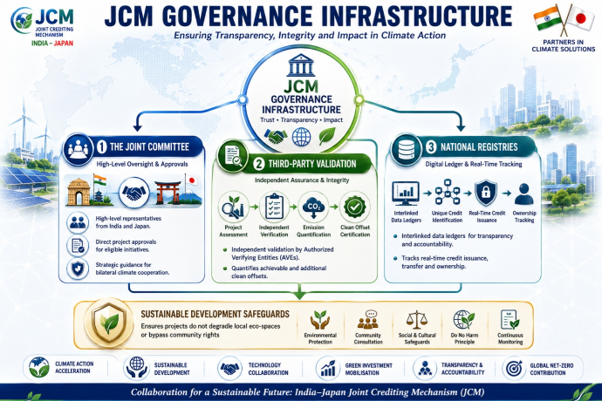
The newly adopted Rules of Implementation shift the JCM from a basic policy proposal into a highly regulated, functional market system built upon five structural pillars:
1. The Joint Committee: A bilateral governing board with equal representation from both governments. It acts as the final clearinghouse for project approvals, methodology validation, and credit distribution rules.
2. Transparent Project Approval Procedures: Defines clear, open-source technical steps to screen, register, and evaluate green projects, preventing speculative or low-quality carbon credits from entering the market.
3. Third-Party Validation & Verification: Mandates strict audits by independent, certified third-party entities. These specialists verify that greenhouse gas (GHG) reductions or carbon captures are real, additional, and measurable.
4. Sustainable Development Safeguards: Contains legal protections ensuring JCM projects actively benefit the local community and do not damage regional environments or biodiversity.
5. National Registries Linkage: Connects electronic carbon databases to record, store, and track the serial numbers of issued JCM credits as they change hands, preventing duplicate claims.
Macro-Economic Benefits: Accelerating Low-Carbon Capital- The operationalization of JCM rules offers deep-tech and financing advantages for India’s green growth targets:
-
- Incentivizing Advanced Green Capital: Japan will co-invest in deploying capital-heavy, advanced low-carbon technologies across India. Key sectors include green hydrogen generation, high-efficiency solar cells, advanced energy storage systems, carbon capture and storage (CCS), and grid modernization.
- Achieving NDCs: These targeted technology transfers allow India to accelerate its trajectory toward its 2030 NDC targets (reducing the emission intensity of its GDP by 45% from 2005 levels) and its long-term goal of Net-Zero by 2070.
UPSC Prelims Fodder: Fact-Check
| Feature | Details |
| Bilateral Accord | Joint Crediting Mechanism (JCM) Rules of Implementation. |
| Adoption Date | 8 June 2026. |
| Global Treaty Mandate | Article 6.2 (Direct ITMO trading) of the Paris Agreement (UNFCCC). |
| Core Governing Body | The Joint Committee (Comprising equal reps from both governments). |
| Accounting Rule | Prevention of double counting via Corresponding Adjustments. |
| Target Field | Low-carbon deep technologies, green hydrogen, and advanced energy projects. |
Conclusion:
The adoption of the JCM Rules of Implementation under Article 6.2 represents a milestone for India’s international climate policy. By pairing strict accountability mechanisms with clear third-party audits and linked registries,
Topic-4: Mega Infrastructure Engineering, Connectivity Networks & Environmental Safeguards
GS Paper 2: Government policies and interventions for development in various sectors and issues arising out of their design and implementation.
GS Paper 3: Infrastructure: Growth and development of Roads, Highways, and Bridges; Conservation, environmental pollution, and degradation; Environmental Impact Assessment (EIA); Security challenges and their management in border areas (Strategic transport corridors).
Context: The Ministry of Road Transport and Highways (MoRTH) highlighted a series of iconic, state-of-the-art mega-bridges constructed across India over the past twelve years. These structures highlight a shift toward advanced structural engineering techniques, such as extradosed and cable-stayed configurations, while explicitly balancing infrastructural expansion with local wildlife protections and military logistics.
Structural Engineering Profiles of India’s Mega Bridges
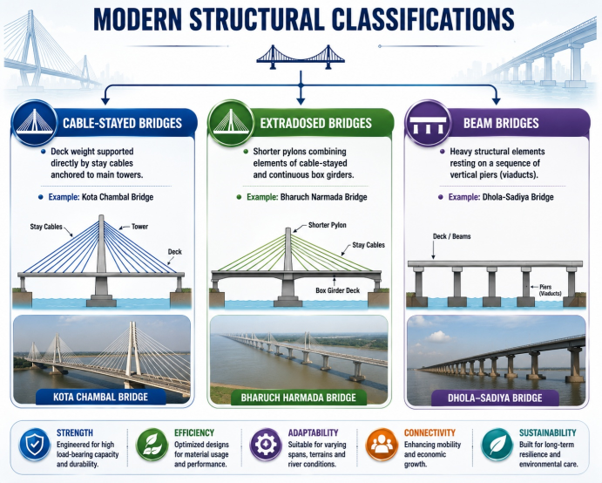
Modern bridge building has evolved past simple concrete beam designs to employ specialized, high-performance structural configurations:
1. The New Saraighat Bridge (Guwahati, Assam)
-
- Specifications: Length of 1.49 km, running parallel to the historic old rail-cum-road Saraighat Bridge over the Brahmaputra River.
- Strategic Value: Connects North and South Guwahati, serving as a critical infrastructure bottleneck solution along the East–West Economic Corridor (NH-27), facilitating faster logistical access to the wider North-Eastern states.
2. Kota Chambal Bridge (Kota, Rajasthan)
-
- Specifications: A 1.4 km long, 6-lane single-plane cable-stayed structure. The stay cables are engineered using individually sheathed steel strands featuring triple corrosion protection. The external cable ducts include aerodynamically optimized surfaces to damp rain- and wind-induced vibrations, increasing the operational lifespan of the structure.
- The Eco-Sensitive Design Layer: To protect the highly sensitive National Chambal Gharial Wildlife Sanctuary—a core breeding ground for the endangered gharial, red-crowned roof turtle, and Ganges River dolphin—engineers designed a 300-meter continuous suspended span. This allows the bridge to cross the river completely clear of the main water channel, keeping the riverbed free of piers to prevent any disruption to local aquatic ecosystems.
3. New Narmada Bridge (Bharuch, Gujarat)
-
- Specifications: A 1.34 km long extradosed bridge handling heavy traffic volumes on the crucial Ahmedabad-Mumbai section of NH-8. Built within a tight 34-month schedule, it features one of the longest extradosed continuous spans in India, optimizing inter-state commercial freight movement.
4. Ganga River Bridge (Aunta–Simaria, Bihar)
-
- Specifications: A 1.8 km long, 6-lane extradosed structure featuring a single segmental concrete configuration with a 34-meter-wide deck. It uses massive 70-meter cantilever arms and varying span intervals ranging from 57 meters to 115 meters.
- Socio-Economic Utility: Built parallel to the nearly 70-year-old Rajendra Setu, this modern corridor directly connects North and South Bihar, eliminating lengthy, multi-hour fuel-intensive detours for commercial trucks.
Border Connectivity & National Security Engineering
The Dhola–Sadiya Bridge (Bhupen Hazarika Setu)
-
- Specifications: Measuring 9.15 km, this structure is India’s longest river bridge over land. It crosses the Lohit River, a primary, highly active tributary of the Brahmaputra, providing a permanent all-weather road link between Northern Assam and Eastern Arunachal Pradesh.
- The Strategic Military Anchor: The bridge’s foundational spans and concrete decks are reinforced to withstand continuous tracking loads from 60-tonne military main battle tanks, specifically accommodating the Indian Army’s Arjun and T-72 platforms. This structural reinforcement allows for the rapid deployment of heavy armor and defense logistics to forward border positions along the Line of Actual Control (LAC).
UPSC Prelims Fodder: Fact-Check
| Bridge Name | River Intersection | Structural Archetype | Core Strategic / Eco Feature |
|---|---|---|---|
| Bhupen Hazarika Setu (Dhola-Sadiya) | Lohit River (Assam-Arunachal) | Reinforced Beam Bridge | Engineered to carry 60-tonne military tanks directly to border zones. |
| Kota Bridge | Chambal River (Rajasthan) | Cable-Stayed | Zero-pier riverbed design protecting the Gharial Wildlife Sanctuary. |
| Aunta-Simaria Bridge | Ganga River (Bihar) | Extradosed | India's widest 34-meter single segmental bridge deck. |
| New Saraighat Bridge | Brahmaputra (Assam) | Multi-span highway node | Core transport link along the NH-27 East-West Corridor. |
| New Narmada Bridge | Narmada River (Gujarat) | Extradosed | Core industrial freight route on NH-8 (Ahmedabad-Mumbai). |
Conclusion:
The deployment of these iconic bridges underscores India’s maturing infrastructure capabilities. By moving beyond simple transit designs to construct complex extradosed and cable-stayed structures, MoRTH is delivering highly durable transportation links.
Topic-5: The India–UK Comprehensive Economic and Trade Agreement (CETA)
GS Paper 2: Bilateral, regional, and global groupings and agreements involving India and/or affecting India’s interests; Effect of policies and politics of developed and developing countries on India’s interests; International institutional frameworks for labor mobility and social security.
GS Paper 3: Indian Economy and issues relating to planning, mobilization of resources, growth, development, and employment; Effects of liberalization on the economy; Changes in industrial policy and their effects on industrial growth.
Context: Marking a historic milestone in India’s modern trade diplomacy, the Ministry of Commerce and Industry announced that the India–United Kingdom Comprehensive Economic and Trade Agreement (CETA) will officially enter into force on 15 July 2026. Concluded after 14 intensive rounds of negotiations, the agreement will activate alongside a companion Agreement on Social Security Contributions (the Double Contribution Convention). This dual-pact architecture aims to accelerate bilateral trade toward a target of USD 100 billion by 2030, establishing an advanced, rule-based framework aligned with Viksit Bharat @2047.
Institutional Timeline and Legal Milestones
The operationalization of CETA is the culmination of a multi-year diplomatic roadmap:
-
- May 2021: Adoption of the India–UK Roadmap 2030 and launch of the Enhanced Trade Partnership.
- 6 May 2025: Formal conclusion of the trade text after fourteen rounds of bilateral negotiations.
- 24 July 2025: Official signing of the CETA text in London by Union Commerce Minister Shri Piyush Goyal and UK Secretary of State for Business and Trade Jonathan Reynolds.
- 10 February 2026: Signing of the companion Double Contribution Convention (DCC).
- 15 July 2026: Concomitant Entry into Force of both the CETA and DCC legal frameworks.
Advanced Market Access Architecture for Goods
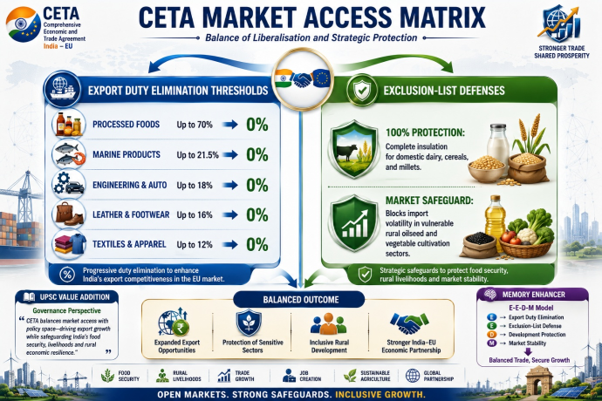
CETA modernizes traditional tariff structures by dismantling standard trade barriers while maintaining strict defenses for domestic rural livelihoods:
-
- The Zero-Duty Access: India secures immediate zero-duty access on approximately 99% of its tariff lines, covering nearly 100% of its current export value to the United Kingdom. This injects deep pricing power into labor-intensive domestic industries (textiles, footwear, marine, and engineering components).
- Bilateral Steel Safeguards: To insulate Indian steel manufacturers from the UK’s incoming steel tariff measures (effective 1 July 2026), a consensus was reached to protect 85% of India’s steel exports from restrictive caps through a combination of Country-Specific Quotas (CSQ), residual quotas, and access under the specialized Authorised Use Scheme (AUS).
Services Exports and the Double Contribution Convention (DCC)-
The services package represents one of the most comprehensive market-opening commitments ever conceded by the UK, covering 137 distinct export sub-sectors:
1. Professional Services Integration-
Enhanced regulatory certainty and clear market access paths are established for Indian IT/ITeS, financial services, legal, consultancy, and healthcare providers. The pact lays down formal tracks for:
-
- Contractual Service Suppliers & Independent Professionals.
- Intra-Corporate Transferees and Investors.
- Dedicated entry pathways for 1,800 cultural professionals annually, specifically covering Indian chefs, yoga instructors, and classical musicians.
2. Social Security Overhaul: The Double Contribution Convention-
Historically, Indian professionals on temporary assignments in the UK were legally forced to contribute to the UK’s National Insurance, despite being ineligible to claim those benefits.
-
- The Repatriation Breakthrough: The DCC completely exempts temporary Indian workers from making dual social security contributions while deployed in the UK.
- The Extended Exemption Window: The period of insurance exemption has been expanded from the traditional 3 years to 5 years. This structural change directly protects the financial interests of over 75,000 Indian professionals and 900 corporate entities annually, heavily reducing compliance overheads for Indian tech and consulting multinationals.
Next-Generation Trade Disciplines-
Moving beyond basic border duties, CETA contains 30 specialized chapters designed to navigate the complexities of modern digital economies:
-
- Digital Trade & Telecommunications: Harmonizing cross-border electronic commerce rules, consumer data protection baselines, and open telecommunications network access.
- Mutual Recognition of Qualifications (MRQ): Upgrading the landmark 2018 MRQ framework to expand academic and professional degree recognition across new technology domains, facilitating dual-degree architectures.
- Bilateral Procurement Access: Introducing structured, transparent parameters for participating in government procurement opportunities on a reciprocal basis.
UPSC Prelims Fodder: Fact-Check
| Feature | Details |
| Enforcement Date | 15 July 2026 (Concomitant launch of CETA & DCC). |
| Tariff Line Capture | 99% of India’s tariff lines reduced to immediate zero-duty. |
| DCC Exemption Term | Scaled upward from 3 years to 5 years. |
| Bilateral Trade Target | USD 100 Billion by the year 2030. |
| Steel Safety Core | 85% of Indian steel exports fully protected under CSQ and AUS. |
| Services Ambit | 137 export sub-sectors explicitly covered under UK commitments. |
| Insulated Sectors | Dairy, millets, cereals, oilseeds, and apples (Placed on Exclusion List). |
Conclusion:
The operationalization of the India–UK CETA and DCC on 15 July 2026 marks a structural shift in India’s global trade engagement. By dismantling high tariffs on 99% of tariff lines while keeping vital agricultural exclusions in place, the treaty secures domestic sensitivities while expanding industrial pricing power.
Topic-6: National Green Hydrogen Mission Architecture & Operationalization Framework
GS Paper 2: Government policies and interventions for development in various sectors and issues arising out of their design and implementation; Centrally sponsored missions and center-state cooperative federalism.
GS Paper 3: Indian Economy and issues relating to planning, mobilization of resources, growth, and development; Infrastructure: Energy; Conservation, environmental pollution, and degradation (Industrial decarbonization and green technology).
Context: Marking an institutional transition from baseline targeting to strict regulatory deployment under the National Green Hydrogen Mission, the Ministry of New and Renewable Energy (MNRE) convened a national programmatic workshop. During the session, Union Minister Shri Pralhad Joshi officially launched the Green Hydrogen Certification Portal of India (GHCI) to operationalize the country’s verification and compliance architecture.
The Green Hydrogen Certification Portal (GHCI)
The newly unveiled GHCI portal shifts the renewable fuel sector away from self-reported data to an independent, legally auditable, and transparent digital verification network:
-
- The Nodal Mechanism: Developed natively by MNRE, the digital platform enforces the Measurement, Reporting, and On-site Verification (MRV) Framework. It provides a standardized national gateway for developers to prove their fuel products meet the statutory Indian Green Hydrogen Standard (carbon emission intensity $\le 2\text{ kg CO}_2\text{ equivalent per kg of H}_2$ produced).
- Third-Party Verification Architecture: Every commercial producer is legally required to appoint an Accredited Carbon Verification (ACV) Agency—certified by the Bureau of Energy Efficiency (BEE)—by March 31 annually. These ACV agencies conduct rigorous on-site scientific audits, quantifying emissions before uploading mandatory compliance data directly through the GHCI portal.
- The Tiered Certification Engine: The portal manages three operational validation tiers:
1. Facility Level Certificate: A mandatory baseline pre-requisite confirming that a processing plant’s core hardware infrastructure is engineered to comply with the standard.
2. Provisional Certificate: An automated, voluntary certificate generated monthly (covering 1 to 11 months) based on immediate, real-time production telemetry data.
3. Final Certificate: A mandatory, annualized certificate issued on a rigid financial year cycle following final multi-parametric verification by an accredited ACV.
-
- Scope Limits: The certification tracks the full environmental footprint of green hydrogen generation, encompassing everything from raw production to compression, purification, and on-site storage. External pipeline transportation, storage outside project boundaries, and downstream carrier conversions are legally exempt from the scope of this specific system.
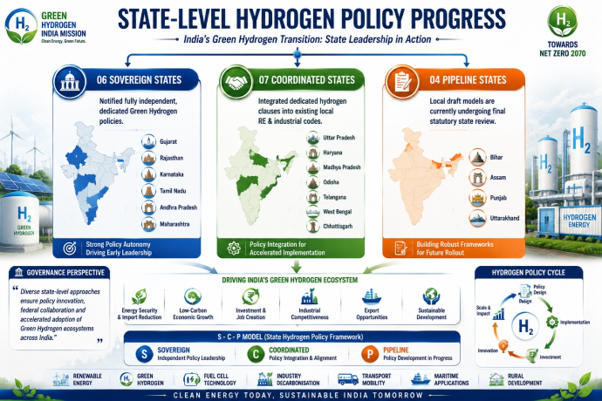
Cooperative Federalism- To prevent fragmented local regulations from bottlenecking infrastructure, MNRE has aligned state-level industrial policies into a unified framework:
Commercial Progress & Downstream Allocations-
The workshop delivered a detailed update on budget allocations and physical progress under the ₹19,744 Crore parent mission:
1. Upstream Hardware Localization (The SIGHT Program)-
To decouple India’s transition from foreign tech supply lines, the Strategic Interventions for Green Hydrogen Transition (SIGHT) program has awarded financial incentives to 15 companies. This funding supports the establishment of 3,000 MW per annum of domestic electrolyser manufacturing capacity. Total production incentives have already been cleared for 8,62,000 MTPA of green hydrogen volume.
2. Heavy Industry Decarbonization Targets
-
- Refining Sector: Supply contracts have been formally cleared to deliver 30,000 MTPA of green hydrogen across India’s core public refiners: IOCL, BPCL, HPCL, and NRL.
- Fertiliser Sector: Binding agreements have been executed to supply 6.7 lakh MTPA of Green Ammonia to 11 mega-fertiliser plants, substituting natural gas imports.
- Steel Sector: A pilot fund of ₹84 Crore has been deployed to test 100% clean hydrogen injection inside active blast furnaces.
3. Clean Mobility & Testing Infrastructure
-
- An allocation of ₹208 Crore is actively supporting a pilot fleet of 37 hydrogen-fueled heavy vehicles and 9 strategic refueling nodes.
- This mobility network is backed by a ₹193.35 Crore investment to stand up 7 specialized national testing facilities.
4. Frugal Innovation & Venture Support
MNRE announced a ₹100 Crore Startup Support Fund specifically focused on early-stage, deep-tech green hydrogen innovations. The first batch of 9 startups has been cleared to receive a combined allocation of ₹22 Crore.
UPSC Prelims Fodder: Fact-Check
| Policy Metric | Operational Value / Institutional Status |
| New Compliance Node | Green Hydrogen Certification Portal of India (GHCI). |
| Auditing Standard | MRV Framework verified by BEE-accredited ACV Agencies. |
| Parent Mission Layout | Launched 2023 | Outlay of ₹19,744 Crore. |
| SIGHT Manufacturing | Incentivizing 3,000 MW/Year of domestic electrolyser output. |
| Macro Mission Goals | 5 MMT production capacity supported by 125 GW of RE by 2030. |
| Refinery Ingestion | 30,000 MTPA allocated to IOCL, BPCL, HPCL, and NRL. |
| Agri-Input Ingestion | 6.7 Lakh MTPA of Green Ammonia routed to 11 fertiliser units. |
Conclusion:
The launch of the GHCI compliance portal marks a shift from setting high-level energy targets to implementing strict regulatory frameworks under the National Green Hydrogen Mission. By pairing independent, BEE-accredited third-party audits with targeted downstream allocations in steel, refining, and transportation, MNRE is building a highly accountable green fuel network.
Spread the Word