Introduction:
Between 2014 and 2026, India’s social security architecture, shifting away from consumption-based welfare toward, women-led economic participation by deploying a comprehensive lifecycle framework, national policy interventions target specific biological, educational, and occupational touchpoints. This systematic method begins with early childhood protection, transitions through tech-aligned vocational training, and culminates in financial inclusion and statutory political representation.
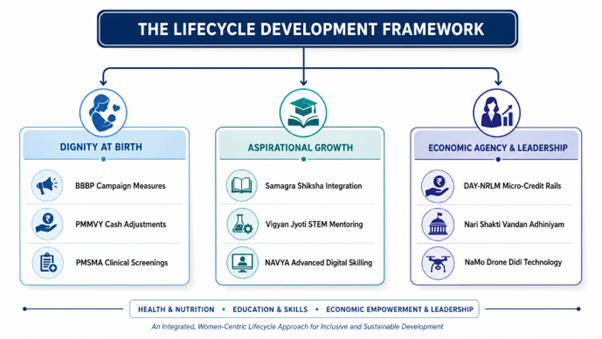
Dignity at Birth
-
- Demographic Corrections: The Beti Bachao Beti Padhao (BBBP) campaign, launched on 22 January 2015, combines mass behavioral adjustments with strict legal enforcement of the PCPNDT Act. National Family Health Survey-5 (NFHS-5) data records an expanded sex ratio of 1,020 women for every 1,000 men, up from 943 in 2011.
- Conditional Cash Transfers: The Pradhan Mantri Matru Vandana Yojana (PMMVY) provides conditional benefits of ₹5,000 for the first child and ₹6,000 for the second child (girl child only) via digital Direct Benefit Transfers (DBT) to offset wage losses and incentivize early childhood immunizations. The scheme has disbursed ₹20,150 crore to 4.28 crore mothers.
- Clinical Health Infrastructures: The Pradhan Mantri Surakshit Matritva Abhiyan (PMSMA) guarantees free, high-quality antenatal care (ANC) on the 9th of every month across 22,000 facilities, conducting 6.85 crore check-ups and identifying 1.03 crore high-risk pregnancies. This is reinforced by the Janani Suraksha Yojana (JSY) and Janani Shishu Suraksha Karyakram (JSSK) to drive institutional births up to 90.6%.
Education and Aspirational Growth
-
- School Retention Systems: Administered under the Samagra Shiksha framework, infrastructure upgrades across 14.71 lakh schools have achieved functional separate girls’ toilets in 97.3% of institutions and clean drinking water access in 99.3%, dramatically lowering secondary school dropout rates. Residential schooling needs are addressed via 5,316 active Kasturba Gandhi Balika Vidyalayas (KGBVs).
- STEM Pathway Creation: The Vigyan Jyoti Scheme has extended mentoring, financial support, and laboratory exposure to 1.12 lakh girls across 300 districts to counter gender disparities in Science, Technology, Engineering, and Mathematics. Supernumerary seats in Indian Institutes of Technology (IITs) and NITs have successfully raised female participation past 20%.
- Vocational Modernization: Under the Pradhan Mantri Kaushal Vikas Yojana (PMKVY), women constitute 45% of total trainees. The newly deployed NAVYA initiative targets adolescent girls across 27 Aspirational Districts, introducing technical curricula covering cybersecurity, artificial intelligence, and green energy workflows.
Financial Inclusion
-
- The SHG Grid: The Deendayal Antyodaya Yojana-NRLM has built a nationwide micro-credit architecture spanning 7,627 blocks, enabling rural women-led Self-Help Groups to leverage ₹12.18 lakh crore in institutional bank credit. This network is supported by 50,548 specialized Bank Sakhis and agricultural Krishi Sakhis.
- The Lakhpati Didi Mission: Operating across 5.94 lakh villages, this flagship economic model coordinates 93.85 lakh SHGs with 10.07 crore members to systematically shift 6 crore women into self-sustaining income brackets generating at least ₹1 lakh annually.
- Collateral-Free Credit Deployment: Under the Pradhan Mantri Mudra Yojana (PMMVY), cumulative credit disbursements reached ₹40.07 lakh crore by March 2026, serving as a prime financing rail for women-led micro-enterprises. This is matched by Stand-Up India, which provides larger structural loans between ₹10 lakh and ₹1 crore.
- Technological Agrarian Integration: The NaMo Drone Didi Yojana equips women SHG members with remote pilot certifications from DGCA-authorized institutions, distributing advanced agricultural drones to lower farm operating costs and open up tech-driven income streams.
- Procurement Democratization: The Womaniya initiative on the Government e-Marketplace (GeM) allows women-led small enterprises to sell directly to public sector entities, securing over ₹28,000 crore in contract allocations in FY 2025-26, outperforming the mandated 3% state procurement target.
- SHE-Mart Networks: Announced in the Union Budget, this initiative sets up community-owned retail storefronts managed by SHG federations to provide marketplace visibility to 1 crore artisan women.
Safety and Public Health Integration
-
- The Mission Shakti Framework: Unifies safety (Sambal) and economic capability (Samarthya) into an integrated support vertical.
- Sambal Safety Infrastructure: Operates 973 One Stop Centres (OSCs) that have provided medical and legal aid to 14.49 lakh women, integrated with the 181 Women Helpline and technology-enabled 112 Emergency Response Support System.
- Samarthya Institutional Care: Manages Shakti Sadans for rehabilitation, Sakhi Niwas working women hostels, and the Palna National Creche Scheme to improve labor-force participation.
- Universal Health Protection: Under AB-PMJAY, 21 crore custom health insurance cards have been generated for women, commanding 48% of total hospital admissions. Over 1.84 lakh Ayushman Arogya Mandirs (AAMs) handle frontline screenings, including checking 8.73 crore women for cervical oncology.
- Basic Quality-of-Life Infrastructure:
- Pradhan Mantri Ujjwala Yojana (PMUY): Delivered 10.55 crore clean cooking gas connections to lower respiratory and indoor air pollution hazards.
- Jal Jeevan Mission (JJM): Provided functional household tap water to 15.84 crore families, eliminating manual water collection labor.
- The Mission Shakti Framework: Unifies safety (Sambal) and economic capability (Samarthya) into an integrated support vertical.
Political Leadership
| Governance Vertical | Current Structural Milestone | Macro Impact |
|---|---|---|
| Panchayati Raj Institutions | 14.5 Lakh Elected Women | Occupy 46% of local government seats, shifting policy focus to rural health, sanitation, and nutrition. |
| Electorate Power | 47 Crore Registered Voters | Comprise 48.62% of the national electorate, clocking a historic 65.78% voter turnout. |
| National Legislatures | Nari Shakti Vandan Adhiniyam | Enacted a mandatory 33% legislative reservation for women in the Lok Sabha and State Assemblies. |
| Strategic Security Forces | National Defence Academy (NDA) | Graduated the first batch of 17 women combat cadets in 2025, scaling total academy enrolment to 158. |
Challenges
-
- The Female Labor Force Participation Rate (FLFPR) Plateau: While financial inclusion through Jan Dhan and Mudra has reached scale, structural barriers such as care work responsibilities and safety issues along regional commuting corridors keep formal wage-earning FLFPR levels low compared to peer emerging market economies.
- Downstream Scaling Bottlenecks for Micro-Enterprises: Millions of women entrepreneurs successfully access introductory Shishu microloans under the Mudra scheme. However, transitioning these micro-enterprises into larger, formal industrial units (Kishor and Tarun tiers) is limited by a lack of advanced equity capital and corporate network links.
- Digital Literacy Disparities in Rural Areas: While tech-driven programs like NaMo Drone Didi and ABDM digital health wallets are expanding, a deep digital divide persists in remote tribal and hilly regions. In these areas, smartphone access and independent data handling are limited, making women dependent on family members or intermediaries.
Way Forward
-
- FPO-Led Value Chain Integration: Connecting rural women-led SHGs with Farmer Producer Organizations (FPOs) and processing facilities to upgrade local livelihoods into high-yield commercial enterprises.
- Scaling Care Infrastructure via Palna: Rapidly expanding the network of workplace creches (Palna National Creche Scheme) to lower the burden of unpaid childcare and improve career progression.
- Targeted Capital Pools for Women-Led Tech Startups: Setting up dedicated venture capital funds within institutions like SIDBI to support women entering advanced deep-tech, electronics, and aerospace manufacturing fields.
- Localized Digital Upskilling: Expanding the NAVYA framework beyond Aspirational Districts to build nationwide digital financial literacy, ensuring safe usage of automated credit systems.
Conclusion
India’s structural transition from basic female welfare to high-impact women-led development is transforming the country’s economic and political landscape. By pairing a rigorous lifecycle framework with large-scale economic programs like Lakhpati Didi and legislative mandates like the Nari Shakti Vandan Adhiniyam, the country has built an enabling ecosystem for female agency.
Spread the Word