
Introduction
India’s domestic industrial strategy has completed a fundamental pivot, transforming its regulatory framework from a document-intensive oversight system into trust-based facilitation model. Recognized under Group A of the World Bank’s GovTech Maturity Index, the state leverages high-density Digital Public Infrastructure (DPI) to automate interactions between business entities and regulatory ministries.
Foundational Pillars of Business Entry and Digital Formalization
The process of starting a commercial business has been re-engineered into an online, paperless experience through integrated GovTech nodes:
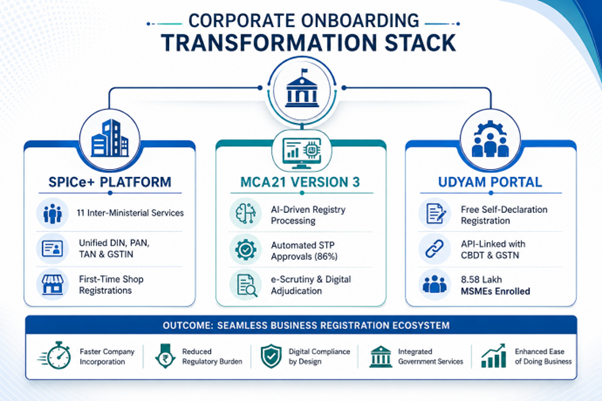
1. The SPICe+ Integrated Platform: A unified web interface that combines 11 statutory services across 3 central ministries, state revenues, and local municipalities. It consolidates 10 separate onboarding steps—including Director Identification Number (DIN) allotment, PAN/TAN configuration, EPFO/ESIC enrollment, and commercial bank account opening—into a single online screen validation.
2. MCA21 Version 3 AI Engine: Serves as the primary registry repository for limited liability companies and LLPs. Driven by machine learning tools like automated e-Scrutiny and digital e-adjudication, it processed 3.84 crore corporate files, routing 86% through automated Straight Through Processing (STP) lines to cut out manual processing delays.
3. Udyam Registration Portal: Provides a documentation-free micro-enterprise onboarding pipeline linked via backend APIs directly with the Central Board of Direct Taxes (CBDT) and the GST Network (GSTN). Registered MSME units grew from 10.02 thousand in October 2020 to 8.58 lakh by June 2026.
4. Startup India Scalability: Deploys targeted capital access points—such as the SISFS (Seed Fund), FFS (Fund of Funds), and dedicated credit guarantee models. Recognized startup assets expanded from 502 in 2016 to over 2.23 lakh by March 2026, adding 23.3 lakh direct jobs while maintaining 48% inclusivity via women partners.
Spatial Modernization
Property acquisition and registration have been modernized through the Digital India Land Records Modernization Programme (DILRMP) to curb title fraud and litigation:
-
- The Unique Land Parcel Identification Number (ULPIN): Operates as the “Aadhaar for Land”, assigning an alphanumeric, geo-coordinate-mapped 14-digit code to over 36 crore individual land parcels across 29 states and Union Territories.
- The NAKSHA Urban Geopolitical Pilot: Uses high-resolution aerial imagery across 116 urban local bodies, covering 5,915 sq. km to build a comprehensive, GIS-integrated city land database.
- National Generic Document Registration System (NGDRS): Implements a unified “One Nation, One Registration” structure across 17 states. It integrates 88.6% of Sub-Registrar Offices directly with regional revenue databases to execute automatic mutation right after property deed finalization.
Deconstructing Permit Rationalization
To remove traditional “Inspector Raj” roadblocks, structural parameters have been introduced across industrial labor and pollution control operations:
1. The OSH Labor Code Simplification
Enacted to absorb 13 outdated central labor enactments, it features:
-
- A single, web-based electronic registration covering an entire facility, replacing 6 separate registrations.
- Single all-India contractor licenses holding a fixed 5-year validity window.
- Prescribing a strict 30-day statutory time ceiling for factory building expansions, backed by automatic deemed approval clauses if deadlines are missed.
- Replaced traditional spot inspections with Randomized Web-Based Inspections conducted by newly designated Inspector-cum-Facilitators.
2. Environmental Consent and Recategorization
-
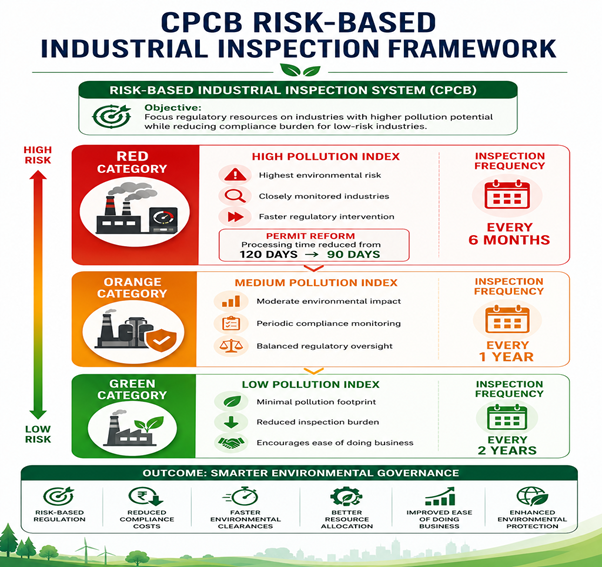
- The Permanent CTO Amendment: Standardized under the Air and Water Pollution Acts, a Consent to Operate (CTO) designation now remains permanently valid until explicitly cancelled. This completely eliminates the need for repeated compliance renewals.
- Risk-Based Inspection Clustered Timeline: Industries are grouped based on their structural pollution indexing into Red, Orange, and Green blocks, matching inspections with actual environmental risk profiles:
3. Centralized Approval Gateways
-
- National Single Window System (NSWS): A digital single-sign-on portal integrating 32 central departments and 34 state frameworks, processing 686 central and 7,498 state clearances. It has issued 8,29,750 approvals since 2021.
- PARIVESH 2.0: A unified hub for green clearances (Environment, Forest, Wildlife, and CRZ) that has reduced the average environmental clearance processing speed to 64 days, beating the statutory 105-day limit.
Deepening Market Connectivity
-
- Government e-Marketplace (GeM): An inclusive, electronic public procurement portal that crossed a record ₹5 lakh crore in Gross Merchandise Value (GMV) in FY 2025-26. Micro and small enterprises (MSEs) executed 68% of total orders, while 2.04 lakh registered women-led entities accounted for ₹79,231 crore in transactions.
- Open Network for Digital Commerce (ONDC): An open-protocol digital network designed to break uncompetitive e-commerce monopolies, onboarding 7.64 lakh sellers across 616 cities.
- PM GatiShakti National Master Plan: A geospatial mapping platform featuring 3,199 interactive data layers across 58 central ministries to automate multi-modal transit coordination and eliminate infrastructure project delays.
- National Logistics Portal (Marine) & LDB 2.0: A logistics data bank that handles real-time data tracking for 100% of import-export containers, improving India’s standing on the World Bank Logistics Performance Index to 38th.
Institutionalizing Credit
-
- Collateral-Free Credit Deployment: The CGTMSE trust has approved ₹9.34 crore in guarantees across 1.15 crore small loans. Concurrently, the Pradhan Mantri Mudra Yojana (PMMY) has disbursed an aggregate ₹40.07 lakh crore across 57 crore accounts, prioritizing women (59.81% of accounts) and new entrepreneurs.
- Automated Credit Assessment Models (CAM): Implemented across public sector banks to review digital data trails (like GST files and bank records), enabling instant, automated approvals for 3.96 lakh MSME accounts worth ₹52,300 crore.
- TReDS Invoice Discounting Integration: Proposed in the Union Budget, this framework links GeM with the Trade Receivables Discounting System (TReDS) to turn outstanding invoices into asset-backed securities, instantly resolving liquidity issues for small suppliers.
Tax Simplification and Border Efficiency
-
- The Unified GST Architecture: Replaced a complex web of central excise, service, and local VAT systems with a single national market layout. Backed by the GSTN e-Invoicing system, the registered taxpayer base grew to 1.64 crore by April 2026.
- Logistics Interoperability via E-Way Bills: Replaced fragmented interstate transit checks with a single electronic tracking pass, scaling generation to 188.27 crore bills in FY 25-26.
- Border Corridors (Export Promotion Mission & ICEGATE): The centralized ICEGATE system streamlines international customs filing, handling 5.89 lakh monthly Bills of Entry. This works alongside the eCoO 2.0 System for automated certificates of origin and the Trade Connect e-Platform. Grassroots trade is expanded by the Districts as Export Hubs framework, covering 590 districts.
Challenges
-
- Editorial analyses in The Hindu highlight that while federal platforms like the OSH labor codes introduce “deemed approvals” after 30 days, local municipal bodies and municipal engineers frequently dispute these automated designations. This tension introduces hidden delays during first-mile construction and utility initialization.
- Critiques in the Indian Express note that despite ONDC onboarding 7.64 lakh sellers, the network lacks the massive consumer acquisition budgets of established global e-commerce duopolies. This keeping transaction volumes heavily clustered around food and grocery niches, rather than high-margin durable goods manufacturing.
- Policy papers from the Observer Research Foundation (ORF) emphasize that while the Jan Vishwas Acts of 2023 and 2026 successfully decriminalized over 700 central provisions, actual enforcement requires corresponding amendments to matching state-level rules. Fragmented state-level follow-through creates uneven compliance costs for multi-state industrial operators.
Way Forward
-
- Linking ULPIN and NGDRS to the ULI Framework: Connecting unique Land Parcel Numbers (ULPIN) with the Unified Lending Interface (ULI) to allow commercial banks to execute automated, instant asset mortgages without requiring physical verification.
- Expanding TReDS Mandates to All Tier-2 Corporate Vendors: Making invoice discounting via TReDS mandatory for all medium and large corporate supply chains to eliminate systemic payment delays for secondary MSME suppliers.
- Deploying Localized Single-Window Desks at D-BRAP Level: Utilizing the District Business Reform Action Plan (D-BRAP) infrastructure to bring central single-window portals down to urban local body collectorates, addressing local inspection friction.
- Automating State-Level Jan Vishwas Decriminalization: Creating a model state-level legislative framework through the Ministry of Cooperation and DPIIT to incentivize states to mirror central decriminalization benchmarks.
Conclusion
India’s structural reforms are transforming the domestic economy, shifting the relationship between the state and the private sector from one of complex bureaucratic control to one of collaborative trust. By pairing integrated digital gateways like SPICe+ and NSWS with modern land mapping and absolute compliance rollbacks, the country lowers entry barriers for new ventures.
Spread the Word