Topic-1: Operationalization of the BHAVYA Scheme
GS Paper 2: Government policies and interventions for development in various sectors and issues arising out of their design and implementation; Coordinated center-state functional mechanisms.
GS Paper 3: Indian Economy and issues relating to planning, mobilization of resources, growth, development, and employment; Changes in industrial policy and their effects on industrial growth; Infrastructure: Industrial Corridors and Investment-ready Parks.
Context: Union Minister of Commerce & Industry Shri Piyush Goyal launched the BHAVYA Portal in New Delhi. This digital rollout officially operationalizes the Bharat Audyogik Vikas Yojana (BHAVYA), the Central Government’s flagship scheme approved with a Cabinet outlay of ₹33,660 crore (budgetary reference of ~₹34,000 crore) to build 100 plug-and-play industrial parks over a six-year horizon.
Institutional Architecture & Financial Model
The BHAVYA scheme systematically moves away from ad-hoc, land-bank allocations toward a structured, corporate-style equity partnership between the center and states.
-
- The 51:49 Joint Venture Model: State Governments will act as the foundational anchors by providing encumbrance-free land titles. In return, the Government of India, through the National Industrial Corridor Development Corporation (NICDC), will match the equity under a 51:49 joint-venture framework to finance complete on-site infrastructure creation.
- Tiered Geographic Sizing Matrix: To accommodate diverse topographies and economic logic, the 100 parks will be built across three distinct size configurations:
- Hilly & Frontier Nodes (25 Acres): Tailored for Northeastern States, smaller Union Territories, and rugged terrain.
- Mid-Sized Economic Nodes (100 to 500 Acres): Allocated based on standard need-assessments across mid-sized states.
- Macro-Industrial Hubs (Up to 1,000 Acres): Developed in close proximity to major metropolitan tier-1/2 cities to leverage existing logistics lines.
The Challenge-Based Selection
The newly launched BHAVYA Portal, engineered by the NICDC, introduces an objective, competitive bidding model for sub-national states, eliminating arbitrary administrative allocations.
-
- Competitive Federalism: States must submit online Detailed Project Reports (DPRs) via the portal. Proposals will be evaluated automatically based on clear criteria: contiguous land availability, baseline multi-modal connectivity, demonstrated investor interest, and region-specific sectoral strengths.
- Phased Rollout Timeline:
- Phase 1 (20 Parks): Evaluation of applications submitted between 1 June and 31 July 2026.
- Phase 2 (30 Parks): Processing of proposals received up to 30 September 2026.
- Subsequent Phases (50 Parks): Scheduled dynamically based on execution data and operational feedback from the initial rounds.
- Remote Investor Mapping: The platform integrates satellite imagery and Geographic Information System (GIS) mapping. This allows global investors to remotely audit available land parcels, electricity/water distribution lines, and nearby transit links before committing capital.
Plug-and-Play Ecosystem
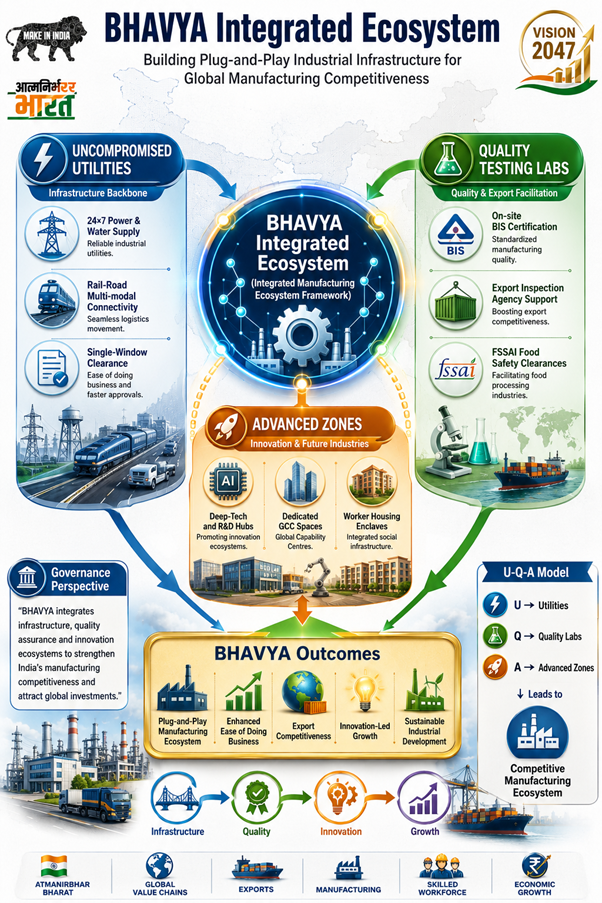
BHAVYA parks are designed to eliminate regulatory delays by establishing pre-cleared, sector-specific ecosystems:
-
- On-Site Testing & Standards Co-location: To minimize quality testing friction for exporters, the parks will integrate advanced, on-site testing laboratories managed in direct partnership with statutory regulatory bodies:
-
-
- Bureau of Indian Standards (BIS): For industrial manufacturing goods and electronics certification.
- Export Inspection Agency (EIA): For fast-tracking pre-shipment quality clearances.
- Food Safety and Standards Authority of India (FSSAI): For processing agro-export compliance.
- Frontier Industrial Zoning: Beyond traditional assembly lines, spaces will be explicitly earmarked for Global Capability Centres (GCCs), Deep-Tech enterprises, advanced R&D labs, and startup incubators.
- International Enclaves: The scheme explicitly allows for the creation of dedicated international clusters developed in cooperation with key partner nations like Japan, Singapore, South Korea, and Switzerland, providing a familiar regulatory and social ecosystem for expatriate professionals.
-
UPSC Prelims Fodder: Fact-Check
| Feature | Details |
| Scheme Nomenclature | BHAVYA (Bharat Audyogik Vikas Yojana). |
| Nodal Department | Department for Promotion of Industry and Internal Trade (DPIIT). |
| Project Management Agency | National Industrial Corridor Development Corporation (NICDC). |
| Cabinet Financial Outlay | ₹33,660 Crore over an operational period of 6 years. |
| Target Infrastructure | 100 investment-ready, plug-and-play industrial parks. |
| Equity Share Pattern | 51:49 model between the Center (NICDC) and State Governments. |
| Selection Mechanic | Challenge-based competitive framework managed via the BHAVYA Portal. |
Conclusion:
The launch of the BHAVYA Portal marks a transition from simple land acquisition to building globally competitive, sector-specific industrial ecosystems. By combining a transparent, challenge-based selection model with a plug-and-play infrastructure layout and on-site testing infrastructure (BIS/FSSAI), the scheme systematically eliminates administrative friction for investors.
Topic-2: Structural Data Reforms for State Finance Commissions & 16th FC Innovations
GS Paper 2: Appointment to various Constitutional posts, powers, functions and responsibilities of various Constitutional Bodies; Devolution of powers and finances up to local levels and challenges therein; Important aspects of governance, transparency, and accountability.
GS Paper 3: Indian Economy and issues relating to planning, mobilization of resources, growth, development, and employment; Data analytics in fiscal governance.
Context: Dr. V. Anantha Nageswaran, Chief Economic Advisor (CEA) to the Government of India, formally released the “Report of the Committee on Datasets for State Finance Commissions” in New Delhi. The launch event also highlighted several upcoming breakthrough recommendations from the Sixteenth Finance Commission (16th FC) designed to overhaul local public finance.
Recommendations of the Datasets Committee
The report establishes a standardized information architecture to replace political guesswork with evidence-based data analytics at the lowest tier of democracy:
-
- CAG Performance Audit Mandate: The Committee has recommended that the Comptroller and Auditor General (CAG) of India undertake a comprehensive nationwide performance audit on the implementation of the 73rd Constitutional Amendment. This audit will evaluate the actual status of functional, financial, and administrative devolution across all states.
- Institutionalizing SFC Cells: State Governments are advised to set up permanent, dedicated State Finance Commission Cells to maintain data continuity between the five-year gaps when temporary commissions are dissolved.
- Data Integration Toolkits:
- Panchayat-Level Fiscal Databases: Creating unified, granular accounting systems at the village level.
- Panchayat Advancement Index Integration: Classifying index performance indicators to help SFCs evaluate localized funding gaps. (Notably, the Panchayat Advancement Index won the Gold Award at the National e-Governance Awards 2026).
- SFC Manual & Reporting Frameworks: Authoring a common reporting format and a standard operational manual to ensure uniform practices across all States and Union Territories.
16th Finance Commission: Strategic Innovations for Local Bodies
Panchayati Raj Secretary Shri Vivek Bharadwaj revealed two massive institutional updates introduced through the Ministry’s consultations with the Sixteenth Finance Commission:
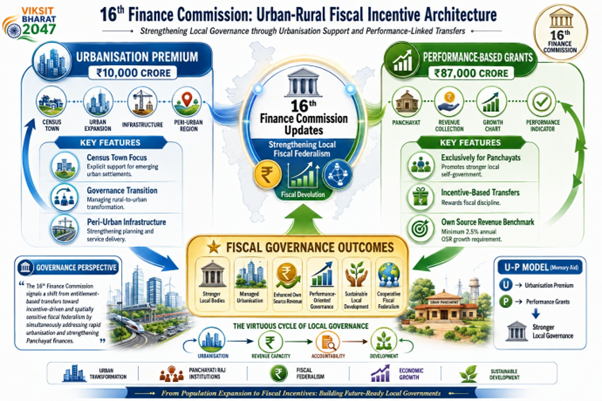
1. The ₹10,000 Crore “Urbanisation Premium”
-
- The Target Ecosystem: Aimed at Census Towns—rural settlements that have acquired urban demographic characteristics (population density, non-farm employment) but continue to be governed administratively as rural Gram Panchayats.
- The Mandate: This is India’s first dedicated national fund designed to manage peri-urban transformation. It gives local bodies the financial cushion needed to upgrade basic public services (drinking water pipelines, street lighting, solid waste units) as rural areas transition into formal urban entities.
2. The ₹87,000 Crore Performance-Based Grant Framework
-
- The Allocation: A massive window of ₹87,000 crore has been earmarked exclusively for Panchayats.
- The Own-Source Revenue (OSR) Condition: To claim these grants, local bodies must meet strict financial benchmarks. Access is legally tied to achieving an annual growth of at least 2.5% in their Own-Source Revenues (via localized property taxes, market fees, and user charges), driving grassroots self-reliance.
UPSC Prelims Fodder: Fact-Check
| Feature | Details |
| Report Title | Report of the Committee on Datasets for State Finance Commissions. |
| Nodal Ministry | Ministry of Panchayati Raj (MoPR). |
| Constitutional Node | Article 243-I (SFC mandate for checking local fiscal health). |
| Award Winner | Panchayat Advancement Index (Gold Award, National e-Governance Awards 2026). |
| New 16th FC Fund | Urbanisation Premium (₹10,000 Crore for Census Towns). |
| Performance Pool | ₹87,000 Crore tied to a 2.5% annual OSR growth threshold. |
| Audit Proposal | Nationwide CAG performance audit on the 73rd Amendment’s devolution. |
Conclusion:
By combining permanent state-level data infrastructure with the 16th Finance Commission’s bold incentives—such as the Urbanisation Premium and performance-linked grants—the reform tackles the historical financial weakness of local bodies.
Topic-3: BRICS Science Academies Forum 2026 & Responsible AI Roadmap
GS Paper 2: Bilateral, regional, and global groupings and agreements involving India and/or affecting India’s interests; Effect of policies and politics of developed and developing countries on India’s interests; Global South diplomacy.
GS Paper 3: Science and Technology- developments and their applications and effects in everyday life; Ethics and governance of Artificial Intelligence; International scientific collaborations.
Context: As a part of India’s BRICS Presidency 2026, the Indian National Science Academy (INSA) convened the first landmark meeting of the BRICS Science Academies Forum 2026.
Held virtually under the theme “Harnessing Artificial Intelligence for Sustainable Development and Strengthening Global South Cooperation,” science academies from ten nations gathered to design a unified, equitable framework for responsible AI deployment.
Expansion of the BRICS Scientific Bloc
The forum highlights a significantly expanded BRICS footprint, bringing together traditional member states alongside newly integrated economic and strategic partners from across the Global South.
-
- The Ten Represented Nations: India, Brazil, China, Egypt, Ethiopia, Indonesia, Russia, South Africa, Belarus, Nigeria, and Vietnam.
- India’s 2026 Presidential Theme: Guided by the overarching national mission: “Building for Resilience, Innovation, Cooperation and Sustainability.”
- The Institutional Pipeline: Moderated by INSA leadership, this initial virtual forum serves as the foundation for the upcoming, in-person Second BRICS Science Academies Forum Meeting scheduled for 22–23 July 2026 at IIT Hyderabad, where the formal declaration will be finalized.
Bridging the Global AI Divide: The Draft Declaration
The core academic brief, presented by IIT Delhi’s School of Public Policy, focuses on a critical challenge: the heavy concentration of advanced AI computing infrastructure in Western corporate monopolies. This imbalance risks creating a deep technical disadvantage for developing economies.
The forum’s draft declaration aims to position AI as an open-source, public good designed to accelerate complex scientific discoveries:
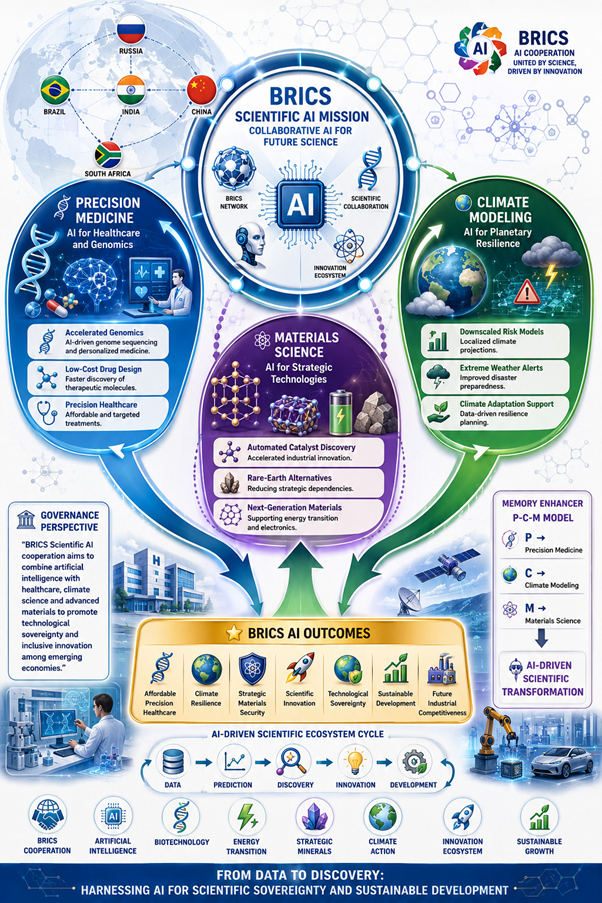
Strategic Action Points for BRICS AI Cooperation
Moving past symbolic diplomatic dialogue, the forum’s science policy leads identified six specific operational areas to build cross-border technology sovereignty:
1. Shared Computing Infrastructure: Creating a federated network of high-performance supercomputing nodes across member states to reduce reliance on Western cloud infrastructure.
2. Open Data Ecosystems: Establishing secure, cross-border scientific data-sharing protocols to pool research datasets while ensuring strict protection of biological and demographic data.
3. Task-Oriented Industrial Models: Shifting focus away from open-ended, compute-heavy Large Language Models (LLMs). Instead, the alliance prioritizes smaller, energy-efficient, and highly specialized task-oriented industrial models tailored for high-stakes environments like engineering, surgery, and electrical grid management where errors carry severe consequences.
4. Multilingual AI Resources: Co-developing localized translation and processing models to preserve regional languages and expand digital access to underrepresented populations.
5. Green Data Infrastructure: Collaborating on engineering blueprints for energy-efficient data centers, specifically utilizing local renewable energy loops to counter the immense electricity demands of AI computing.
6. Academic and Researcher Mobility: Setting up joint task forces and fast-tracked visa pathways to facilitate fluid exchange programs for young AI scientists and software engineers.
Country-Specific Strategic Interventions
Each participating academy contributed targeted recommendations to refine the upcoming declaration:
-
- India (INSA): Emphasized integrating the humanities and social sciences into core AI training pipelines to address algorithmic bias and build public trust.
- China (CAS): Called for standardized AI readiness benchmarks, open-source code repositories, and objective evaluation mechanisms for localized testing.
- Indonesia: Focused on deploying AI for automated disaster risk management, early-warning telemetry, and climate change mitigation.
- Egypt: Highlighted AI’s immediate role in resolving Global South challenges across food security, sustainable farming, and primary healthcare access.
- Vietnam: Advocated for shared Digital Public Infrastructure (DPI) blocks and joint training programs to close digital skill gaps.
- Ethiopia: Focused on co-developing robust cybersecurity shields to counter cross-border cybercrime and ransomware networks.
UPSC Prelims Fodder: Fact-Check
| Feature | Details |
| Convening Body | Indian National Science Academy (INSA). |
| Diplomatic Anchor | India’s BRICS Presidency 2026. |
| Presidency Motto | “Building for Resilience, Innovation, Cooperation and Sustainability.” |
| Forum Expansion | 10 Member Nations represented at the Science forum. |
| Core Policy Focus | Task-oriented industrial models and Global South open data networks. |
| Onsite Summit Venue | IIT Hyderabad (Scheduled for July 22–23, 2026). |
| Technical Partner | CSIR-NIScPR (National Institute of Science Communication and Policy Research). |
Conclusion:
The 2026 BRICS Science Academies Forum marks a strategic step toward technological self-reliance for the Global South. By organizing a unified response to the widening digital divide and focusing on open-source, task-oriented industrial models, the forum lays the groundwork for equitable technology governance.
Spread the Word