Indian Polity & Governance
Tamil Nadu & Bengal Poll Aftermath:
Context: Significant political shifts occurred post-2026 Assembly elections, with the Tamilaga Vettri Kazhagam (TVK) staking claim to form a government in Tamil Nadu.
-
- Governor’s Role: Governor Rajendra Arlekar asked the TVK chief to prove support of 118 MLAs (the majority mark).
- Constitutional Discretion: Governor has a 2-week window for floor tests in cases of a hung assembly or emerging coalitions.
- Article 164: Relevant to the appointment of the Chief Minister and the Council of Ministers.
- Coalition Shifts: The Congress snapped 20-year ties with the DMK to support TVK, signaling a change in state alliance patterns.
- West Bengal: Post-poll violence led to calls for Supreme Court intervention regarding electoral roll integrity.
- Model Code of Conduct (MCC): Parties alleged violence occurred while the MCC or its immediate transition was active.
- Rajya Sabha Impact: The election results are expected to alter the composition of the Opposition in the Upper House by mid-June 2026.
- Democratic Erasure: Editorials highlighted the challenges of political transitions and post-election stability.
- Precedents: These developments highlight the Governor’s “discretionary powers” in inviting the single largest party vs. a pre-poll/post-poll alliance.

(TH)
CPO Portal for Governance:
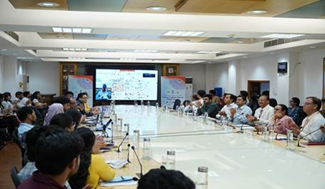
Context: NITI Aayog launched the Central Prabhari Officer (CPO) Portal to enhance real-time monitoring of last-mile delivery of welfare schemes.
-
- Purpose: To bridge the feedback loop between the Centre, States, and District administrations.
- Mechanism: It provides a structured chain from ground-level observation to central oversight.
- Focus Areas: Priority given to health, nutrition, and education outcomes in backward districts.
- Data-Driven: Aligns with the Digital India and DBT (Direct Benefit Transfer) architecture.
- Regional Development: Aims to localise Sustainable Development Goals (SDGs) at the block level.
- Accountability: Ensures decisions and ground-level outcomes are traceable in real-time.
- Governance Shift: Moves from periodic reporting to continuous data-driven supervision.
- New Members: R. Balasubramaniam and Dr. Joram Aniya were recently appointed as full-time members to oversee such initiatives.
- Efficiency: Designed to reduce leakages and duplication in public expenditure.
- Federal Cooperation: Strengthens administrative responsiveness within India’s multi-tier federal system.
(PIB)
International Relations
West Asia War and Energy Security:
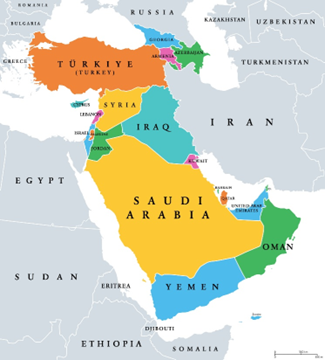
Context: The Ministry of Petroleum & Natural Gas held an inter-ministerial briefing on developments in West Asia and their impact on Indian seafarers and energy supplies.
-
- Seafarer Safety: No incidents involving Indian-flagged vessels were reported in the past 48 hours despite regional tensions.
- Repatriation: The Indian Embassy in Tehran facilitated the movement of 2,520 Indian nationals via land routes.
- Energy Prices: Middle East tensions drove global oil and gold prices higher on May 6.
- LPG Supply: Strategic provision made for LPG pool molecules to support the Pharma and Chemical sectors amidst supply chain risks.
- Operational Readiness: PSU OMCs (Oil Marketing Companies) organized awareness camps for 5kg FTL cylinders to ensure local energy access.
- Decriminalization: The passage of the Jan Vishwas Bill 2026 was noted for improving ease of doing business in volatile sectors.
- Maritime Security: US forces repelling attacks in the Strait of Hormuz remained a critical watch-point for Indian oil tankers.
- Inflation Concerns: Rising energy prices due to the West Asia conflict are being monitored for their impact on domestic CPI (Consumer Price Index).
- India’s Stance: Prime Minister Modi reiterated support for peace and condemned drone attacks in the UAE.
- Strategic Reserves: Ongoing discussions on the status of India’s Strategic Petroleum Reserves (SPR) to buffer against supply shocks.
(ET)
India-Vietnam Comprehensive Strategic Partnership:
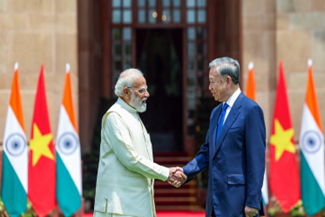
Context: Prime Minister Narendra Modi and Vietnamese President To Lam held bilateral talks in New Delhi, signing 13 MoUs to deepen defense and trade ties.
-
- Significance: Vietnam is a key pillar of India’s Act East Policy and a critical partner in the Indo-Pacific region.
- Defense Cooperation: Discussions focused on maritime security, defense co-production, and strengthening the “Comprehensive Strategic Partnership”.
- Trade Relations: Both nations aim to enhance trade beyond the current portfolio, focusing on tech and logistics.
- UNSC Support: Vietnam and India often coordinate positions on international law, particularly the UN Convention on the Law of the Sea (UNCLOS).
- Regional Stability: The meeting underscored shared concerns over South China Sea stability.
- Infrastructure: Exploring collaboration in digital public infrastructure (DPI) and green energy.
- Cultural Links: Emphasis on Buddhist circuit tourism and archaeological restoration in Vietnam by India.
- Energy Security: Discussions on oil and gas exploration in Vietnam’s offshore blocks.
- Strategic Trust: The visit marked a milestone in the “Enhanced Comprehensive Strategic Partnership” established in earlier years.
- Outcomes: 13 MoUs were exchanged covering various sectors including defense, logistics, and technology.
(ET)
Economy
Fair and Remunerative Price (FRP) for Sugarcane:
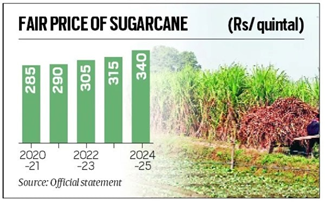
Context: The Union Cabinet approved the FRP of ₹365/qtl for sugarcane for the 2026-27 season.
-
- Statutory Status: FRP is the minimum price that sugar mills have to pay to farmers, determined under the Sugarcane (Control) Order, 1966.
- Calculation: Based on the recommendation of the Commission for Agricultural Costs and Prices (CACP).
- Sugar Season: Typically runs from October to September.
- Ethanol Blending: FRP helps ensure a steady supply of cane for India’s Ethanol Blended Petrol (EBP) Programme.
- Recovery Rate: The price is linked to a basic recovery rate (e.g., 10.25%), with premiums for higher recovery.
- Mandatory Payment: Mills are legally bound to pay FRP within 14 days of delivery.
- State-Advised Price (SAP): Some states like UP and Punjab declare their own SAP, which is usually higher than the FRP.
- Global Prices: Domestic FRP is kept competitive to ensure sugar exports remain viable.
- Sustainability: Increasing FRP aims to insulate farmers from rising input costs like fertilizers and fuel.
- Consumer Impact: FRP adjustments often influence the retail price of sugar and ethanol-linked energy costs.
(DD)
Emergency Credit Line Guarantee Scheme (ECLGS) 5.0:
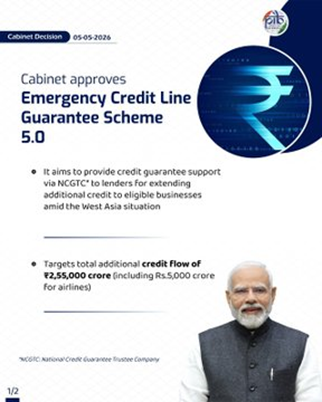
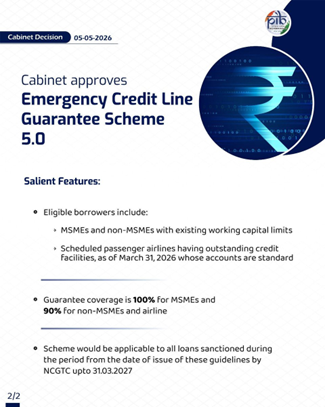
Context: The Union Cabinet approved ECLGS 5.0, a ₹5,000 crore initiative providing 100% government-backed credit guarantees to support MSMEs and the aviation sector, which are facing distress due to rising fuel costs and supply chain shocks linked to the West Asia conflict.
-
- Focus Sectors: Targets MSMEs and the Aviation sector.
- Financial Support: The initiative has a targeted lifeline of ₹5,000 crore.
- Government Guarantee: Provides 100% government-backed credit guarantees to lenders.
- Objective: Mitigate the impact of rising fuel costs and supply chain shocks.
- Implementation: Managed by the National Credit Guarantee Trustee Company Limited (NCGTC).
- Key Features: Capped interest rates and zero guarantee fees.
- NPA Mitigation: Encourages lending by reducing risk for banks.
- Sovereign Guarantee: Provides total backing for loans.
- Energy Impact: Aviation sector faces pressure from a 56% YoY increase in India’s crude oil basket.
- Macro Relevance: Supports MSMEs, which contribute roughly 30% to India’s GDP.
(ET)
Geography, Mapping, Ecology & Environment and DM
Kamala HEP and Arunachal Projects:
Context: The Ministry of Power provided updates on major hydropower projects in the Northeast, including the Subansiri Lower and Kamala HEP.
-
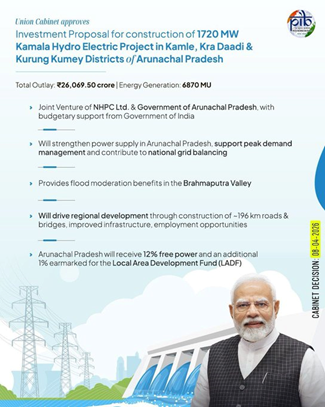
- Kamala HEP: Located in Kamle district, Arunachal Pradesh; aims to provide 12% free power to the host state.
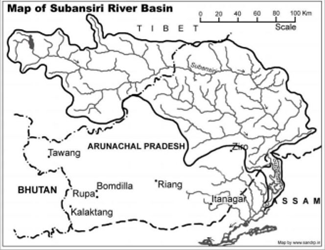
- Subansiri Lower (2000 MW): Confirmed to be at an advanced stage with 750 MW already commissioned; full commissioning expected by December 2026.
-
- Dibang Multipurpose (2880 MW): Part of the strategic infrastructure push in Arunachal Pradesh.
- Etalin (3097 MW): One of India’s largest upcoming hydropower ventures.
- Local Area Development Fund (LADF): Projects must earmark 1% of revenue for local district development.
- Infrastructure Impact: Includes construction of 196 km of roads and bridges primarily for local use.
- Socio-Economic Benefits: Targeted hospitals and schools funded through project CSR.
- Trans-Boundary Water: These projects are critical for India’s water management and strategic presence in the Northeast.
- NHPC Limited: The primary executing agency for these multipurpose projects.
- Strategic Significance: Arunachal’s potential for “Green Power” is central to India’s Net Zero 2070 goals.
(ET)
Science & Technology
LEO Satellite Communications:
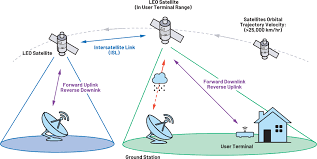
Context: Reliance Industries (Jio Platforms) is planning a multi-billion dollar investment in Low Earth Orbit (LEO) satellites.
-
- Competitors: The move pits Jio against global players like Starlink and Amazon Kuiper.
- Tech Advantage: LEO satellites (500-2,000 km altitude) offer lower latency compared to traditional Geostationary satellites.
- Connectivity: Aimed at providing high-speed internet to remote and “blackout” regions in India.
- Strategic Autonomy: Aligns with India’s goal for a robust domestic satellite communication (Satcom) presence.
- Spectrum Allocation: A key regulatory debate continues regarding whether Satcom spectrum should be auctioned or administratively allocated.
- Space Policy: Supported by the Indian Space Policy 2023, which encourages private sector participation.
- Mission Drishti: Recently launched by startup GalaxEye, highlighted by the PM, showing a growing domestic space tech ecosystem.
- Security: LEO constellations are critical for secure strategic communications and disaster management.
- Data Sovereignty: Localizing satellite data processing within Indian jurisdictions.
- Infrastructure Integration: Satcom will complement 5G/6G terrestrial networks for seamless connectivity.
(ET)
Important data/facts
Economy
India’s Export Milestone (FY 2025-26):
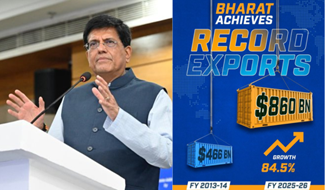
Context: Revised data from the Commerce Ministry shows India’s total exports hit an all-time high of $863.11 billion in FY26.
-
- Growth: A 4.6% increase from the previous fiscal year’s $825.26 billion.
- Merchandise Exports: Reached $441.78 billion, showing resilience despite global trade headwinds.
- Services Sector: Services exports were the primary driver, reaching a record peak (specific figure to be finalized in full reports).
- Global Context: Growth occurred amidst high interest rates in developed markets and geopolitical uncertainties.
- Tech Exports: High-end technology and engineering goods contributed significantly to the merchandise basket.
- Pharma & Chemicals: Remained key pillars of India’s export resilience.
- Trade Balance: While exports rose, the government continues to monitor the trade deficit impact from energy imports.
- Logistics Efficiency: Success attributed partly to the PM Gati Shakti and National Logistics Policy improvements.
- Future Target: India aims for $2 trillion in total exports by 2030.
- Sectoral Performance: Engineering and gems/jewelry sectors showed steady trajectories despite price fluctuations.
(News on AIR)
Spread the Word