
Indian Polity & Governance
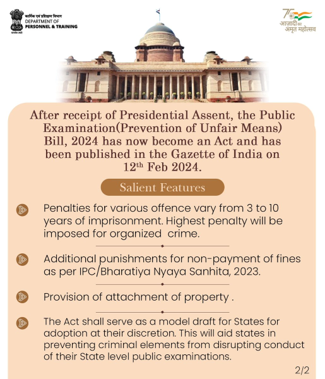
Public Examinations (Prevention of Unfair Means) Act, 2024:
Context: Discussions around paper leaks and exam reforms highlighted strict enforcement measures under the Anti-Paper Leak central legislation.
-
- Nodal Ministry: Ministry of Personnel, Public Grievances and Pensions (Department of Personnel and Training).
- Scope of Act: Covers public examinations conducted by UPSC, SSC, RRBs, IBPS, NTA, and central government ministries/departments.
- Offences Defined: Leakage of question papers, unauthorized access to question banks, impersonation, tampering with computer networks, and fake websites.
- Cognizable & Non-Bailable: Offences under the law are cognizable, non-bailable, and non-compoundable.
- Penal Provisions for Individuals: Imprisonment from 3 to 5 years and a fine up to ₹10 lakh.
- Penal Provisions for Organized Crime: Imprisonment from 5 to 10 years and a minimum fine of ₹1 crore.
- Service Provider Liability: Service providers (e.g., tech vendors) involved in paper leaks face fines up to ₹1 crore and recovery of examination costs.
- Attachment of Property: Provisions exist for attachment and forfeiture of property belonging to organized crime syndicates.
- Investigating Authority: Officers not below the rank of Deputy Superintendent of Police (DSP) or Assistant Commissioner of Police (ACP) investigate cases.
- National Technical Advisory Committee: Recommends technological safeguards for secure online/computer-based test processes.
(TH)
Union Council of Ministers & Constitutional Provisions:
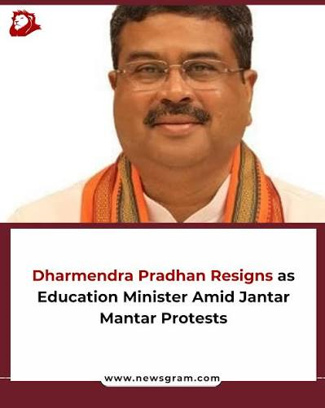
Context: Following public demonstrations, the Union Minister of Education tendered his resignation, bringing focus to the constitutional mechanics governing the Union Council of Ministers.
-
- Constitutional Mandate: Article 74(1) provides for a Council of Ministers (CoM) with the Prime Minister as the head to aid and advise the President.
- Appointment & Tenure: Under Article 75(1), the PM is appointed by the President, and other Ministers are appointed by the President on the advice of the PM.
- Pleasure of the President: Under Article 75(2), ministers hold office during the pleasure of the President.
- Collective Responsibility: Article 75(3) specifies that the CoM is collectively responsible to the Lok Sabha (not Parliament as a whole).
- Individual Responsibility: A Minister is individually responsible to the President and can be removed by the President on the Prime Minister’s recommendation.
- Resignation Mechanism: A Minister tenders resignation addressed to the Prime Minister, who forwards it to the President for formal acceptance.
- Size Limit: The 91st Constitutional Amendment Act, 2003, capped the total number of ministers (including PM) at 15% of the total strength of the Lok Sabha.
- Ministerial Advice: Advice tendered by Ministers to the President shall not be inquired into in any court (Article 74(2)).
- Non-Member Provision: A person who is not a member of either House can be appointed as a minister, but must be elected/nominated within 6 months (Article 75(5)).
(TH)
International Relations
India-Romania Bilateral & Strategic Relations:
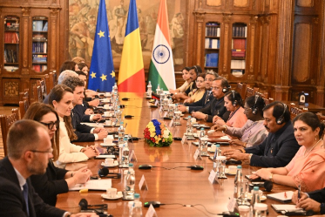
Context: High-level diplomatic engagements took place between India and Romania aimed at expanding bilateral cooperation in Eastern Europe.
-
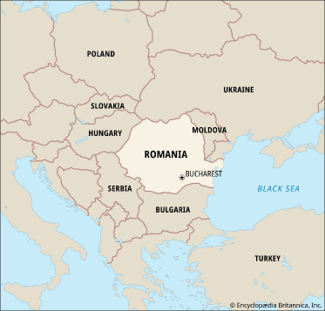
- Geographic Location: Romania is an Eastern European nation bordering the Black Sea, Ukraine, Moldova, Bulgaria, Serbia, and Hungary.
- Capital & Major River: Capital is Bucharest; the Danube River forms its southern border and empties into the Black Sea.
- Strategic Gateway: Acts as a maritime transit hub for Central Europe via the Black Sea Port of Constanța.
-
- Multilateral Alliances: Member of the European Union (EU) and NATO.
- Three Seas Initiative (3SI): Active participant in 3SI (Baltic, Black, Adriatic Seas) focusing on regional infrastructure and energy connectivity.
- Operation Ganga (2022): Romania served as a vital evacuation hub for Indian students returning from Ukraine.
- Defence Cooperation Agreement: India and Romania signed a Defence Cooperation Agreement in 2023 covering military education, technology transfer, and joint training.
- Economic Synergies: Key areas include IT, pharmaceuticals, automotive components, and renewable energy.
- International Solar Alliance (ISA): Romania signed the Framework Agreement to join ISA as a full member.
- Cultural Ties: Long-standing Indology tradition at the University of Bucharest; historic linkage with Mihai Eminescu’s literature.
(IE)
Maritime Security & International Law in Conflict Zones:
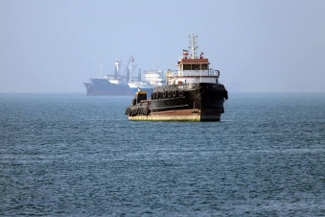
Context: An attack on a commercial merchant vessel in the Black Sea highlighted freedom of navigation concerns and safety protocols for Indian seafarers in geopolitical conflict zones.
-
- UNCLOS 1982: United Nations Convention on the Law of the Sea defines maritime zones: Internal Waters, Territorial Sea (12 NM), Contiguous Zone (24 NM), and Exclusive Economic Zone (EEZ – 200 NM).
- Freedom of Navigation (FoN): Applicable in high seas and EEZs under UNCLOS Article 87.
- Montreux Convention (1936): Regulates maritime traffic through the Turkish Straits (Bosphorus and Dardanelles), giving Turkey control over naval passage into the Black Sea.
- Black Sea Geography: Bordered by 6 countries: Turkey, Bulgaria, Romania, Ukraine, Russia, and Georgia.
- Right of Innocent Passage: Applies to foreign ships traversing a coastal State’s territorial sea as long as it is not prejudicial to peace or security.
- High-Risk Areas (HRA): Designated by the Joint War Committee (JWC) of the London maritime insurance market to regulate shipping insurance premiums.
- International Maritime Organization (IMO): Specialized UN agency responsible for regulating shipping safety, security, and marine pollution.
- Directorate General of Shipping (DGS): Statutory body under Ministry of Ports, Shipping and Waterways enforcing seafarer safety norms in India.
- IMPACT/MARSEC Levels: Maritime security alert levels (1, 2, and 3) set standard security protocols for merchant ships entering volatile waters.
- MADRAS / MADAGASCAR / IFC-IOR: Information Fusion Centre – Indian Ocean Region (IFC-IOR) monitors real-time maritime domain awareness (MDA).
(IE)
Geography
Ken-Betwa River Link Project:
Context: Recent developments and environmental oversight meetings highlighted updates regarding the implementation of the Ken-Betwa River Link Project (KBLP).
-
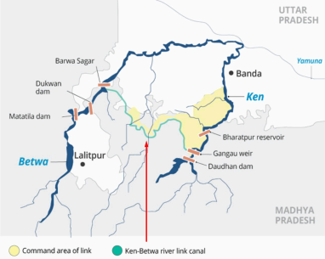
- First ILR Project: Ken-Betwa is the first major project under the National Perspective Plan for interlinking of rivers.
- Geography: Involves transferring surplus water from the Ken River to the water-deficit Betwa River in the Bundelkhand region (MP and UP).
- Tributary Status: Both Ken and Betwa are right-bank tributaries of the Yamuna River.
- Origin: Ken originates in the Ahirawan/Vindhya range (Katamgi, MP); Betwa originates in the Vindhya Range (Raisen, MP).
- Key Components: Involves construction of the Daudhan Dam and a canal linking the two river basins.
- Impact on Protected Areas: The project submerges a portion of Panna Tiger Reserve (Madhya Pradesh).
- Implementation Agency: Executed by the Ken-Betwa Link Project Authority (KBLPA), a Special Purpose Vehicle (SPV).
- Beneficiary Districts: Covers drought-prone areas across MP (Chhatarpur, Tikamgarh, Panna) and UP (Banda, Mahoba, Jhansi).
- National Water Development Agency (NWDA): The apex agency tasked with formulating interlinking proposals under the Ministry of Jal Shakti.
- NCT / Inter-State Aspect: Inter-State agreement signed between MP, UP, and the Union Government in 2021.
(DTE/TH)
Science & Technology
Quantum Finance Hub & Amaravati Quantum Valley:
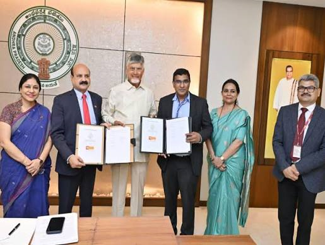
Context: Punjab National Bank and the Government of Andhra Pradesh signed an MoU to establish India’s first bank-led Quantum Finance Hub at Amaravati Quantum Valley.
-
- Concept: Quantum Finance applies quantum computing and algorithms to complex financial tasks (e.g., risk modeling, fraud detection, high-frequency trading).
- National Quantum Mission (NQM): Approved in 2023 by DST with an outlay of ₹6,003 crore (2023-31) to build intermediate-scale quantum computers (50-1000 qubits).
- Four Thematic Hubs (T-Hubs) under NQM:
-
-
- Quantum Computing
- Quantum Communication
- Quantum Sensing & Metrology
- Quantum Materials & Devices
-
-
- Quantum Key Distribution (QKD): A secure communication technique that uses quantum mechanics to exchange encryption keys, preventing eavesdropping.
- Quantum Superposition: Property allowing qubits to exist in states of 0, 1, or both simultaneously, dramatically increasing processing speed.
- Quantum Entanglement: Interconnected states between particles where measuring one instantly affects the other regardless of distance.
- Post-Quantum Cryptography (PQC): Development of cryptographic algorithms resistant to attacks by future fault-tolerant quantum computers.
- Amaravati Quantum Valley (AQV): A dedicated state-led initiative to foster a quantum tech ecosystem in Andhra Pradesh.
- Interdisciplinary Cyber-Physical Systems (NM-ICPS): Broader parent mission framework supporting frontier tech research.
- FinTech Security Application: QKD and PQC ensure unbreakable encryption for inter-bank communications and core banking systems (CBS).
(TH)
Chandipura Virus Encephalitis (CHPV):
Context: Health authorities intensified surveillance across states following reports of Chandipura virus cases triggering Acute Encephalitis Syndrome (AES).
-
- Causative Agent: Chandipura virus (CHPV) belongs to the genus Vesiculovirus of the family Rhabdoviridae.
- Primary Vector: Transmitted mainly by phlebotomine sandflies (Phlebotomus argentipes); mosquitoes like Aedes can also act as vectors.
- First Discovery: First isolated in 1965 during an outbreak in Chandipura village, Maharashtra.
- Clinical Manifestation: Causes rapid onset of fever, vomiting, and Acute Encephalitis Syndrome (AES), leading to high mortality rates in children under 15.
- Target Organ: Mainly affects the Central Nervous System (CNS), causing inflammation of the brain tissue.
- Treatment Availability: No specific antiviral drug or licensed human vaccine exists; treatment is strictly supportive and symptomatic.
- Diagnostic Test: Confirmed using RT-PCR or ELISA tests developed by ICMR-National Institute of Virology (NIV), Pune.
- Vector Control: Controlling sandfly breeding using indoor residual spraying of insecticides (like synthetic pyrethroids).
- Host Range: Humans are accidental dead-end hosts; vector resides in cracks and crevices of mud houses.
- Epidemiological Pattern: Outbreaks predominantly occur during the monsoon and immediate post-monsoon seasons when vector density peaks.
(IE)
Defense
‘Samudra Pradakshina’ Expedition:
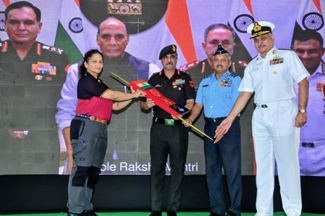
Context: The Union Defence Minister flagged in ‘Samudra Pradakshina’, India’s first-ever Tri-Service all-women circumnavigation sailing expedition.
-
- First-Ever Tri-Service Expedition: Crew comprised officers combined from the Indian Army, Indian Navy, and Indian Air Force.
- Vessel Used: IASV Triveni (Indian Army Sailing Vessel).
- Voyage Footprint: Covered 25,500 nautical miles over 314 days across four major oceans.
- Starting & Ending Port: Flagged off and completed at Mumbai, Maharashtra.
- Key Ocean Capes Crossings: Crossed the Great Capes – Cape Leeuwin (Australia), Cape Horn (South America), and Cape of Good Hope (Africa).
- Predecessor Expeditions: Follows the Navy’s Navika Sagar Parikrama (INSV Tarini) expeditions.
- Sailing Rules: Operates under unassisted circumnavigation norms (passing the equator twice, crossing all meridians, no artificial canals used).
- Objective: Promotes gender inclusion in armed forces, jointness across three services, and maritime adventure.
- Indigenously Built: Reflects push for indigenous marine manufacturing and seamanship training.
- Nodal Ministry: Ministry of Defence (MoD).
(PIB)
Defence Reforms & Indigenisation:
Context: Ahead of the 27th Kargil Vijay Diwas (26 July), the Ministry of Defence released key updates regarding defence structural reforms and indigenisation milestones.
-
- Kargil Review Committee: Recommendations led to major structural changes in higher defence management, including the post of Chief of Defence Staff (CDS).
- Department of Military Affairs (DMA): Created in 2019 under the Ministry of Defence, headed by the CDS serving as ex-officio Secretary.
- Role of CDS: Four-star General acting as Principal Military Advisor to the Raksha Mantri and head of the DMA.
- Positive Indigenisation Lists (PILs): Items listed cannot be imported after designated deadlines and must be procured locally.
- SRIJAN Portal: An online portal launched to enable Defence Public Sector Undertakings (DPSUs) to partner with private vendors for indigenisation.
- iDEX (Innovations for Defence Excellence): Provides seed funding and incubation support to startups and MSMEs for defence technology.
- Defence Industrial Corridors (DICs): Two corridors established in Uttar Pradesh and Tamil Nadu to boost local supply chains.
- Gallantry Awards Hierarchy: Param Vir Chakra (PVC) is India’s highest military decoration for war-time valor, followed by Maha Vir Chakra (MVC) and Vir Chakra (VrC).
- Capital Procurement Budget: A specific percentage (over 75%) of the defence capital acquisition budget is reserved for domestic industry.
- Joint Theatre Commands: Ongoing reform led by the DMA to integrate Army, Navy, and Air Force operational commands.
(PIB)
Government Schemes & Initiatives
BHAVYA Rasayan – Chemical Parks Scheme:
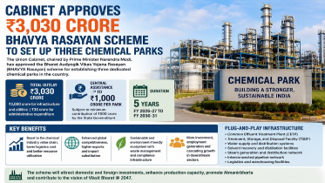
Context: The Union Cabinet approved the Bharat Audyogik Vikas Yojana Rasayan (BHAVYA Rasayan) scheme with a total outlay of ₹3,030 crore to set up three dedicated Chemical Parks.
-
- Nodal Ministry: Ministry of Chemicals and Fertilizers (Department of Chemicals and Petrochemicals).
- Tenure & Outlay: Implemented over 5 years (FY 2026–27 to FY 2030–31) with an outlay of ₹3,030 crore.
- Funding Pattern: Central grant of up to ₹1,000 crore per park; participating State Governments must contribute a minimum of ₹500 crore per park.
- Selection Route: States will be selected via a competitive Challenge Route.
- Land Requirement: Minimum contiguous land area required is 8 sq. km (800 hectares) per park.
- Plug-and-Play Infrastructure: Provides shared utilities including Common Effluent Treatment Plants (CETP), Treatment, Storage & Disposal Facilities (TSDF), and solvent recovery systems.
- Predecessor Comparison: Unlike the broader Petroleum, Chemicals and Petrochemicals Investment Regions (PCPIRs) of 2007, BHAVYA Rasayan is smaller-scale and explicitly focused on hazardous-waste compliance infrastructure.
- Economic Significance: The chemical sector is an upstream supplier to agriculture, pharmaceuticals, electronics, and automotive manufacturing.
- Global Benchmark: Modeled after international cluster concepts like Germany’s Verbund parks and China’s dedicated chemical zones.
- Policy Alignment: Direct convergence with Aatmanirbhar Bharat to curb import reliance on specialized chemicals.
(PMO/TH)
Spread the Word