ANS.
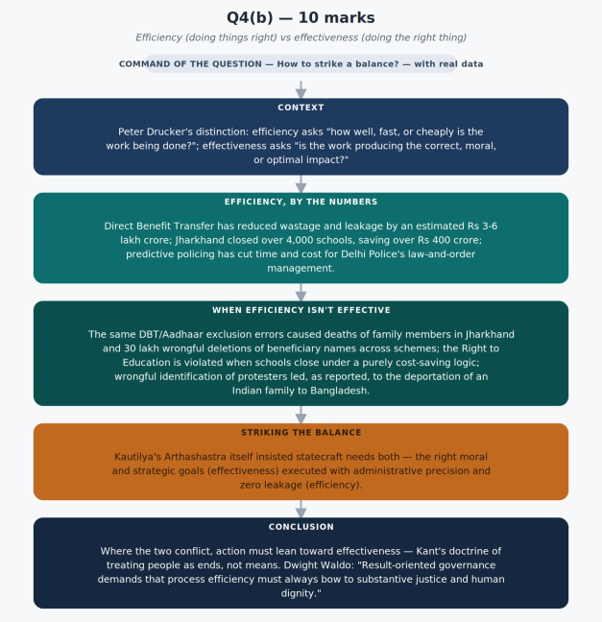
STRUCTURE
1. Explain the statement CONTEXT in brief
2. Then Explain both Efficiency is doing things right, while effectiveness doing right things with examples
3. Show synthesis
4. Conclusion with a philosophy or quote
THE CONTEXT (INTRODUCTION)
Both efficiency and effectiveness are considered the two principles of pub,ic administration by Peter Drucker.
Efficiency focuses on the means and processes of an action. It is the ability to accomplish a task with minimal expenditure of time, effort, energy, financial resources, or materials. It asks: “How well, fast, or cheaply is the work being done?”
Effectiveness focuses on the ends, outcomes, and strategic goals of an action. It is the degree to which an objective is achieved and produces the intended or desired result. It asks: “Is the work being done producing the correct, moral, or optimal impact?”
BODY
| Efficiency | Effectiveness |
|---|---|
| 1. DBT has reduced wastage and leakage: Rs 3-6 lakh crore 2. Jharkhand has closed over 4k schools and has saved over 400 crore 3. Predictive policing has reduced time and cost consumption for police in law and order management-Delhi police | 1. Death of a family members in Jharkhand and 30 lakh deletions of names of beneficiaries of all schemes 2. Right to education is violated when education is denied by closing schools-capability approach 3. Wrongful identification of protesters as highlighted by India Express and deportation of one Indian family to Bnagladesh. |
Synthesis
Both are important and can play complement to each other.
Kautilya: In the Arthashastra, Kautilya stressed that statecraft requires a balance: the administration must select the right moral and strategic goals (effectiveness), but must execute tax collection, infrastructure, and intelligence operations with administrative precision and zero leakage (efficiency).
CONCLUSION:
Even if both have relevance but action of state must be more aligned to effectiveness-doctrine of humanity of Kant.
“Result-oriented governance demands that process efficiency must always bow to substantive justice and human dignity.” — Dwight Waldo
Spread the Word