
ANS.
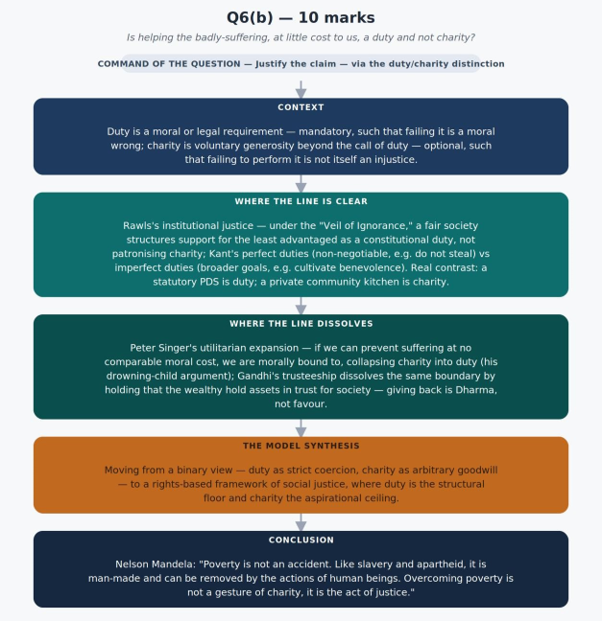
STRUCTURE
1. Start with duty and charity and explain differences
2. Then link to philosophers’
3. Synthesis
4. Conclusion with a philosophy or quote
INTRODUCTION
Duty is a moral or legal requirement that dictates how one must act. Duty is mandatory; failing to fulfil a moral duty constitutes a moral wrong or a breach of justice.
Charity is an act of voluntary kindness or generosity that goes beyond the call of duty. Charity is optional; performing it is praiseworthy, but failing to perform it is not considered a moral violation or an act of injustice.
| Dimension | Moral Duty (Obligation) | Charity (Supererogation) |
|---|---|---|
| Moral Requirement | Mandatory: Omission results in a moral wrong or injustice. | Optional: Omission is morally neutral, though commission is praised. |
| Status of Recipient | The recipient is a rights-holder entitled to support or fair treatment. | The recipient is a beneficiary reliant on the donor's goodwill. |
| Philosophical Basis | Grounded in Deontology, Rights Theory, and Structural Justice. | Grounded in Voluntarism, Altruism, and Individual Generosity. |
| Institutional View | Enforced through constitutional rights, legal welfare, and social justice. | Conducted through private philanthropy, NGOs, and voluntary donations. |
Examples:
-
- Right to Food Food Drives:
- Duty: A government running a statutory Public Distribution System (PDS) to ensure food security under the Right to Life (Article 21). Providing rations to eligible citizens is a legal and constitutional duty of the state.
- Charity: A private civil society group running a community kitchen or food drive during a holiday. It is an act of voluntary goodwill, but not a legal obligation.
- Right to Food Food Drives:
-
- Corporate Social Responsibility (CSR):
- Duty: A corporation strictly complying with environmental protection laws, paying fair living wages, and paying taxes without tax evasion.
- Charity: A corporation donating a portion of its net profits to build a community park or fund sports scholarships.
- Corporate Social Responsibility (CSR):
-
- Disaster Relief & Healthcare:
- Duty: An attending emergency room doctor treating a critical patient brought into the casualty ward. The doctor has a professional and legal duty of care.
- Charity: A doctor volunteering medical services during a humanitarian crisis in another country during their personal leave.
- Disaster Relief & Healthcare:
| Clear distinction | Lack of distinction |
|---|---|
| John Rawls’ Institutional Justice (Duty First): Rawls posits that justice is the first virtue of social institutions. Under his "Veil of Ignorance," a fair society structures its basic systems so that supporting the least advantaged is a constitutional and legal duty, ensuring citizens receive assistance as a matter of right, not as patronizing charity. Immanuel Kant’s Perfect vs. Imperfect Duties: Kant separates strict, non-negotiable prohibitions (perfect duties, e.g., do not steal) from broader moral goals (imperfect duties, e.g., cultivate benevolence). The model synthesis treats systemic welfare as a "perfect duty" of the state, while encouraging individual benevolence as an "imperfect duty" that elevates personal character. | • Peter Singer’s Utilitarian Expansion (Elevating Charity to Duty): Singer argues that if it is in our power to prevent something bad from happening without sacrificing anything of comparable moral importance, we are morally bound to do it. The synthesis adopts this by redefining excess wealth and social capital not as assets for arbitrary gifting, but as resources subject to a moral duty of redistribution. • Mahatma Gandhi’s Philosophy of Trusteeship (Synthesis through Responsibility): Gandhi dissolved the boundary between duty and charity by asserting that the wealthy hold assets on trust for society. Giving back is neither a favour nor optional charity; it is Dharma—a solemn duty to restore social equilibrium and dignity to the marginalized |
The model synthesis
The model synthesis between Duty and Charity lies in transitioning from a traditional, binary view—where duty is seen as strict coercion and charity as arbitrary goodwill—to a Rights-Based Framework of Social Justice.
CONCLUSION
In an optimal ethical, legal, and administrative model, duty and charity are not opposing forces; rather, duty serves as the structural floor, while charity acts as the aspirational ceiling.
“Poverty is not an accident. Like slavery and apartheid, it is man-made and can be removed by the actions of human beings. Overcoming poverty is not a gesture of charity, it is the act of justice.” — Nelson Mandela
Spread the Word