
ANS.
STRUCTURE
1. Explain the CONTEXT in brief
2. Then explain how the District Magistrate can act as empathy versus compliance with rules
3. Conclusion with a philosophy or quote
THE CONTEXT (INTRODUCTION)
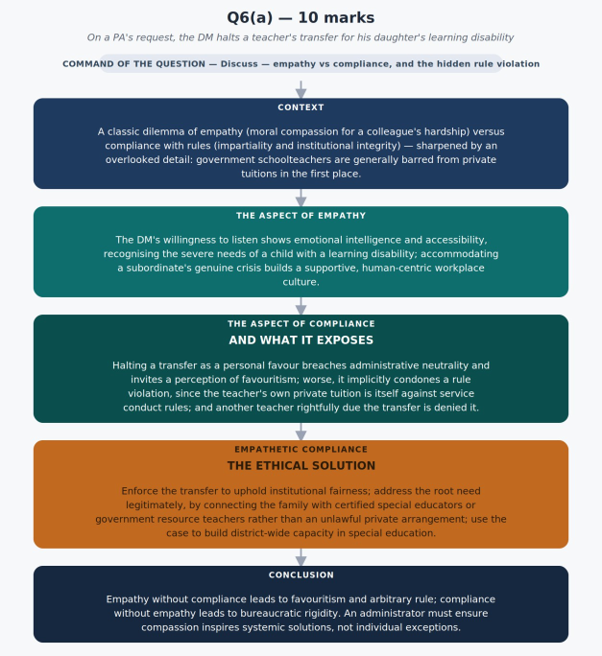
This scenario presents a classic administrative dilemma involving a conflict between empathy (moral compassion toward a colleague’s personal hardship) and compliance with rules (impartiality and institutional integrity).
“Education is the most powerful weapon which you can use to change the world… and the teacher is the heart of that transformation.”— Nelson Mandela
Analysis of the DM’s Action
1. The Aspect of Empathy
-
- Compassionate Governance: The DM’s willingness to listen to his PA demonstrates emotional intelligence and accessibility. He recognizes the severe emotional and developmental needs of a child with a learning disability.
- Supportive Workplace Culture: By accommodating a subordinate’s genuine crisis, the DM builds organizational loyalty and reflects human-centric leadership.
“A civil servant must be guided by a real spirit of service… Treat the common man as your own, and you will never go wrong.”— Sardar Vallabhbhai Patel
2. The Aspect of Compliance with Rules
-
- Conflict of Interest & Nepotism: Halting an administrative transfer based on a personal favour for a staff member breaches administrative neutrality, creating a perception of favouritism.
- Validation of Illegal/Unethical Practice: Schoolteachers in government service are generally prohibited from conducting private tuitions. By rewarding the teacher with a transfer cancellation, the DM implicitly condones a violation of service rules.
- Erosion of Equal Opportunity: Another teacher eligible for transfer or replacement may be denied their rightful administrative placement due to this arbitrary intervention.
“Civil service neutrality is akin to the rule of law”-Max Weber.
Justification support:
-
- Under Section 28 of the Right of Children to Free and Compulsory Education (RTE) Act, 2009, there is a statutory ban on government school teachers engaging in private tuition or private coaching.
- The J&K Education Department issued strict notifications debarring government school teachers from running private tuition centers or providing paid coaching at home.
- The Bihar government issued strict directives explicitly prohibiting government school teachers from conducting private coaching classes or engaging with private tuition centers.
Striking the Ethical Balance
True administrative leadership does not mean choosing empathy over rules, nor cold rules over empathy. It requires empathetic compliance—using legitimate mechanisms to solve personal problems without compromising administrative integrity.
| Dimension | Rule Bypass (DM's Current Choice) | Empathetic Compliance (Ethical Solution) |
|---|---|---|
| Integrity | Compromised by granting personal favors. | Preserved by applying rules uniformly. |
| Private Tuitions | Indirectly endorsed/sanctioned. | Discouraged; official avenues used instead. |
| Child's Needs | Met through illegal/informal means. | Met through legitimate, formalized support. |
Alternative Course of Action for the DM
1. Enforce the Transfer: Proceed with the teacher’s transfer to uphold institutional fairness, public policy on private tuitions, and rule-based governance.
2. Address the Root Need Legitimately: Assist the PA through official channels—such as connecting them with certified special educators, government-appointed resource teachers, or civil society organizations specializing in learning disabilities.
3. Institutional Capacity Building: Use this case as a signal to improve specialized educational infrastructure for neurodivergent children within the district so no parent has to rely on informal tuitions.
CONCLUSION:
Empathy without compliance leads to favouritism and arbitrary rule, while compliance without empathy leads to bureaucratic rigidity. An administrator must ensure that compassion inspires systemic solutions rather than individual exceptions.
As Dr. A. P. J. Abdul Kalam noted, “If a country is to be corruption free and become a nation of beautiful minds, I strongly feel there are three key societal members who can make a difference: the father, the mother, and the teacher.”
Spread the Word