PART-I: ANALYSIS & TRENDS
| Q.N. | THEME | CONTINUITY VS. CHANGE |
|---|---|---|
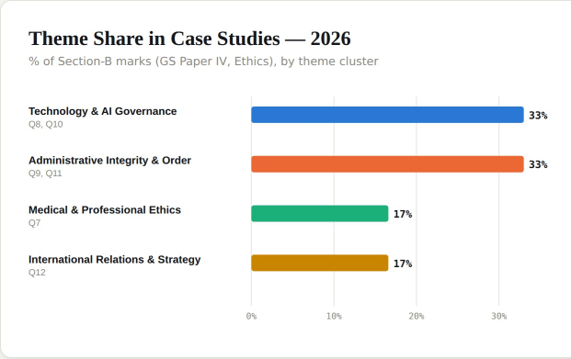
| 7 | Medical Ethics — Informed Consent & Patient Autonomy | CHANGE |
| 8 | AI & Predictive Policing | CHANGE |
| 9 | Corruption & Institutional Integrity | CONTINUITY |
| 10 | AI in Welfare Delivery | CHANGE |
| 11 | Ethnic Conflict & Administrative Neutrality | CONTINUITY |
| 12 | Ethics in International Relations | CONTINUITY |
SUB-QUESTIONS TRENDS
| 2013 | 2019 | 2022 | 2026 |
|---|---|---|---|
| (a) What are the options available to you? (b) Evaluate each of these options and choose the option you would adopt, giving reasons. | [Comprehensive Single Instruction]: Identify the ethical issues involved in this case. What options are available to the women employee? | (a) Under the given conditions, what are the options available to you as a member of the Inspecting Team? (b) Critically evaluate each of the options listed by you. (c) What option would you adopt and why? (d) What are the ethical dilemmas being faced by you? (e) What can be the consequences of overlooking the observations raised by the Inspecting Team? | (a) What are the ethical issues involved in this case? (b) Discuss the options open to Seema. Identify the recommended option and justify it. |
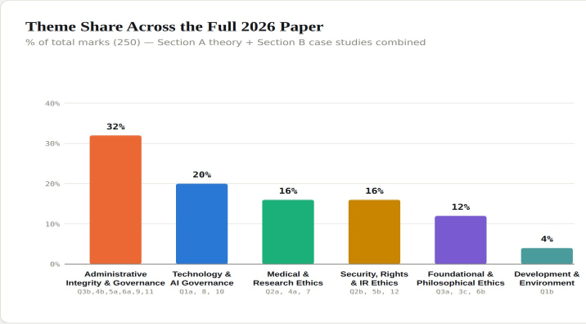
THEME-WISE MARKS WEIGHTAGE (2013–2026)
| Theme | 13 | 14 | 15 | 16 | 17 | 18 | 19 | 20 | 21 | 22 | 23 | 24 | 25 | 26 | Share (%) |
|---|---|---|---|---|---|---|---|---|---|---|---|---|---|---|---|
| Social Justice | 20 | - | 25 | - | - | 20 | - | - | - | 20 | - | - | - | 4.9% | |
| Civil Services | 40 | 40 | 20 | 65 | 40 | 80 | 60 | 20 | 20 | 40 | 40 | - | 20 | 40 | 30.4% |
| Dev-Env Conflict & Corp Governance | 45 | 20 | 20 | 65 | 60 | 20 | - | 100 | 100 | 40 | 60 | 60 | 20 | 35.0% | |
| Attitude / Emotional Intelligence | - | 40 | 40 | - | - | - | - | - | - | 40 | - | - | - | 7% | |
| Probity in Governance | 20 | 20 | 25 | - | 20 | - | 40 | - | - | - | 20 | - | 60 | 11.9% | |
| Ethics in IR | - | - | - | - | - | - | 20 | - | - | - | - | - | 20 | 20 | 3.5% |
| Technology - AI - Social Media/welf are/security | - | - | - | - | - | - | - | - | - | - | - | 60 | - | 40 | 5.8% |
| Bioethics | 20 | 1.2% | |||||||||||||
| TOTAL MARKS | 125 | 120 | 130 | 130 | 120 | 120 | 120 | 120 | 120 | 140 | 120 | 120 | 120 | 120 | 100% |
PART-II: CASE STUDIES MODEL ANSWER
CASE STUDY-7: THEME-BIOETHICS
Lata, a mother of two children, was admitted to a hospital for acute abdominal pain. Her sister-in-law, Sujatha, accompanied her. Dr. Mansi examined Lata and recommended a diagnostic laparoscopy. Lata’s consent was taken to conduct the medical procedure under general anesthesia.
During the laparoscopy, Dr. Mansi’s team discovered a tumour in Lata’s uterus. A closer examination suggested that the tumour could be malignant.
One option before Dr. Mansi was to extract a sample for biopsy. In that case, if the tumour was malignant, Lata would have to undergo another surgery for removal of the uterus. An alternative was to remove the uterus immediately.
Dr. Mansi had to take a quick decision. As Lata was under general anesthesia, Dr. Mansi explained the situation to Sujatha. Sujatha agreed with Dr. Mansi’s recommendations for a hysterectomy, wherein Lata’s uterus would be removed to avoid the risk and pain of undergoing another surgery. Dr. Mansi removed Lata’s uterus after receiving Sujatha’s consent in writing. Lata was informed of this the next day. She was very upset and felt betrayed as she had not consented to the removal of her uterus.
Lata complained to the police who tried to convince her that Dr. Mansi had acted with good intention to help a patient. Sujatha was of the same opinion, however Lata was not convinced and decided to approach the court.
a) Discuss the ethical issues involved in this case.
b) Discuss the moral conduct of the doctor in this situation.
ANS.
THE SCENARIO DESCRIPTION
The relationship between doctor-patient is guided by both regulatory provisions and bioethics which backbone is based on the four cardinal principles: Autonomy, Beneficence, Non-Maleficence and Justice. The morality of Dr. Mansi will be decided by weighing down these provisions and circumstances.
“As to diseases, make a habit of two things — to help, or at least, to do no harm.” — Hippocrates.
The stakeholders:
1. The doctor
2. The patient
3. The relatives
4. The hospital
5. The government
6. The medical board/commission
7. The society
OPTION A: THE ETHICAL ISSUES ARE:
1. Violation of informed consent & patient autonomy: Lata’s autonomy over her own body was bypassed without prior discussion regarding potential intra-operative contingencies. Common Cause case 2018 — Supreme Court explicitly recognized patient autonomy and bodily integrity as fundamental rights under Article 21
2. Beneficence vs. Paternalism: Mansi acted out of beneficence (aiming to save Lata from a potential second surgery and cancer risk), but executed it through medical paternalism—assuming the doctor knows best without respecting the patient’s self-determination.
3. Lack of legal validity of surrogate consent: Sujatha (sister-in-law) was neither Lata’s legally appointed healthcare proxy nor her legal It violated Supreme Court ruling in Samira Kohli case 2008.
4. Violation of circumstantial ethics: There was no Immediate Life-Threatening Emergency.
5. Right intention vs. rightness of action: Merely right intention is not enough for ethical justification.
6. Bodily integrity: Removal of the uterus carries lifelong physical and psychological consequences — too significant a decision to be delegated to a third party absent true urgency.
7. Breach of fiduciary trust: The doctor-patient relationship rests on trust; unilateral action, however well-meant, damages it — reflected in Lata’s sense of betrayal.
8. Essentialism Constructivism: Is health merely the absence of biological disease, or does it include complete social and mental well-being? Where does healing end and enhancement begin?
OPTION B: DISCUSSION ON THE MORAL CONDUCT OF THE DOCTOR
The discussion should take into consideration following legal and ethical framework:
1. Laws and rules governing the relationship between doctor-patient:
-
-
-
- Article 21 and case laws including Samira Kohli case 2028
- The Indian Medical Council (Professional Conduct, Etiquette and Ethics)
- SoP under medical science under such circumstances
- BNS section of bodily hurt
-
-
2. The four Principles of medical/bioethics
3. Moral reasoning based on theory of justice/Kantian duty ethics and utilitarian outcome orientation
The doctor conduct violates Samira Kohli case 2028
-
- Lack of life threatening circumstances: The doctor could have waited four thee patient to get Overriding consent is legally permissible only in an immediate life-threatening emergency where waiting for the patient to regain consciousness would result in death or irreparable harm.
- Taking surrogate consent is illegal: A doctor cannot rely on consent from a relative—including a sister-in-law or mother—when the patient is a competent adult, unless the relative is an legally appointed healthcare proxy.
- Consent for one procedure is not blanket consent: Consent provided for a diagnostic procedure (laparoscopy) cannot be treated as implied consent for a radical, life-altering surgical procedure (hysterectomy).
- Good intentions are not a legal defense: The court explicitly ruled that saving a patient time, pain, or money by carrying out an additional procedure during the same anesthesia session is not a valid legal defense for proceeding without informed consent.
From medical ethics, the role doctor is to save life but that doesn’t override autonomy and informed consent of the patient-Kerala HC judgement, Dr. T.T. Thomas 1987.
From philosophical perspective:
Doctor conduct has justification from utilitarian perspective that there is good outcome and if doctor could have conducted the similar act even in case of informed consent or the removal of the uterus invariably could not have been altered.
But from deontological and theory of justice perspective, doctor conduct is not ethical as doctor failed to show fairness in procedure as well as duty to adhere the medical ethics standards.
Resultantly, the conduct of doctor breaches both medical ethics and SC set judicial precedents for which the doctor may face legal consequences.
CONCLUSION
A doctor is supposed to exhibit absolute professional ethics in the age of awakened citizenry to act not in a paternalistic manner but more in a participatory manner with ‘Seva Bhav’-doctrine of service to humanity of Vivekananda.
“Wherever the art of Medicine is loved, there is also a love of Humanity.” — Hippocrates
CASE STUDY-8: THEME-PREDICTIVE POLICING
Ravi is a senior police officer with vast experience in riot control and cyber policing. Since one year, he has been the Superintendent of Police (SP) of a district with a history of frequent rioting.
Last year, Ravi had sought installation of an AI enabled software for predictive policing. This system has been operational for approximately six months. This new system employs advanced algorithms for capturing the biometric data of persons in a crowd and swiftly relating it to a data library. This has enabled the police to identify the persons involved in various crimes.
The system has identified an immigrant and low-income neighbourhood as a centre for gang violence and drug trafficking. Aided by this AI analysis, the local police has focused its patrolling, preventive detentions and establishing checkposts. Consequently, public order and law enforcement has visibly improved.
Last week, some community leaders, civil rights lawyers and human rights activists visited Ravi’s office. They submitted a memorandum that the new system is faulty as it is based on incorrect historical data caused by social biases and discriminatory policing. The memorandum also alleges that the increased surveillance has created a climate of tension amongst residents. This feeling is aggravated by the fact that the residents are not aware of the data noted against their names.
a) What are the ethical issues including biases involved in the use of AI in data-driven policing?
b) Place yourself in Ravi’s role and discuss the alternatives Justify the action that optimizes compliance with ethics. (250 words, 20 marks)
ANS.
THE SCENARIO DESCRIPTION
Data-driven governance has become a new norm to improve what Bentham will say efficiency on the one hand and stability and order in terms of his Panopticon concept. The SP seems to be following this Bentham call but at the same time one should know that humans cannot be treated merely as means-breaching doctrine of humanity of Kant.
Algorithms are opinions embedded in code.” — Cathy O’Neil, Weapons of Math Destruction
“Technology is a useful servant but a dangerous master.”— Christian Lous Lange The stakeholders:
1. The SP and police
2. The government
3. Community leaders, civil rights lawyers and human rights activists
4. The society
OPTION A: THE ETHICAL ISSUES ARE:
1. Breach of doctrine of humanity of Kant: Humans are being merely treated as means.
2. Bentham’s efficiency vs Orwellian dystopia: That efficiency becomes ground to justify compromise of rights of people having less faith in people, more in law.
3. Bentham’s Panopticon vs. Foucault’s Panopticism: The surveillance gets decentralised to control behaviour off people rathe rather than serving them.
4. Erosion of Contextual Judgment: Using AI matching as a primary ground for detention rather than doing thorough, empathetic human investigation reflects a civil servant prioritizing “automated convenience” over constitutional rights and individual liberty.
Example: During the investigation into the 2020 Northeast Delhi riots, the Delhi Police deployed Facial Recognition Technology (FRT) to identify suspects. Over 80% of cases relying on FRT that reached a verdict eventually ended in acquittal or discharge due to lack of actual corroborative evidence.
5. Historical/algorithmic bias: The system is trained on past arrest data reflecting years of discriminatory policing — “garbage in, garbage out” — so it reproduces and legitimises old prejudice as objective science.
6. Feedback loop/self-fulfilling prophecy: Increased patrolling based on flagged data generates more arrests in that neighbourhood, which further “confirms” the biased data — a vicious cycle of over-policing.
7. Violation of privacy: Covert capture of biometric data without informed consent violates the right to privacy under Article 21, as affirmed in S. Puttaswamy 2017.
8. Lack of transparency/”black box” accountability: Residents are unaware of data held against them, denying them any opportunity to contest it — a breach of natural justice.
9. Erosion of presumption of innocence: Preventive detention based on statistical correlation rather than individualised suspicion edges toward “pre-crime” policing, undermining due process under Article 21.
10. Chilling effect and trust deficit: Unconsented surveillance breeds fear and alienation, weakening community cooperation essential to effective policing.
11. Diffused accountability: When the algorithm errs, responsibility is unclear — the officer, the department, or the vendor — creating an accountability vacuum.
OPTION B: RAVI’S ROLE — ALTERNATIVES AND JUSTIFICATION
| Alternative | Compliance with ethics |
|---|---|
| 1. Continue as it is with grievance redressal | Technology works on utilitarian principles of GGGN but grievance redressal can minimise biasness |
| 2. Discontinue the AI system immediately and order a third party audit for review | Restores fairness and trust but sacrifices genuine crime-prevention gains and ignores that traditional policing carried its own biases too — an overcorrection. |
| 3. Adopt participatory approach with third party audit and safeguards-FRT with physical verification | • Retain predictive analytics strictly as a decision-support tool — never the sole basis for detention — with mandatory human oversight ("human-in-the-loop") • Periodic third-party bias audits, • A citizen's right to access and contest their own data, • A grievance-redressal mechanism, and structured community engagement. • AI Corrective tool to eliminate errors "AI must be guided by human values—compassion, ethics, and wisdom."— Fei-Fei Li |
Justification:
1. Predictive policing helps in creating relevant deterrence, efficiency and stability-Bentham/ Hobbes
2. Instead to discontinuing, it should be reviewed with algorithmic explanability, sand-box approach and community participation-Sen’s Nyaya bleded with Rawls’ Niti
3. Doctrine of proportionality: SC in Puttasawmy case didn’t completely strike means.
4. Law is the bottom line, ethics is ceiling-MLKJ
The response must be also take into consideration:
-
- Constitutional morality (Articles 14, 15, 21)
- AI Ethics and NITI Aayog’s Responsible AI principles — safety, fairness, non-discrimination, transparency, accountability and privacy
- DPDP 2023/BNS/Judicial precedents
- 7-Sutra of AIGG 2025
CONCLUSION
Predictive policing must remain an aid to human judgement, never a substitute for it. As Amartya Sen distinguishes in The Idea of Justice, true justice (Nyaya) lies not merely in the correctness of institutions and algorithms (Niti) but in the lived, felt fairness experienced by the last citizen on the street.
“The purpose of the machine is to serve man, not to transform man into a machine.”— E. F. Schumacher
CASE STUDY-9: THEME-CORRUPTION AND PROBITY IN GOVERNANCE
Seema is a senior bureaucrat with a reputation of honesty and professional efficiency. She has recently been posted as the District Collector (DC) to Surinder Nagar, where a large industrial area is being established.
The new industrial area had caused many farmers to submit applications for change of land use (CLU) to convert their farmlands into residential areas. There is an unusually large backlog of these applications awaiting processing. Seema noticed that some applications had been approved selectively with no visible chronological pattern. The case files showed a few complaints of some approvals being subject to receipt of large bribes from the applicants.
On further fact-finding, Seema realized that a small group of touts was controlling this illegal activity through some subordinate officials in the Collectorate. This had created a fear in the other employees who were reluctant to process any application. The resultant backlog has been piling up thereby hindering local economic progress and causing public dissatisfaction.
Seema was faced with a major moral and administrative challenge of dismantling this corruption network without hampering daily administrative operations. An aggressive internal investigation would result in institutional resistance and, possibly, a backlash from labour unions. Conversely, ignoring this situation would encourage the wrongdoers and unnecessarily continue this avoidable harassment to the populace.
a) What are the ethical issues involved in this case?
b) Discuss the options open to Seema. Identify the recommended option and justify it.
ANS.
THE SCENARIO DESCRIPTION
The given situation in the case study presents as administrative dilemma probity in governance and institutional stability. The situation demands leadership that goes beyond routine management to dismantle entrenched patronage networks without causing administrative paralysis.
As the District Collector the public trust must be upheld as “Public office is a public trust.” — Grover Cleveland
The Stakeholders:
1. District Collector
2. Local Farmers & Applicants
3. Subordinate & Administrative Staff
4. Local Community & Industry
5. State Government & Public
OPTION A: ETHICAL ISSUES INVOLVED IN THIS CASE
-
- Systemic corruption and breach of fiduciary duty
- Test of moral courage prudence
- Lack of work ethics
- Public service has become public loot/greediness
- Misuse of taxpayers’ money
- Lack of transparency and accountability
- Unmindfulness of Buddha lacking sensitivity
- Breach of doctrine of humanity
- Ethical blindness
- Selfishness of Hobbes
OTHER ETHICAL ISSUES
-
- Betrayal of public trust
- Arbitrary exercise of discretion
- Institutional capture
- Culture of fear and suppressed whistleblowing
- Conflict between probity and administrative continuity
- Failure of internal accountability mechanisms
- Good governance vs ethical governance
OPTION B: OPTIONS OPEN TO SEEMA, RECOMMENDED OPTION, AND JUSTIFICATION
-
- Minimal Intervention & Incremental Reform
- Aggressive Purge & Mass Disciplinary Action
- Strategic Institutional Reform, Targeted Prosecution & Digital Automation
- Escalate to the state vigilance commission/higher authorities
| Option | Pros | Cons | Feasibility / Acceptability Status |
|---|---|---|---|
| Option 1 | • High short-term operational continuity • Zero union/staff backlash | • Perpetuates systemic corruption • Sustains citizen harassment | Not Acceptable |
| Option 2 | • Strong deterrent effect • Direct elimination of corrupt staff | • Risk of union strikes & paralysis • Severe legal/procedural litigation | Less Acceptable |
| Option 3 | • Sustainable systemic fix • Preserves staff morale & continuity | • Requires initial capital & effort • Tech adoption learning curve | Most Acceptable |
| Option 4 | • Transfers high-level accountability • External specialized investigation | • Delayed ground-level relief • Administrative dependency & delay | Feasible |
The Recommended Option (Option 3):
1. Digitization & First-In, First-Out (FIFO) Processing
2. Introduce time-bound deemed approvals
3. Surgical Action Against Touts & Key Operatives
4. Protection and Reassurance for Honest Staff
5. Clearance of Backlog via Special Drive
Justification of the Recommended Action
-
- Principle of Proportionality & Strategic Leadership
- Kantian Ethics & Duty
- Max Weber’s Rational-Legal Authority
- Mission Karmayogi- Jan Seva
“Corruption is paid by the poor.” — Pope Francis
CONCLUSION
Kant once remarked that Utilitarian can justify corruption as it brings good outcomes. But corruption has potential to destroy governance-the fall of Roman empire. But a civil servant must have wisdom like Sanjeev Chaturvedi and Tukaram Munde on how to tackle such situation. Time is always right to do what is right-MLKY.
“A civil servant should never let her guard down and should adhere to absolute integrity”-Sardar Patel.
CASE STUDY-10: TECHNO-ECONOMIC GOVERNANCE AND WELFARE
Vikas is a government officer with over a decade of service in public administration. He has recently moved as the District Collector (DC) of Nainipura, a remote hilly district bordering a forest. Due to Nainipura’s low levels of economic development, one of his major duties is to ensure proper functioning of the public distribution system (PDS) amongst the economically weaker sections (EWS).
During his on-site visits, Vikas was apprised of a typical administrative challenge in operating the PDS. To prevent leakages, all distributors were required to carry out real-time biometric identification of the beneficiaries, whose fingerprints were tallied with identity card records. This was creating problems as the operating system sometimes rejected fingerprint matching in the cases of growing children, manual labourers and senior citizens. The problem was further compounded in periods of low WiFi connectivity. The distributors, in such cases, resorted to personal discretion when they could identify the recipient.
Vikas had to address this problem on priority. Strictly adhering to government regulations would ensure fiscal probity but would greatly trouble the proposed beneficiary, i.e., EWS. It may even impinge on their fundamental right to life as per Article 21 of the Constitution. Conversely, leaving the resolution solely to the discretion of the distributors could lead to misuse and leakages.
a) What are the options open to Vikas? How should he balance fiscal probity with empathy towards the designated beneficiaries?
b) Discuss the ethics of using technology as a gatekeeper for welfare schemes.
ANS.
THE SCENARIO DESCRIPTION
Techno-economic governance and discretion remain formidable challenges for ethical governance and an administrator must remain committed to the ideals of NOLAN PRINCIPLES.
The Stakeholders:
1. District Collector
2. EWS Beneficiaries (Children, Laborers, Elderly)
3. PDS Distributors
4. State Government & Taxpayers
OPTION A: OPTIONS OPEN TO VIKAS & BALANCING FISCAL PROBITY WITH EMPATHY
| Option | Pros | Cons | Status |
|---|---|---|---|
| 1. Strict Adherence to Biometric Mandate | • Complete fiscal probity • Zero risk of fake beneficiaries | • Excludes genuinely needy citizens • Violates Right to Life (Art. 21) | Not Acceptable |
| 2. Unrestricted Dealer Discretion | • Ensures immediate food delivery • Prevents beneficiary starvation | • High risk of corruption & leakage • Loss of administrative control | Less Acceptable |
| 3. Hybrid Authentication & Exception Management | • Prevents exclusion errors • Maintains robust oversight | • Requires additional workflow • Mild administrative overhead | Most Acceptable |
BALANCING FISCAL PROBITY WITH EMPATHY
To balance these competing priorities, a Hybrid Exception-Handling Framework:
1. Alternative Authentication Modalities: Introduce Iris scanners or OTP-based mobile authentication at PDS outlets for beneficiaries whose fingerprints fail to register due to manual labor or age.
2. Offline Proxy Registers with Dual-Authorization: Enable an offline “Override Mode” during network outages or biometrics failure, requiring dual sign-offs (e.g., dealer + local Sarpanch/Panchayat Secretary or SHG representative) to allow grain release.
3. Automated Audit & Sample Verification: Conduct periodic post-facto door-to-door audits and physical checks of offline override logs to deter dealer fraud without blocking immediate access to food.
4. Targeted Biometric Re-enrollment Camps: Organize mobile updating drives in hilly areas to re-capture biometric data for growing children and manual laborers.
OPTION B: ETHICS OF USING TECHNOLOGY AS A GATEKEEPER FOR WELFARE SCHEMES
1. Exclusion vs. Inclusion Errors: Technocratic governance often prioritizes minimizing Type I errors (financial leakages) at the expense of creating Type II errors (excluding genuine beneficiaries). Denying food to a starving family is a far greater moral failure than a minor fiscal leakage.
2. Technological Determinism vs. Human Dignity: Treating biometric verification as absolute strips administrative staff of moral reasoning and reduces vulnerable human beings to digital entries.
3. Digital Divide & Structural Inequity: In remote, hilly regions with poor connectivity, technological gating disproportionately punishes marginalized populations, worsening existing geographic and socioeconomic divides.
4. Constitutional Morality: As affirmed by the Supreme Court in Puttaswamy and welfare-related jurisprudence, state technology must pass the test of proportionality. Security controls must not destroy the substantive right to food under Article 21.
5. Moral Disengagement: Rather than using administrative discretion to issue food off-the-record during biometric failures, officers treated the machine’s “rejection” as absolute truth, placing technological metrics above human life.
-
-
- In 2017, an 11-year-old girl, Santoshi Kumari in Jharkhand, died of starvation after her family’s ration card was cancelled because it wasn’t linked to Aadhaar. Over 20 similar starvation deaths were documented across rural India due to technological denial of welfare.
-
6. Algorithmic Cruelty: The introduction of Jeevan Pramaan (digital life certificates) required senior citizens to use AI-driven facial recognition or biometric scanners on smartphones/kiosks to prove they were alive and continue receiving government pensions.
-
-
- Thousands of frail, elderly pensioners—whose facial features had changed due to extreme age or whose fingerprints were faded—were flagged as “dead” or “unverified” by automated audit algorithms.
-
The resultant outcome is that technology should be guided by humanity.
“When we design for the last person, we design with empathy.” – Nandan Nilekani
CONCLUSION
A compassionate welfare state must ensure that technology serves humanity, not the other way around. Technology and discretion must be guided by ethical governance.
“The real danger is not that computers will begin to think like men, but that men will begin to think like computers.” — Sydney J. Harris
CASE STUDY-11: ETHNIC CONFFLCIT MANAGEMENT
Rajapuram is a border district. Jhara and Biru, its two major communities are in continual conflict with each other. The social fabric is fractured and demands mending.
Ethnic tensions between the two communities have erupted into violence resulting in a large number of deaths. The stated causes are conflicting land claims, uneven resource allocation and inadequate political representation in government bodies. Separate relief camps had to be created for the two communities. The situation is volatile and appears to be getting out of control.
Rajan has been appointed the District Magistrate (DM) of Rajapuram and tasked to quickly get the situation under control. His immediate tasks include restoring administrative authority, reopening the highway and initiating peace talks. On taking over his appointment, Rajan realized that the inter-community rivalry had even seeped into the local administration and police. With functional neutrality being the immediate casualty, it had made both communities distrustful of the government. The neighbouring country could utilize the opportunity to spur insurgent activity and further aggravate the situation. Rajan favoured a controlled approach starting with opening the highway to restore food and medical supplies. He toyed with the idea of requisitioning CRPF units to help restore administrative control.
a) Discuss the ethical issues that need to be addressed in this case.
b) What are the options open to Rajan? Which option would ensure protection of his non-partisan image without compromising ethics?
ANS.
THE SCENARIO DESCRIPTION
Managing ethnic conflict in a sensitive border region requires an administrative approach that combines firm law enforcement with proactive peacebuilding. The given situation threatens both local human security and national sovereignty.
As District Magistrate (DM), there should be strategic leadership approach with Phronesis (practical wisdom) of Aristotle.
“Peace is not merely the absence of tension; it is the presence of justice.” — Martin Luther King Jr.
The Stakeholders:
1. District Magistrate
2. Jhara and Biru Communities
3. Local Administration & Police
4. Displaced Citizens in Relief Camps
5. National Security Establishment
OTPION A: ETHICAL ISSUES
1. Barbarism over civility conduct by the two tribes resulting into chaos.
2. Perceived actual impartiality
3. Justice reconciliation:
4. Breakdown of Institutional Neutrality and Fiduciary Duty
5. Humanitarian Urgency Security Imperatives
6. Protection of Human Rights Public Order
7. Securitization Long-Term Peacebuilding
8. Trust deficit in Governance
9. National Security Civil Harmony
OPTION B: OPTIONS OPEN TO RAJAN & SELECTION OF THE MOST ETHICAL, NON-PARTISAN OPTION
| Option | Pros | Cons | Feasibility / Acceptability Status |
|---|---|---|---|
| Option 1: Complete Operational Reliance on Local Police & Administration | • Uses local knowledge • Avoids immediate escalation | • Deeply compromised neutrality • Fuels community distrust | Not Acceptable |
| Option 2: Heavy Handed Militarization & Total Lockdown | • Rapid containment of violence • Secures border immediately | • Severe humanitarian distress • Alienates citizens further | Less Acceptable |
| Option 3: Deployment of CRPF with Impartial Administrative Reshuffle and Peace Dialogues | • Restores immediate neutrality • Secures supply lines | • Demands high coordination • Resistance from biased local elements | Most Acceptable |
Recommended option: 3
Strategy to Preserve Non-Partisan Image Without Compromising Ethics
1. Deployment of Neutral Forces (CRPF) for Core Security Tasks
2. Institutional Sanitization & Impartial Relief Distribution
3. Joint Peace Committees & Institutional Dialogue
How to maintain neutrality is considered rule of law by Max Weber. The action must speak which should be guided by constitutional morality.
Lord Hewart’s justice approach-justice should appear to be done
Ethical Justification
-
- Rawlsian Justice & Fairness
- Constitutional Morality (Article 14 & 21)
- Pragmatic Neutrality
CONCLUSION
A similar incident based conflict state is Manipur which has experienced unrest for some time. By combining neutral security enforcement via CRPF with transparent, inclusive dialogue, stability and peace can be established.
Sardar Patel: “Every citizen must place the nation above self.”
CASE STUDY-12: ETHICS OF ARMS EXPORT AND NATIONAL INTEREST
Ajit has been recently promoted as the Head of the Department of Weapon Sales (DWS) in the Ministry of Defence Production (MDP). His charter of duties includes international sales of weapons produced domestically by MDP.
In two recent wars, MDP weapons have performed admirably, resulting in many countries showing interest in buying them, particularly long-range artillery and missiles. Country A and country B have asked for these weapons. However, production constraints restrict DWS to accept only one purchase order.
Country A is a developing nation with a sound technology base. MDP is planning R&D collaboration with it for the next generation of weapons. It is not part of any security alliance and needs weapons for protection from a troublesome neighbour. It seeks a large acquisition on a long-term loan.
Country B is also a developing nation. Military strength is its priority, with the military budget often ingressing into allocations for human resources and infrastructure development. It is in security alliance with a superpower who has a large military base there and periodically allots it financial grants. It is a member of an economic bloc with which the government is currently negotiating a free trade agreement. It is not a signatory of NPT but possesses smaller nuclear weapons and delivery systems. It supports some guerrilla forces abroad. It has sought a smaller acquisition and is prepared to make some advance payment. It is currently negotiating arms purchases from another nation too.
Ajit discussed this case with his counterparts in the related departments. Therein, the significant economic benefits, employment generation and stronger diplomatic relations arising from this sale were highlighted. It was also emphasized that refusing the deal could result in country B purchasing weapons from some other supplier.
Ajit was aware that in arms sales, due diligence at each stage was pivotal to ensure conformity to national policy and international treaties.
a) Discuss the options available to Which option should he select and why?
b) How can Ajit balance nation’s economic and strategic interests with ethical considerations? (250 words, 20 marks)
ANS.
THE SCENARIO DESCRIPTION
As Head of DWS, the approach must be guided by an enlightened national interest which is interwoven with global interest, peace and stability. Gandhi was of view that ends should be in harmony with means.
The Stakeholders:
1. Head of DWS (Ajit)
2. Ministry of Defence Production (MDP)
3. Country A & Country B
4. National Public & Defense Industry
5. Global community
OTOPN A: OPTIONS AVAILABLE TO AJIT & SELECTION OF THE RECOMMENDED OPTION
| Option | Pros | Cons | Feasibility / Acceptability Status |
|---|---|---|---|
| Option 1: Sell to Country B | • Immediate cash flow via advance payment • Leverages ongoing FTA negotiations • Prevents market loss to competitor nations | • High risk of proliferation and regional destabilization • Indirectly supports guerrilla proxy warfare | Not Acceptable |
| Option 2: Partial Supply / Split Order to Both | • Maintains diplomatic ties with both nations • Captures short-term revenue while keeping R&D open | • Violates production constraints • Fails to meet operational volume needed by Country A | Less Acceptable |
| Option 3: Approve Sale to Country A and Decline Country B | • Aligns with legitimate self-defense principles • Unlocks strategic, long-term R&D synergy | • Requires offering credit/loan terms • Misses immediate advance cash inflow from Country B | Most Acceptable |
Justification for Selecting Country A
Country A should be recommended for the purchase order based on core pillars:
1. Strategic & Technological Synergy
2. Responsible Defense Export Ethics
3. Mitigation of Severe Ethical & Security Risks
4. No-first use policy
India has never put commercial interest over strategic and long term interest even in case of strait of Hormuz and tariff imposed by US on India. India has remained a responsible nuclear weapon state with no-first-use policy.
OPTION B: BALANCING NATION’S ECONOMIC AND STRATEGIC INTERESTS WITH ETHICAL CONSIDERATIONS
1. End-User Monitoring & Non-Diversion Guarantees: Mandate strict End-User Certificates (EUCs)
2. Institutionalized Ethical Risk-Screening
3. Structured Financial Engineering for Strategic Partners
4. Strict Alignment with International Treaties
“Self-defence is not only our right; it is our duty.” – Ronald Reagan
CONCLUSION
True statecraft requires distinguishing between profitable short-term transactions and sustainable strategic partnerships. India is a responsible country and is known for Vasudhaiv Kutumbakam-One Earth, One Family, One Future.
“A business that make only money is a poor business”-Henry Ford.
Download pdfSpread the Word