Introduction:
India’s FinTech build on Digital Public Infrastructure (DPI) such as Aadhaar, UPI and consent-based data systems has demonstrated how technology can combine financial inclusion with scale, speed and innovation. Mumbai is hosting world’s largest 7th Global Fintech Fest (GFF) gathering from 8 to 11 September 2026.
Basics of Global Fintech Fest 2026:
-
- Theme: “Potential to Impact: Agentic AI | Tokenisation | Quantum: Trusted, Connected, Global Systems for Inclusive Finance.”
- Agentic AI: AI systems that can sense, decide and act in real time within guardrails. For example, handling fraud checks or personalised advice while keeping a human able to understand and override the decision.
- Tokenisation: Turning real assets (like property or bonds) into digital units that can be owned in fractions and settled instantly, widening who can invest in them.
- Quantum: Next-generation computing that can both break older encryption and build new quantum-safe security for financial systems.
- Organisers: Payments Council of India (PCI), NPCI and the Fintech Convergence Council (FCC), backed by MeitY, Department of Financial Services, RBI, SEBI, IFSCA, PFRDA and NITI Aayog.
What Makes Indian FinTech Possible
i. UPI: 24,509 million transactions in August 2026. It handles nearly half of the world’s real-time digital transaction volume and now operates in 11 countries.
ii. Aadhaar e-KYC: Over 2,458 crore verification transactions as of June 2026, cutting paperwork and onboarding time for financial services.
iii. DigiLocker: 73.53 crore registered users & 936.03 crore documents issued digitally.
iv. Direct Benefit Transfer (DBT): ₹53.26 lakh crore transferred cumulatively as of September 2026, cutting out intermediaries in welfare delivery.
v. ONDC: Over 20 crore buyers and 5 lakh sellers across 1,000+ cities by June 2026, extending the open, interoperable model from payments to e-commerce.
vi. Financial Inclusion Index: Rose from 43.4 in March 2017 to 70.0 in March 2026. RBI’s own composite measure of how included Indians are in formal finance.
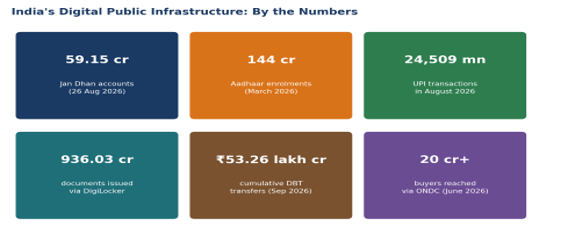
Fig. 1 – The scale of India’s Digital Public Infrastructure, the base layer GFF 2026 showcases to the world.
The Regulatory Ecosystem:
-
- SRO-FT (May 2024): RBI’s Self-Regulatory Organisation framework for FinTech which promot ethical conduct and dispute resolution within the industry itself.
- Digital Payment Security Controls (2021): Common minimum-security standards across internet and mobile banking; NPCI also runs AI/ML-based fraud monitoring on UPI.
- Digital Personal Data Protection Act, 2023 and Rules, 2025: India’s core data protection law and its implementing rules.
- Regulatory Sandbox (August 2019): Lets new financial products be tested in a controlled environment, with or without regulatory relaxations.
- Digital lending safeguards: A Digital Lending Apps directory, the National Cybercrime Reporting Portal (cybercrime.gov.in, Helpline 1930), and the SACHET portal for illegal deposit-collection complaints.
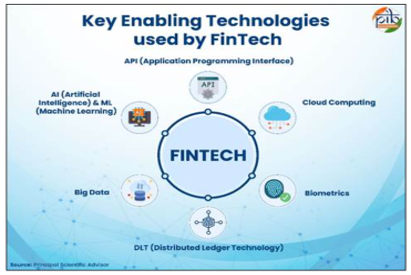
Key Enabling Technologies used by FinTech:
How Does India’s Model Compare Globally?
| System | Model | How It Is Funded | Global Standing |
|---|---|---|---|
| India - UPI | Government/central-bank-backed public infrastructure, run by NPCI (industry-owned, RBI-regulated) | Zero Merchant Discount Rate (MDR) since 2020, backed by a shrinking government subsidy | Handles about half the world's real-time digital transaction volume; now live in 11 countries |
| Brazil - Pix | Central-bank-run instant payment system, similar public-rail philosophy to UPI | Free for individuals, but charges a merchant fee on larger transactions | One of the fastest-adopted payment systems globally; often cited as UPI's closest global peer |
| China - Alipay / WeChat Pay | Privately-run 'super-app' wallets, not a single public rail like UPI | Merchant fees and data-driven cross-selling of loans, insurance and investments fund the platforms | Dominant in China's domestic market; less interoperable and less exported globally than UPI |
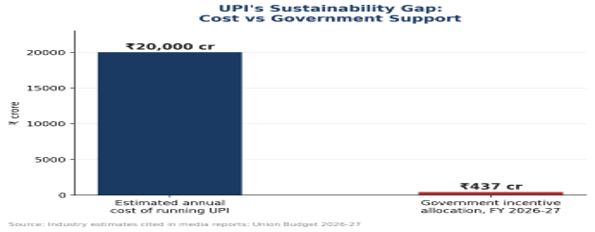
Fig. 2 – The heart of India’s fintech policy debate: who pays for a ‘free’ public payments rail?
What This Comparison Show?
-
- India chose public infrastructure over private super-apps: Unlike China, India built one shared rail (UPI) that any bank or app can plug into. This is closer to Brazil’s Pix model than to China’s walled-garden wallets.
- “Free” is a policy choice, not a law of nature: Brazil already charges larger merchants a fee on its UPI-equivalent. India is only now, in 2026, opening the legal door to a similar fee after years of zero-MDR.
- Scale creates its own new problem: Precisely because UPI succeeded so completely, at 84% of India’s retail digital payments, its funding gap is now a matter of national financial-infrastructure importance, not just a business dispute between banks and fintech apps.
Significance:
-
- DPI has become one of India’s most credible global exports, and a genuine soft-power and diplomatic asset with the Global South.
- Interoperable, public digital rails reduce dependence on a handful of private global payment networks.
- Financial inclusion gains (index up from 43.4 to 70.0) show real, measurable movement of people into the formal financial system.
- A trusted regulatory ecosystem (sandbox, SRO, data protection law) lets India test new technologies like agentic AI and tokenisation without repeating past mistakes.
Challenges:
-
- Parliamentary Standing/Finance Committee (report cited in media, 2026) warned that UPI’s zero-MDR model is not financially sustainable, and pushed for a viable revenue mechanism so the ecosystem does not perpetually strain the government exchequer.
- RBI Governor Sanjay Malhotra has publicly said UPI is “not truly free”: someone bears the roughly 0.25% per-transaction processing cost, whether it is banks, fintech firms, or eventually merchants and users.
- Industry estimates cited widely in 2026 reporting put UPI’s annual ecosystem cost at around ₹20,000 crore, while the government’s own incentive allocation for UPI and RuPay debit cards fell from ₹2,000 crore in the 2025-26 Budget to just ₹437 crore in 2026-27, a shrinking subsidy against a growing cost base.
- Market-structure analysis (Takshashila Institution and others) flags that two foreign-backed apps, PhonePe and Google Pay, together handle over 80% of UPI transactions, and that NPCI’s own 30% market-share cap rule has been repeatedly postponed, now to December 2026.
- RBI Deputy Governor T. Rabi Sankar has said India must pursue a “zero-fraud” goal even as digital payment fraud rates fall, underlining that trust, not just scale, is what keeps a payment system credible.
- Fintech funding data (Tracxn, GlobalData, 2026) shows India remains the world’s third-largest fintech funding market, but capital is now concentrated in fewer, later-stage companies. Deal count fell sharply even where total funding held up, meaning fewer new fintech ideas are getting early-stage backing than before.
Way Forward
-
- Parliament and Finance Ministry have already amended the Payment and Settlement Systems Act, 2007 in 2026 to permit a calibrated Merchant Discount Rate. This should now be implemented carefully protecting small merchants and individuals while charging large high-value transactions, similar to Brazil’s Pix model.
- NPCI should enforce its own 30% market-share cap on time rather than deferring it again to reduce concentration risk from any single private app controlling too much of a public payment rail.
- RBI and Finance Ministry should treat UPI’s funding gap as a long-term infrastructure financing question not an annual budget line item. Since a public good used by over 55 crore people needs predictable, not year-to-year, funding.
- Government and NPCI should keep strengthening AI/ML-based fraud monitoring and public awareness (cybercrime.gov.in, Helpline 1930), since RBI’s own leadership has flagged trust as the real long-term currency of digital payments.
- SIDBI, NSTFDC and early-stage investors should be encouraged to support first-time and seed-stage fintech founders, so India’s fintech innovation pipeline does not depend only on a handful of large, later-stage companies.
- Ministry of External Affairs (NEST Division) and MeitY should continue exporting the DPI model to Global South partners, since UPI’s international expansion to 11 countries is both a diplomatic asset and a way to build new, non-Western digital finance corridors.
Conclusion:
However, very success of that model has created a new problem which is someone has to pay ₹20,000 crore-a-year bill for keeping it running and government’s own subsidy is shrinking not growing. How India resolves the coming MDR debate, without losing either its inclusion gains or its innovation edge will decide whether DPI remains a model the world wants to copy or a public good that quietly runs out of road.
Spread the Word