TOPIC-1: Launch of India Valve Registry at India Valves 2026
-
- GS Paper 2 (Government Policies & Interventions in Healthcare; Inclusive Healthcare & Human Rights)
- GS Paper 3 (Science and Technology — Medical Technology, R&D in Cardiovascular Medicine, Indigenous Clinical Evidence, and Health Infrastructure under Swasth Bharat).
Introduction: Vice President Shri C. P. Radhakrishnan launched the India Valve Registry at India Valves 2026 in Chennai on September 05, 2026. The multicentre registry marks India’s first dedicated clinical database to systematically collect real-world data on transcatheter valve interventions and structural heart disease treatments across the country.
About India Valves 2026:
-
- India Valves 2026 is the national academic forum for cardiologists, cardiac surgeons, and researchers specializing in structural heart diseases.
- The newly launched India Valve Registry is a collaborative, multi-hospital initiative designed for the secure, de-identified collection of real-world patient data undergoing transcatheter heart valve interventions.
- It bridges the gap in indigenous clinical research by providing “our country’s own data for our own countrymen” to refine treatment protocols, track long-term intervention outcomes, and optimize cardiovascular care.
Key Impact
-
- Indigenous Clinical Evidence Base: Shifts relying solely on Western medical registries to generating localized, India-specific clinical evidence for tailored cardiovascular treatments.
- Real-World Evidence (RWE) Tracking: Systematically logs procedural success, long-term patient outcomes, and risk factors associated with non-surgical transcatheter valve therapies.
- Equity & Human Rights Focus: Reaffirmed that healthcare is a fundamental human right, urging medical professionals to make advanced structural heart therapies affordable and accessible.
- Alignment with Swasth Bharat: Anchors clinical R&D and indigenous data generation into the broader national goal of building a Swasth Bharat as a prerequisite for Viksit Bharat @2047.
UPSC Quick Reference Table
| Feature | Detailed Specification |
| Event & Venue | India Valves 2026 (National Academic Meeting, Chennai, Tamil Nadu) |
| Chief Guest | Shri C. P. Radhakrishnan (Vice President of India) |
| New Initiative | India Valve Registry |
| Primary Objective | Multi-centre, de-identified collection of data on transcatheter valve interventions |
| Core Paradigm | Transitioning individual clinical cases into collective, India-specific clinical evidence |
| Strategic Goal | Enhancing healthcare quality, patient safety, and equity for a Swasth Bharat |
Conclusion:
Establishing the India Valve Registry creates a robust framework for evidence-based cardiovascular medicine in India. Translating clinical experiences into a national data repository ensures that medical innovation remains accessible, patient-centric, and aligned with national health goals.
TOPIC-2: Inauguration of BAPS Swaminarayan Hindu Mandir in Paris
-
- GS Paper 1 (Indian Culture, Heritage, and Architectural Synthesis)
- GS Paper 2 (Bilateral, Regional, and Global Groupings involving India — India-France Strategic Partnership, Soft Power Diplomacy, and Diaspora Engagement).
Introduction: Prime Minister Shri Narendra Modi addressed the inauguration of the BAPS Swaminarayan Hindu Mandir in Paris (Bussy-Saint-Georges) via video conference. The Prime Minister hailed the opening of the first traditional stone Hindu temple in France as a landmark cultural milestone that enriches French diversity and strengthens the broader India-France Strategic Partnership.
About the BAPS Swaminarayan Mandir (Paris):
-
- The temple represents a 56-year spiritual journey originally envisioned in 1970 which is located in Bussy-Saint-Georges near Paris.
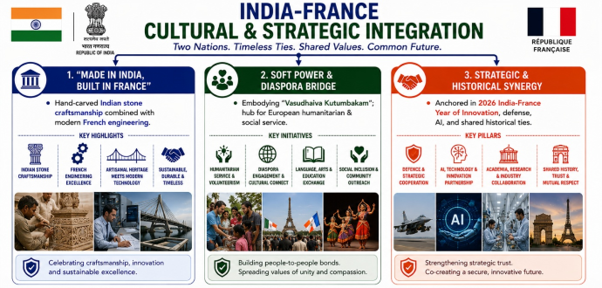
- The structure embodies the synthesis of traditional Indian art and modern technology—built with stones hand-carved by artisans in India and assembled using contemporary French engineering.
- The complex serves as a sanctuary for worship, Indian heritage and community service across Europe.
Key Highlights
-
- Architectural & Synthesis Milestone: Blends Vedic stone-carving traditions (shila texts) with modern structural engineering, symbolizing collaborative craftsmanship between both nations.
- Universal Humanism & Soft Power: Serves as a global platform promoting Vasudhaiva Kutumbakam (The World is One Family) and Indian cultural values across Continental Europe.
- Historical & Literary Linkages: Recalled the shared historical sacrifices of Indian soldiers in France during World War I, French scholars popularizing Sanskrit, Romain Rolland’s writings, and Mirra Alfassa’s (“The Mother”) spiritual journey from Paris to Puducherry.
- Synergy with “2026 India-France Year of Innovation”: Aligns cultural soft power with expanding bilateral cooperation in Artificial Intelligence (AI), defense industrial partnerships, space technology, and climate action under the Special Global Strategic Partnership.
- Humanitarian & Social Service Hub: Continues the Swaminarayan tradition of integrating spiritual centers with community welfare, medical outreach, and youth development.
UPSC Quick Reference Table
| Feature | Detailed Specification |
| Event Name | Inauguration of BAPS Swaminarayan Hindu Mandir, Paris |
| Location | Bussy-Saint-Georges (Paris Suburbs, France) |
| Architectural Model | Hand-carved stone craftsmanship (“Made in India, Built in France”) |
| Key Distinction | First traditionally built stone Hindu temple in France |
| Core Philosophical Anchor | Vasudhaiva Kutumbakam (The World is One Family) |
| Bilateral Context | 2026 India-France Year of Innovation & Special Global Strategic Partnership |
Conclusion:
The inauguration of the BAPS Swaminarayan Hindu Mandir in Paris adds a new dimension to India-France civilisational and diplomatic ties. Fusing ancient Indian architectural heritage with modern engineering creates a long-lasting symbol of bilateral cooperation and cultural exchange across Europe.
TOPIC-3: Bharat Health Global Expo 2026
-
- GS Paper 2 (Government Policies & Interventions in Healthcare & Trade)
- GS Paper 3 (Indian Economy — Pharmaceutical Sector, R&D, Biosimilars, Medical Value Travel, and Supply Chain Resilience).
Introduction: Union Minister of Commerce & Industry Shri Piyush Goyal addressed the Bharat Health Global Expo 2026 in New Delhi. He urged the pharmaceutical industry to evolve beyond its traditional reliance on generic medicines by strengthening R&D, accelerating innovation in new molecules and biosimilars, and building resilient, globally integrated healthcare supply chains.
About Bharat Health Global Expo 2026:
-
- The Bharat Health Global Expo 2026 brings together the entire healthcare and life-sciences value chain on a single platform.
- The convention highlights a multi-pronged strategy: shifting from low-cost generics to high-value biopharmaceuticals, mitigating Active Pharmaceutical Ingredient (API) and Key Starting Material (KSM) import risks, encouraging outward investments for last-mile delivery (notably in Africa), and promoting medical value travel.
Key Highlights
-
- Transitioning Beyond Generics: Encouraged domestic firms to lead in patents, biosimilars, biotech, and new molecular entities by leveraging the Research and Development Innovation Fund (RDIF).
- Outward-Looking Supply Chain Resilience: Defined resilience as geographical diversification across multiple suppliers and countries—rather than total indigenization—to prevent supply chain weaponization.
- Regulatory Harmonization: Advocated for regulatory convergence with developed economies to attract investments in clinical trials, patenting, and advanced medical technology.
- Infrastructure & Plug-and-Play Hubs: Highlighted ongoing bulk drug park developments (Andhra Pradesh, Gujarat, Himachal Pradesh) and offered plug-and-play facilities across 100 new industrial parks for pharma and medical device manufacturing.
- Promoting Medical Value Travel: Called for a mission-mode push to capture a larger share of the global $8 billion medical value travel market by leveraging world-class Indian healthcare facilities and medical professionals.
- FTA Market Access Integration: Emphasized that 9 recent Free Trade Agreements (FTAs) have expanded preferential market access across 38 developed countries with a combined GDP of $60 trillion.
UPSC Quick Reference Table
| Feature | Detailed Specification |
| Nodal Ministry | Ministry of Commerce & Industry, Government of India |
| Event Name | Bharat Health Global Expo 2026 (New Delhi) |
| Next Frontier Sectors | Biosimilars, Biotechnology, New Molecular Entities, and Medical Devices |
| Financing/R&D Tool | Research and Development Innovation Fund (RDIF) |
| Pharma Infra Hubs | Bulk Drug Parks in AP, Gujarat, Himachal Pradesh & Plug-and-Play Industrial Parks |
| Trade Policy Synergy | Leveraging FTAs giving access to $60 Trillion combined global GDP |
Conclusion:
Transforming India’s pharmaceutical ecosystem from the “pharmacy of the world” into an innovation-led global health stack requires expanding R&D in biopharma, reforming clinical trial regulations, and building resilient supply chains. Integrating these steps with trade agreements and modern industrial infrastructure advances national goals for Viksit Bharat 2047.
Spread the Word