Indian Polity & Governance
NITI Aayog Governing Council Meets to Address Inclusive Human Development:
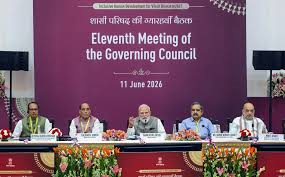
Context: PM chaired the 11th Governing Council Meeting of NITI Aayog at the Rashtrapati Bhavan Cultural Centre in New Delhi. The session brought together State Chief Ministers and Lieutenant Governors under the cooperative federalism banner of ‘Team India’.
-
- Core Theme: The 11th session centred on the theme “Inclusive Human Development for Viksit Bharat @2047”, focusing on equitable socioeconomic distribution.
- The Framework Pillars: The Council deliberated on the Inclusive Human Development Framework anchored around four core pillars:
- Foundational Human Capital and Future-Ready Skills
- Productive Employment, Entrepreneurship, and Decentralised Growth
- Health, Nutrition, and Wellbeing
- Equity and Dignity for All
- Vision Realization: The primary objective of the meeting was to transform the national vision of Viksit Bharat (Developed India) into concrete, measurable outcomes across all tiers of society.
- Integration Enablers: Key execution enablers emphasized included Digital Public Infrastructure (DPI), technological convergence, multi-stakeholder partnerships, and data-driven administrative systems.
- Accountability Mechanism: A structured outcome tracking system was introduced to evaluate short, medium, and long-term targets to ensure strict fiscal and administrative accountability.
- Alignment of Visions: The meet explicitly sought to align independent State-level visions with the overarching National Vision to avoid developmental disparities.
- Chief Secretaries’ Inputs: The Council reviewed and integrated action plans arising from the recommendations of the 5th National Conference of Chief Secretaries (held in December 2025).
- Education Focus: Five key thematic sub-sectors originating from the Chief Secretaries’ meet were integrated: Early Childhood Education, Schooling blocks, and Higher Education frameworks.
- Composition of the Council: The meeting was attended by Chief Ministers of States/UTs, UT Administrators, Ex-officio Union Ministers, Special Invitees, and the Vice Chairman/CEO of NITI Aayog.
- Static/Constitutional Blueprint: Unlike the statutory Planning Commission it replaced in 2015 via an executive resolution, NITI Aayog operates purely as a non-constitutional, advisory think-tank designed to reinforce bottom-up cooperative federalism.
(PIB)
Letters of Approval Issued to Three Global Universities for Indian Campuses:
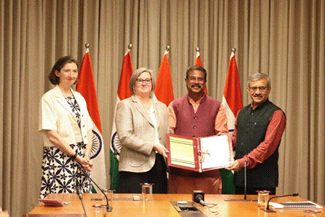
Context: In a major step towards internationalizing higher education, the Union Minister of Education officially issued Letters of Approval (LoA) to three globally renowned foreign universities to set up operational expansion campuses within India.
-
- The Institutions: The three premier global universities granted the LoAs are the University of Bristol (UK), the University of York (UK), and the University of New South Wales (UNSW, Australia).
- Policy Anchor: This administrative execution is firmly anchored in the mandates of the National Education Policy (NEP) 2020, which advocates for allowing top global institutions into India.
- Regulatory Framework: The entries are governed under the University Grants Commission (Setting up and Operation of Campuses of Foreign Higher Educational Institutions in India) Regulations.
- Autonomy Matrix: These foreign branches will enjoy administrative, financial, and pedagogical autonomy to decide their admission criteria, fee structures, and curriculum design.
- Capital Outflow Mitigation: By providing world-class education locally, the policy aims to check the immense brain drain and conserve foreign exchange reserves currently spent on overseas tuition.
- Repatriation of Funds: Under current UGC regulations, these foreign higher education institutions are permitted to repatriate their generated funds to their parent campuses, subject to Foreign Exchange Management Act (FEMA) guidelines.
- Faculty Benchmarks: The regulations stipulate that the quality of education and faculty recruitment standard at the Indian branch campuses must be completely at par with the main campus overseas.
- Prohibition Clause: These institutions are explicitly restricted from offering online or open-and-distance learning courses under this specific entry route; courses must be physical and campus-based.
- Static Data (NEP 2020): NEP 2020 sets an ambitious target to raise India’s Gross Enrolment Ratio (GER) in higher education, including vocational education, from 26.3% (2018) to 50% by the year 2035.
- Research & Collaboration: The presence of these foreign campuses is expected to spur domestic-foreign joint research publications and improve India’s institutional rankings globally.
(PIB)
Indian Society & Social Justice
Ministry of Health Releases NFHS-6 Fact Sheets Highlighting Key Health Gains:
Context: The Ministry of Health and Family Welfare (MoHFW) officially released the comprehensive fact sheets of the National Family Health Survey-6 (NFHS-6), providing an updated, data-driven look at India’s demographic transition.
-
- Indicator Spectrum: The newly released NFHS-6 fact sheets focus tightly on 101 major core indicators that map critical health, fertility, and nutritional trends across all Indian states.
- Data Harmonization: A major structural highlight of NFHS-6 is its alignment with international data standards, allowing for easier tracking of United Nations Sustainable Development Goals (SDG-3: Good Health and Well-being).
- Fertility Rates: The data confirms that India’s Total Fertility Rate (TFR) continues to stabilize firmly below the standard sub-replacement level of $2.1$, indicating long-term population stabilization.
- Maternal Health: The sheets record institutional births hitting historic highs across rural pockets, directly corresponding to a steady decline in the Maternal Mortality Ratio (MMR).
- Immunization Milestones: Digital health interventions (like the U-WIN platform) have driven a marked expansion in full immunization coverage among infants aged 12–23 months.
- The Anemia Challenge: Despite overall nutrition gains, micronutrient deficiencies and anemia levels among women of reproductive age and young children remain a complex public health challenge.
- Nodal Survey Agency: The International Institute for Population Sciences (IIPS), Mumbai, served as the designated nodal agency responsible for the coordination and technical execution of NFHS-6.
- Financial & Technical Support: The survey receives critical funding from the Government of India, alongside technical backing from global entities like USAID and the ICF international network.
- Sampling Rigor: NFHS-6 captured sample sets across hundreds of thousands of households nationwide, ensuring scientific representation across diverse socio-economic strata.
- Policy Application: The resulting database will serve as the primary statistical baseline for restructuring the National Health Mission (NHM) and determining financial allocations under the Finance Commission’s health grants.
(TH)
International Relations
India Hosts the 13th BRICS Urbanisation Forum in New Delhi:
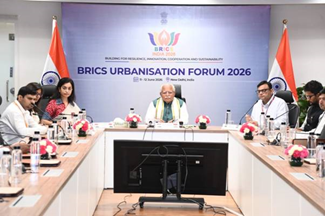
Context: India formally commenced hosting the two-day high-level ministerial event, the 13th BRICS Urbanisation Forum, running from June 11 to June 12, 2026, in New Delhi.
-
- Chairship Details: The forum is a primary ministerial-level milestone executed under India’s official BRICS Chairship for the year 2026.
- Core Theme: The 13th edition is being organized under the central theme: “Cities for People: BRICS Cooperation for Inclusive and Resilient Urban Futures”.
- Guiding Philosophy: The Union Ministry stated that India’s chairship is steered by the Prime Minister’s motto of ‘Humanity First’ and the systemic theme of resilience and innovation.
- Historical legacy: This marks the fourth time India is hosting this specialized forum. India previously hosted the inaugural forum in New Delhi (2013), Visakhapatnam (2016), and virtually (2021).
- Key focus areas: The multilateral deliberations are centered on rapid urban growth, housing shortages, public mobility systems, and municipal climate risk mitigation.
- Institutional strengthening: A key objective of the 2026 forum is building stronger municipal financial structures and expanding the capacity of local urban governance.
- Expanded geopolitical scope: This forum represents one of the first major urbanization meets following the recent expansion of the BRICS bloc, bringing diverse demographic profiles together.
- Best practices exchange: The forum acts as a dedicated platform for member states to share legislative policies, urban planning frameworks, and smart-city data analytics.
- Static Data (BRICS): Originally formed as BRIC (Brazil, Russia, India, China) in 2009, it became BRICS with the entry of South Africa in 2010. It represents over 40% of the world’s population and a major chunk of global economic growth.
- Urbanization static: According to Census data and UN projections, more than 40% of India’s population is expected to reside in urban ecosystems by 2035, necessitating urgent multilateral policy interventions.
(PIB)
Economy
Varanasi Integrated as the First City Under the ‘Easy Connect’ Aviation Model:
Context: The Union Minister of Civil Aviation announced that Varanasi (Uttar Pradesh) has become the first city in India to be fully integrated into the newly conceptualized Easy Connect hub-and-spoke aviation model.
-
- The core concept: The Easy Connect framework allows international travelers departing from tier-2/regional airports to complete all immigration, customs, and baggage check-in formalities at their point of origin.
- The Hub-and-Spoke Link: Passengers from Varanasi connecting via major international hub airports (like IGI Airport, Delhi) can bypass transit check-ins and proceed directly to their international boarding gates.
- Operational efficiency: The model is specifically designed to drastically reduce congestion at mega-hub international terminals in metropolitan cities.
- Baggage tagging: The integration features advanced single-point baggage tagging, ensuring that checked luggage is automatically transferred to international carrier flights without manual re-check.
- Nodal regulatory bodies: The project is executed via close operational coordination between the Ministry of Civil Aviation, the Central Board of Indirect Taxes and Customs (CBIC), and the Bureau of Immigration.
- Tourism boost: Varanasi’s selection as the pioneer site aims to enhance international spiritual and cultural tourism into the Buddhist circuit and the older cultural hubs of Uttar Pradesh.
- Scalability: Following the Varanasi pilot project, the Ministry plans to scale the Easy Connect model to 15 other regional airports across India to decentralize international outbound logistics.
- Infrastructure requirements: Implementing this model required upgrading Varanasi’s Lal Bahadur Shastri International Airport with dedicated international clearance bays and secure transit communication lines.
- Static Data (Aviation Sector): India is currently the third-largest domestic aviation market globally. The government’s civil aviation push operates primarily under the umbrella of the National Civil Aviation Policy.
- Economic impact: By making travel through regional centres friction-free, the policy enhances the ease of doing business and lowers global transit turnaround times for international business travellers.

(IE)
Science & Technology
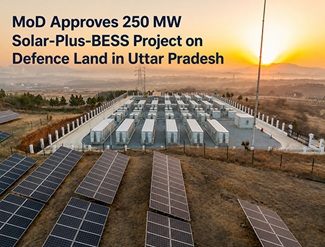
Approval of 250 MW Solar-BESS Project on Defence Land in Sitapur:
Context: The Union Minister of Defence formally approved the installation of a 250 Megawatt (MW) Solar Power Project integrated with a Battery Energy Storage System (BESS) at the Sitapur Ex-Cantonment in Uttar Pradesh.
-
- First-of-its-Kind: This marks the first instance where vacant Indian military/defence land is being utilized for an integrated mega-scale green energy generation project.
- The BESS Advantage: The inclusion of a Battery Energy Storage System (BESS) allows the facility to store surplus solar power generated during peak sunlight and release it during peak load hours or nighttime.
- Ownership Integrity: The project guidelines explicitly state that the Ministry of Defence (MoD) will retain absolute land ownership; no title or property rights are transferred to external vendors.
- Strategic objective: The initiative is designed to maximize the energy self-sufficiency of local military cantonments and strategic defence installations.
- Fiscal efficiency: The captive power generation model is projected to yield massive long-term fiscal savings for the exchequer by significantly lowering institutional electricity grid bills.
- Grid stability: By relying on localized BESS power during peak hours, the project alleviates high-voltage stress on the regional civilian electricity grid network of Uttar Pradesh.
- National target alignment: The 250 MW project directly contributes to India’s updated Nationally Determined Contributions (NDCs) targeting 500 GW of non-fossil fuel energy capacity.
- Land optimization: The policy sets a new administrative precedent for utilizing un-utilized ex-cantonment safety buffer zones for green infrastructure without compromising military readiness.
- Technical Static (BESS): Lithium-ion or advanced chemistry cell batteries are typically utilized in BESS configurations to convert the DC solar generation into storable energy, later converted to AC via large-scale inverters.
- Environmental Impact: The project is estimated to displace hundreds of thousands of tons of carbon dioxide (CO2) emissions annually by replacing conventional coal-fired thermal grid power.
(IE+PIB)
Government Schemes & Initiatives
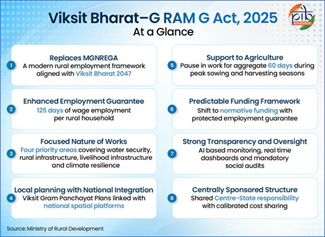
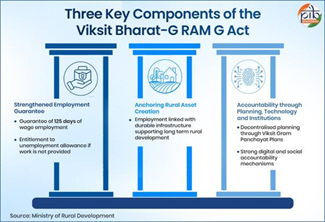
‘VB-GRAM G’ Framework for Rural Employment:
Context: The Union Minister for Rural Development and Agriculture unveiled a massive rural transformation project: the Viksit Bharat – Guarantee for Rozgar and Ajeevika Mission (Gramin) or VB-GRAM G framework.
-
- Financial Outlay: The framework has been launched with an enormous dedicated budgetary allocation of ₹1.25 lakh crore aimed entirely at the rural economy.
- Effective Date: The scheme’s structural implementation guidelines will become fully operational on the ground from July 1, 2026.
- Target Coverage: The mission aims to touch and upgrade infrastructural and economic capabilities across nearly 2.8 lakh Gram Panchayats nationwide.
- Dual Focus: The scheme is uniquely structured to simultaneously generate direct livelihood employment while constructing durable community assets in rural areas.
- Digital Governance: A core component of VB-GRAM G is the mandatory adoption of digital governance tools for asset tagging, wage disbursement, and monitoring.
- Skill Mapping: It incorporates a localized skill-mapping mechanism to transition unskilled agrarian laborers into semi-skilled technical and service-oriented rural roles.
- Convergence model: The framework seeks to converge elements of existing flagship schemes like MGNREGS, Deendayal Antyodaya Yojana-NRLM, and PM-AWAS Yojana.
- Focus on Women: A minimum dedicated percentage of the livelihood funds is earmarked for women-led Self-Help Groups (SHGs) to bolster rural financial autonomy.
- Climate-Resilient Assets: The asset creation mandate focuses primarily on water conservation structures, agro-forestry tracts, and climate-resilient village connectivity.
- Static/Constitutional Data: Rural development falls under the domain of the 11th Schedule of the Indian Constitution (introduced via the 73rd Constitutional Amendment Act, 1992), which lists 29 subjects functional to Gram Panchayats.
(PIB/TH)
Important data/facts
International Relations
India-Venezuela Bilateral Energy Ties Deepen as Trade Data Released:
Context: Bilateral and diplomatic energy engagements between India and Venezuela witnessed a significant surge, backed by official trade data releases and high-level bilateral diplomatic interactions in New Delhi.
-
- Bilateral Volume: Official trade figures reveal that bilateral commerce between India and Venezuela reached USD 678.94 million for the fiscal year 2025-26 (FY26).
- Crude Import Ranking: Venezuela successfully rose to become India’s 3rd largest supplier of crude oil for the month of May 2026, marking a major shift in India’s import mix.
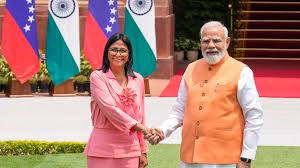
- High-Level Diplomacy: The Vice President of Venezuela held extensive meetings with India’s Union Minister of External Affairs in New Delhi to strengthen strategic ties.
- Refinery Engagement: The visiting Venezuelan high-level delegation travelled to the Jamnagar oil refinery in Gujarat to inspect processing compatibilities.
- Jamnagar’s Significance: The Jamnagar facility, owned by Reliance Industries, is globally recognized as the world’s largest single-point, grassroots oil refining complex.
- Strategic Diversification: India’s calculated return to heavy Venezuelan crude purchases is part of its broader energy security strategy to diversify away from over-dependence on any single geographical region.
- Refinery Suitability: Indian private and public sector refineries possess highly advanced complex configurations (high complexity index) specifically engineered to efficiently process heavy, sour crude variants like those from Venezuela.
- Geopolitical Balancing: The deep economic interaction comes amid complex global geopolitics and evolving international sanctions regimes, highlighting India’s pursuit of strategic autonomy.
- Non-Oil Components: Beyond hydrocarbons, the bilateral talks explored expanding trade into pharmaceuticals, medical equipment, and agricultural commodities where India holds an export advantage.
- Historical Context: Historically, Venezuela holds some of the largest proven oil reserves in the world (primarily concentrated in the Orinoco Belt), making it a critical partner for energy-hungry developing economies like India.
(IE)
Miscellaneous
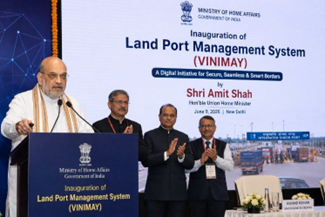
Launch of LPMS ‘VINIMAY’ to Modernize Cargo and Passenger Movement:
Context: The Union Minister of Home Affairs and Cooperation launched a highly sophisticated digital platform named the Land Port Management System (LPMS) -‘VINIMAY’ in New Delhi.
-
- Primary Objective: ‘VINIMAY’ is engineered to completely digitize and streamline both cargo clearance and passenger transit tracking across India’s various land ports.
- Nodal Ministry: The project is directly overseen by the Ministry of Home Affairs (MHA) through the Land Ports Authority of India (LPAI).
- Trade Facilitation: The digital framework aims to drastically reduce the ‘Turn Around Time’ (TAT) for cross-border commercial trucking and cargo logistical networks.
- Security Paradigm: By introducing automated digital checks, it strengthens border security through end-to-end electronic manifest validation, reducing human error and smuggling risks.
- Operational Integration: The system creates a single-window interface that synthesizes data from Customs, Immigration, Border Security forces, and plant/animal quarantine departments.
- Real-time Tracking: It offers real-time dashboards for logistics operators, creating an integrated ecosystem that aligns with India’s National Logistics Policy.
- Scope of Coverage: The digital system will be rolled out across all functional Integrated Check Posts (ICPs) along India’s land borders with Bangladesh, Nepal, Bhutan, and Myanmar.
- Economic Diplomacy: The step boosts India’s Neighbourhood First policy by providing smoother land-based trading corridors for South Asian sub-regional integration.
- Static Data (LPAI): The Land Ports Authority of India (LPAI) is a statutory body established under the Land Ports Authority of India Act, 2010. It is tasked with creating, maintaining, and managing border infrastructure.
- Static Data (Cross-Border Trade): Land-based trade accounts for a massive portion of India’s bilateral commerce with Bangladesh (India’s largest trading partner in South Asia) and Nepal.
(PIB)
Spread the Word