
Indian Polity & Governance
Satirical Movements and the Boundaries of Free Speech:
Context: A massive satirical digital movement turned offline protest, the “Cockroach Janta Party” (CJP), organized a gathering at Jantar Mantar demanding accountability over exam leaks. The movement was sparked by a metaphorical remark made by Chief Justice Surya Kant during a Supreme Court hearing.
-
- Article 19(1)(a): Guarantees the Freedom of Speech and Expression to all citizens, which judicially includes satire, parody, political dissent, and peaceful demonstration.
- Reasonable Restrictions: The right is not absolute and is subject to reasonable restrictions under Article 19(2) on grounds of public order, decency, morality, and the sovereignty and integrity of India.
- Right to Assemble Peacefully: Protected under Article 19(1)(b), allowing citizens to gather without arms. The state can regulate this via reasonable restrictions under Article 19(3) for public order.
- The Role of Jantar Mantar: Historically designated by the judiciary and administration as a regulated zone for democratic protests in the capital, subject to permissions from the Delhi Police to balance security and rights.
- Contempt of Court Act, 1971: Publicly reacting to or satirizing judicial remarks must not cross lines into Criminal Contempt, defined as scandalizing or lowering the authority of any court, or interfering with judicial proceedings.
- Fair Criticism vs Contempt: Indian jurisprudence establishes that fair criticism of judicial processes or light-hearted satire does not automatically attract contempt actions unless it structurally undermines public faith in the judiciary.
- Public Interest Litigation (PIL): The Delhi High Court declined an urgent hearing on a PIL seeking to ban or heavily restrict the crowd-control aspects of this flash protest. PILs are a tool to protect broader public interest.
- Origin of PILs: Introduced in India in the late 1970s/early 1980s by Justice P.N. Bhagwati and Justice V.R. Krishna Iyer, relaxing the traditional rule of Locus Standi.
- Mainstream Use of Social Media Satire: Modern political communication highlights how viral algorithmic trends on platforms like Instagram can rapidly scale digital discontent into offline civic mobilizations.
- The Right to Protest: The Supreme Court has repeatedly held that the right to peaceful protest is an essential facet of democracy, provided it does not indefinitely block public thoroughfares (as ruled in the Shaheen Bagh case).
(TH)
Proposed Democratic Electoral Reforms for the Nicobarese Tribal Community:
Context: The Andaman and Nicobar Islands administration is preparing to introduce formal, mainstream democratic elections to the Nicobarese tribal community, shifting from traditional governance systems. This includes constituency delimitation and reserving leadership posts for women.
-
- The Shift in Governance: Historically, the Nicobarese community has been governed via a traditional council system led by village captains. The reform aims to introduce mainstream adult suffrage.
- Demographics of Nicobarese: They are an Austroasiatic-speaking group and constitute the largest tribal group in the Andaman and Nicobar archipelago.
- Particularly Vulnerable Tribal Groups (PVTGs): While the Andamanese, Jarawas, Onges, Sentinelese, and Shompens are classified as PVTGs, the Nicobarese are NOT a PVTG; they are a Scheduled Tribe.
- Constitutional Authority of UT Administration: Because Andaman & Nicobar Islands is a Union Territory without a legislature, the administration functions directly under the President of India via an Administrator/Lieutenant Governor under Article 239.
- Presidential Regulations: Under Article 240, the President has the supreme power to make regulations for the peace, progress, and good government of the Andaman and Nicobar Islands.
- Delimitation Process: Delimitation is the act of redrawing boundaries of regular assembly or local body constituencies to reflect population changes based on recent census trends.
- Protection of Aboriginal Tribes Regulation (ANPATR), 1956: Tribal areas in the archipelago are heavily protected under this law, which restricts entry, land acquisition, and commercial exploitation by outsiders.
- Gram Sabha and Local Governance: The proposed plan integrates structural elements of the 73rd Constitutional Amendment Act but adapts it to the sensitive tribal dynamics of the region.
- Women Reservation: The inclusion of reserved seats for women marks a progressive break from traditional tribal leadership structures, which have historically been male-dominated.
- Strategic and Anthropological Sensitivity: Any administrative alteration in Nicobar must balance democratic integration without disrupting the indigenous culture and delicate island ecosystem.
(TH)
Society & Social Justice
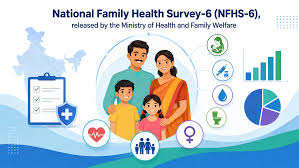
Mission Indradhanush & National Family Health Survey (NFHS) Progress:
Context: During an address in Daman, the PM highlighted landmark achievements in public healthcare, noting that child immunization under Mission Indradhanush shot up from 60% before 2014 to nearly 90% today, while institutional deliveries have crossed 90%.
-
- Launch & Objective: Mission Indradhanush was launched by the Ministry of Health and Family Welfare (MoHFW) in December 2014 to achieve full immunization coverage for all children and pregnant women.
- Target Demographic: It targets children under 2 years of age and pregnant women who have remained unvaccinated or partially vaccinated under the routine immunization programme.
- Intensified Mission Indradhanush (IMI): Periodic drives (like IMI 3.0, 4.0, 5.0) were rolled out to patch vaccination gaps in low-coverage districts, particularly focusing on left-out populations post-pandemic.
- Diseases Covered: It provides protection against life-threatening diseases, including Diphtheria, Whooping Cough, Tetanus, Polio, Tuberculosis, Measles, Hepatitis B, Meningitis, and Pneumonia.
- U-WIN Portal: The immunization drive is technologically backed by the U-WIN digital platform, designed to register and track every pregnant woman and child for immunization across India.
- Institutional Delivery Surge: The milestone of over 90% institutional deliveries is mapped directly by the National Family Health Survey (NFHS) data frameworks.
- NFHS Structure: Conducted under the aegis of MoHFW, with the International Institute for Population Sciences (IIPS), Mumbai, serving as the nodal agency for data collection and survey design.
- Janani Suraksha Yojana (JSY): A 100% centrally sponsored scheme under the National National Health Mission (NHM) that provides cash incentives to reduce maternal and neonatal mortality by promoting institutional deliveries.
- Sustainable Development Goal (SDG) Alignment: These achievements are directly mapped to SDG 3, which explicitly targets ensuring healthy lives and promoting well-being for all ages.
- Maternal Mortality Ratio (MMR) Impact: Rising institutional deliveries have accelerated India’s decline in MMR, pushing many Indian states below the global SDG target of less than 70 maternal deaths per 1,00,000 live births.
(PIB)
International Relations
Inter-Ministerial Briefings on the West Asia Geopolitical Crisis:
Context: An urgent inter-ministerial briefing was convened to evaluate the fallout of recent geopolitical friction in West Asia. The crisis has triggered strategic alarms across Indian trade channels, aviation corridors, and energy supply lines.
-
- Choke Points in West Asia: The region contains critical maritime trade bottlenecks specifically the Strait of Hormuz (between the Persian Gulf and Gulf of Oman) and the Bab-el-Mandeb Strait (connecting the Red Sea to the Gulf of Aden).
- Strait of Hormuz Geopolitics: It is the world’s most important oil transit choke point. A significant portion of India’s crude oil imports from Iraq, Saudi Arabia, and UAE must pass through this narrow strait.
- Bab-el-Mandeb & Red Sea Crisis: Security disruptions here force shipping lines to bypass the Suez Canal entirely, rerouting vessels around Africa via the Cape of Good Hope, adding weeks to transit times and skyrocketing freight insurance premiums.
- Aviation Corridor Disruption: Conflict in West Asian airspace forces commercial flights to reroute, leading to longer flight paths, increased aviation turbine fuel (ATF) consumption, and higher ticket fares.
- India’s Energy Security Vulnerability: India imports over 85% of its crude oil requirements. Any prolonged disruption or price spike in Brent Crude directly stresses India’s Current Account Deficit (CAD) and fuels domestic inflation.
- Strategic Petroleum Reserves (SPR): To buffer against such supply disruptions, India has built underground strategic crude oil storage facilities managed by ISPRL at Visakhapatnam, Mangaluru, and Padur.
- IMEC Project Impact: Escalating instability in West Asia poses severe implementation delays for the India-Middle East-Europe Economic Corridor (IMEC), signed on the sidelines of the G20 New Delhi Summit.
- Indian Diaspora & Remittances: West Asia (the Gulf Cooperation Council region) hosts over 8.5 million non-resident Indians. India is the world’s largest recipient of inward remittances, with a huge chunk originating from this very corridor.
- Operation De-escalation Diplomatic Stance: India consistently advocates for dialogue, diplomacy, and de-escalation in West Asia, maintaining its “strategic autonomy” by balancing bilateral relationships with Israel, Iran, and the Arab nations.
- Impact on Fertilizer Imports: West Asia is a major exporter of rock phosphate, sulfur, and finished fertilizers (like Urea) to India. Disruptions here directly jeopardize input costs for the Indian agricultural sector.
(PIB)
Environment
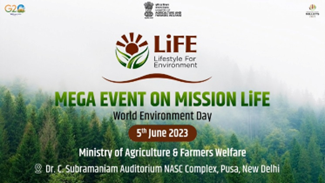
World Environment Day & Mission LiFE:
Context: On World Environment Day, PM Modi emphasized India’s ancient cultural ethos of conservation, sharing a Sanskrit Subhashitam highlighting the success of domestic animal recovery and climate initiatives under Mission LiFE.
“प्रकृति का संरक्षण केवल एक दायित्व नहीं, बल्कि हमारी संस्कृति और संस्कारों का भी अभिन्न हिस्सा है।
मधु वाता ऋतायते मधु क्षरन्ति सिन्धवः।
माध्वीर्नः सन्त्वोषधीः॥“
May the air flow pleasantly and beneficially around us, may the rivers provide life-giving and nourishing water, and may herbs and plants bring health and well-being to all living beings.
-
- World Environment Day: Celebrated globally on June 5th since its establishment by the UN General Assembly in 1972 during the Stockholm Conference.
- Mission LiFE (Lifestyle for Environment): Launched by India at COP26 in Glasgow, it is an India-led global mass movement to nudge individuals to adopt sustainable living habits.
- Core Principle of LiFE: It seeks to replace the prevalent ‘use-and-dispose’ economy with a circular economy characterized by mindful and deliberate utilization.
- Target Species Recovery: The government noted targeted biological recovery for species like the Great Indian Bustard (GIB), Snow Leopard, Sloth Bear, and Cheetah.
- Great Indian Bustard Status: Listed as Critically Endangered under the IUCN Red List, Schedule I of the Wildlife (Protection) Act, 1972, and Appendix I of CITES.
- Snow Leopard Status: Listed as Vulnerable under IUCN. India hosts a significant population under Project Snow Leopard, mostly in the trans-Himalayan region.
- Cheetah Reintroduction: Under Project Cheetah (the world’s first intercontinental large wild carnivore translocation), African cheetahs were translocated to Kuno National Park, Madhya Pradesh.
- Constitutional Provisions: Article 48A (DPSP) directs the State to protect and improve the environment, while Article 51A(g) (Fundamental Duty) mandates citizens to protect natural environments.
- National Mission for a Green India (GIM): One of the eight missions under the National Action Plan on Climate Change (NAPCC), aimed at protecting, restoring, and enhancing India’s diminishing forest cover.
- Nature-Based Solutions (NbS): The Ministry of Environment highlighted NbS as cost-effective, sustainable interventions that use ecosystems to address societal challenges like climate change.
(PIB)
Science & Technology
Ethical Hacking Intervention in Central Board of Secondary Education (CBSE) IT Ecosystem:
Context: Following reports of critical vulnerabilities in its student data portals, the CBSE engaged a 19-year-old ethical hacker alongside experts from the Indian Institute of Technology (IIT) to audit and plug gaps within its IT architecture.
-
- Ethical Hacking (White Hat): The practice of intentionally penetrating a computer system or network to find security vulnerabilities that a malicious hacker could exploit.
- Data Vulnerability Types: Common web application bugs include SQL Injection (SQLi), Cross-Site Scripting (XSS), and Broken Authentication, which expose private databases to unauthorized access.
- CERT-In (Indian Computer Emergency Response Team): The national nodal agency for responding to computer security incidents. It operates under the Ministry of Electronics and Information Technology (MeitY).
- Information Technology Act, 2000: The primary legal framework in India dealing with cybercrime and e-commerce. Section 43 deals with penalty and compensation for damage to computer systems; Section 66 addresses computer-related offenses.
- Digital Personal Data Protection (DPDP) Act, 2023: Outlines strict compliance for data fiduciaries (like CBSE). Entities must implement reasonable security safeguards to prevent personal data breaches, failing which severe monetary penalties apply.
- Data Fiduciary vs Data Principal: Under Indian law, the individual whose data is collected is the Data Principal (students/parents), and the entity determining the purpose of processing is the Data Fiduciary (CBSE).
- National Cyber Security Strategy: India’s policy architecture to protect critical information infrastructure, audit government portals, and foster public-private collaborations to repel cyber warfare.
- Critical Information Infrastructure (CII): Defined under Section 70 of the IT Act as computer resources whose destruction would have a debilitating impact on national security, economy, or public health.
- NCIIPC: The National Critical Information Infrastructure Protection Centre is the designated organization created to secure CIIs across sectors like banking, telecom, and government data centers.
- Bug Bounty Programs: Institutionalized practices where organizations reward independent cybersecurity researchers for responsibly discovering and reporting security flaws before they are exploited.
(TH)
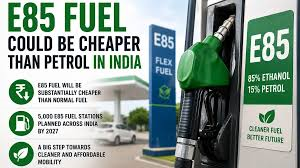
Launch of E85 Fuel in India:
Context: The Union Minister for Petroleum & Natural Gas launched E85 fuel, a monumental step forward in India’s biofuel roadmap aimed at cutting crude imports and promoting alternative green fuels.
-
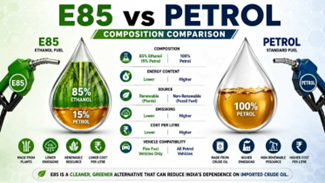
- What is E85 Fuel? E85 is an ethanol fuel blend containing 85% ethanol and 15% gasoline (petrol) by volume.
- Flex-Fuel Vehicles (FFVs): Ordinary internal combustion engine vehicles cannot run on E85. It requires Flex-Fuel Vehicles equipped with modified engines and fuel systems to withstand ethanol’s corrosive properties.
- Ethanol Production Source: Produced primarily through fermentation of starch and sugar-based feedstocks like sugarcane, corn, broken food grains, and agricultural waste.
- National Policy on Biofuels (2018 Amendment): Originally targeted 20% ethanol blending in petrol (E20) by 2030, which the government advanced to the target year 2025–26. E85 marks the next frontier.
- Chemical Nature: Ethanol contains oxygen, allowing engines to combust fuel more completely, which drastically reduces greenhouse gas emissions like carbon monoxide.
- Calorific Value Challenge: Ethanol has a lower energy density (calorific value) than pure petrol, meaning vehicles running on E85 may experience slightly lower fuel mileage.
- 1G vs 2G Biofuels: 1st Generation (1G) uses food crops (sugarcane juice, molasses); 2nd Generation (2G) uses non-food biomass and agricultural residues like paddy straw and corn cobs.
- Economic Benefits: Drastically cuts India’s massive crude oil import bill, strengthens forex reserves, and provides direct remunerative support to domestic farmers.
- Environmental Perks: Significantly lowers particulate matter PM 2.5 and PM 10 and sulphur oxide emissions, curbing urban smog.
- GST Incentives: To push the biofuel economy, the Government of India lowered the GST rate on ethanol meant for the Ethanol Blended Petrol (EBP) programme to 5%.
(PIB)
Government schemes/Policies/Initiatives
Mera Yuva Bharat (MY Bharat) Youth Convention:
Context: The Ministry of Youth Affairs & Sports organized the ‘Youth for Viksit Bharat – MY Bharat Youth Convention’ at Thyagaraj Stadium, New Delhi, celebrating the youth’s role in nation-building and marking a recent Guinness World Record for quiz participation.
-
- What is MY Bharat? Launched on National Unity Day (31st October 2023), Mera Yuva Bharat (MY Bharat) is an autonomous body set up by the Government of India.
- Nodal Ministry: It functions under the Ministry of Youth Affairs & Sports.
- Target Age Group: The primary beneficiaries are youth in the age group of 15-29 years (in alignment with the definition of ‘youth’ in the National Youth Policy). For programs specifically targeting adolescents, the age subgroup is 10–19 years.
- Phygital Platform: It operates as a “phygital” platform combining physical interaction with digital access to bridge the gap between youth and government youth-centric benefits.
- Guinness World Record Milestone: The convention celebrated MY Bharat’s record for the “Most Users to Take an Online Quiz in One Week” via the Viksit Bharat Young Leaders Dialogue (VBYLD) Quiz, drawing over 50 lakh participants.
- Core Objective: To act as a ‘youth development mechanism’ and single-window platform that empowers youth as active drivers of development, rather than passive recipients.
- Viksit Bharat @2047 Alignment: The platform aligns youth aspirations directly with India’s overarching vision to turn into a fully developed nation by the centenary of its independence in 2047.
- Experiential Learning: The platform lists opportunities for youth to engage in social work, government internships, digital literacy drives, and community leadership roles.
- Demographic Dividend: India boasts one of the youngest populations globally, with over 65% of its population below the age of 35. MY Bharat targets capitalising on this specific Demographic Dividend.
- Integration of NYKS and NSS: The digital architecture of MY Bharat serves to unify and upgrade existing networks like the National Youth Corps, Nehru Yuva Kendra Sangathan (NYKS), and National Service Scheme (NSS).
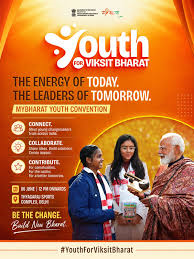
(PIB)
Facts/Data
ECONOMY
Annual and Q4 Provisional Estimates of India’s GDP:
Context: The Ministry of Statistics and Programme Implementation released the Provisional Estimates of Annual Gross Domestic Product (GDP). PM Modi confirmed India recorded a robust 7.7% growth rate for FY 2025-26 and a 7.8% growth rate in Q4 ending March 31.
-
- Data Releasing Authority: The provisional estimates of GDP are compiled and released by the National Statistical Office (NSO), which operates under MoSPI.
- Base Year: The current base year used for calculating India’s real GDP and Gross Value Added (GVA) is 2011-12.
- Real GDP vs Nominal GDP: Real GDP is calculated at constant prices (adjusting for inflation), whereas Nominal GDP is calculated at current market prices without adjusting for inflation.
- GDP vs GVA: GDP = GVA + Product Taxes – Product Subsidies. GVA maps the supply-side performance of various sectors (Agriculture, Industry, Services).
- Resilience Amid Global Headwinds: The 7.7% annual growth underscores India’s position as the fastest-growing major economy despite global supply chain shocks and high inflation regimes worldwide.
- Core Sectors Framework: Economic momentum is closely tracked via the Index of Eight Core Industries (ICI), which comprises 40.27% of the weight of items included in the Index of Industrial Production (IIP).
- Top Core Industries by Weight: Refinery Products holds the highest weight, followed by Electricity, Steel, Coal, Crude Oil, Natural Gas, Cement, and Fertilizers.
- Four Components of GDP (Expenditure Method): Private Final Consumption Expenditure (PFCE), Government Final Consumption Expenditure (GFCE), Gross Fixed Capital Formation (GFCF/Investments), and Net Exports ($X – M$).
- GFCF Significance: The high growth numbers are heavily supported by GFCF, reflecting aggressive capital expenditure (CapEx) by the government on infrastructure expansion.
- Fiscal Deficit Linkage: High economic growth aids fiscal consolidation, helping the government stick to its Glide Path for reducing the Fiscal Deficit as a percentage of GDP.
(TH/PIB)
Sports
R. Praggnanandhaa Wins Norway Chess 2026 Title:
Context: The 20-year-old Indian Grandmaster Rameshbabu Praggnanandhaa clinched the prestigious Norway Chess 2026 title after a phenomenal performance, registering consecutive victories over Magnus Carlsen and World Champion D. Gukesh.
- Norway Chess Format: Norway Chess is one of the elite annual super-tournaments globally. It features a unique format where every drawn classical game is immediately broken by an Armageddon tie-break.
- Armageddon Rule: In an Armageddon game, White gets more time on the clock but must win the game. A draw counts as a victory for Black.
- Grandmaster (GM) Title: The highest title a chess player can attain, awarded by FIDE (International Chess Federation). It requires achieving three GM norms and a peak FIDE Elo rating of at least 2500.
- Young Indian Chess Surge: India’s chess ecosystem has exploded, driven by a new generation of grandmasters trained in the post-Viswanathan Anand era.
- Gukesh Context: Fellow Indian GM Dommaraju Gukesh is the reigning World Chess Champion, having won the Candidates Tournament to challenge for the crown.
- FIDE Rating System: FIDE uses the Elo rating system to calculate the relative skill levels of players in zero-sum games like chess.
- Classical vs Rapid vs Blitz: Chess formats are segregated based on time controls. Classical offers long thinking times (often over 90 minutes per player), Rapid is shorter (15-60 mins), and Blitz is ultra-fast (under 10 mins).
- Praggnanandhaa’s Track Record: He became an international master at age 10 (the youngest in history at the time) and a Grandmaster at age 12.
- FIDE World Cup vs Candidates: The FIDE World Cup is a knockout tournament that serves as a primary qualification pathway for the Candidates Tournament, which determines the challenger to the reigning World Champion.
- National Sports Awards Link: Stellar chess achievements are recognized under India’s national framework via the Major Dhyan Chand Khel Ratna Award and the Arjuna Award.

(IE)
Spread the Word